Why the Serial Number on Your Catalytic Converter Is Worth More Than You Think
Most scrap yards won't tell you this, but the serial number stamped on your catalytic converter is one of the most valuable pieces of information you own. It tells a buyer exactly what's inside — which precious metals, how much, and what the load is worth. If you're selling converters in Toronto or anywhere across Ontario without reading that number first, you're negotiating blind. And in a market where the platinum price today can swing your payout by hundreds of dollars per unit, that's a costly mistake.
This guide breaks down how to find, read, and use converter serial numbers — so you walk into any transaction knowing what you have.
What a Catalytic Converter Serial Number Actually Tells You
A catalytic converter serial number isn't just a random string of characters. It's a coded identifier that links your specific converter to a manufacturer's data record — and that record contains the precious metal content profile. Inside every converter is a ceramic or metallic substrate coated with a blend of platinum group metals (PGMs): typically platinum, palladium, and rhodium. The serial number is the key to unlocking exactly how much of each metal your unit contains.
Buyers use serial numbers to look up assay data — either from proprietary databases or published reference sheets. When they scan or key in your serial, they pull the projected PGM yield for that unit. The platinum price today, combined with palladium and rhodium spot rates, then determines the calculated value. No serial number means the buyer estimates low or passes entirely. That's money left on the table.
- Platinum: Typically dominant in older domestic converters and diesel applications
- Palladium: More common in modern gasoline converters from the late 1990s onward
- Rhodium: Present in smaller amounts but often the highest-value metal per troy ounce
Where to Find the Serial Number on Your Converter
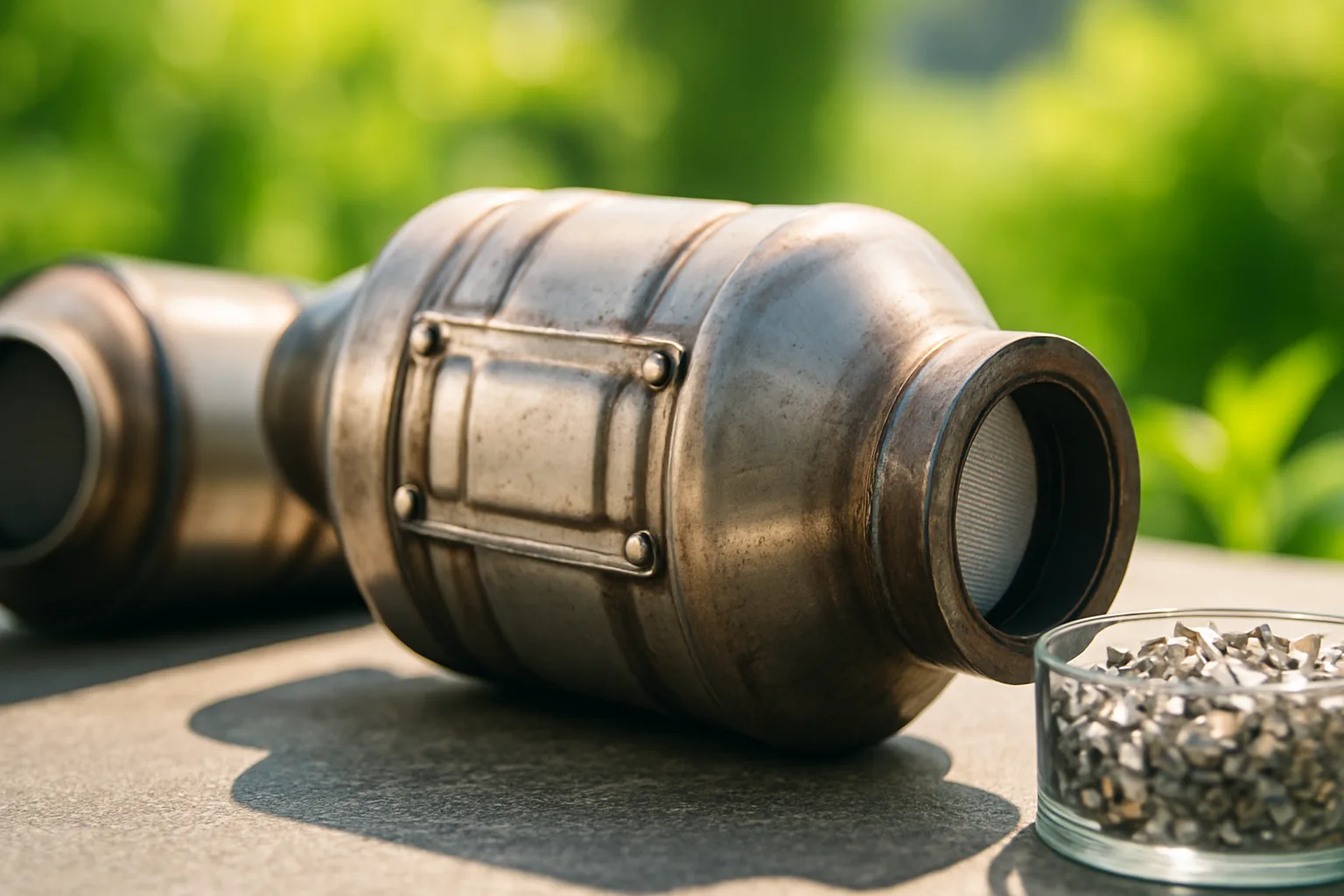
Location varies by manufacturer, vehicle make, and converter type. Don't expect consistency. Some converters stamp the number directly onto the outer shell. Others weld a small plate to the body. A few cast the number into the end cap. If the converter has been on a vehicle for years, that number may be obscured by rust, carbon buildup, or road grime — which is why a wire brush and good lighting are standard tools in any serious converter operation.
Here's where to look, depending on what you've got:
- Top or side of the body shell: Most common location on OEM (original equipment manufacturer) units. Look for stamped alphanumeric codes, sometimes preceded by a manufacturer prefix.
- End cap flanges: Aftermarket converters often stamp here. Numbers tend to be shorter and may include a country-of-origin code.
- Welded data plate: Found on some heavy-duty and diesel converters. The plate may include additional emissions certification codes alongside the serial.
- Heat shield (if still attached): Occasionally, the serial is on the shield rather than the body. This is less common but worth checking.
Once you've located it, photograph it before cleaning if possible — the original stamp is sometimes clearer than what remains after wire brushing. Keep those photos. Platforms like Canada's B2B scrap recycling marketplace support photo documentation precisely because visual records protect both seller and buyer when serial verification matters.
How to Decode the Serial Number Format
There's no universal standard across all manufacturers, but most serial numbers follow recognizable patterns once you know what to look for. Understanding the structure helps you cross-reference against price lists and avoid being misquoted by a buyer who "can't find it in the system."
OEM Converter Codes
Original equipment converters — the ones that came on the vehicle from the factory — carry manufacturer-specific codes. A Toyota converter might begin with a prefix like 6221 or include a four-to-six digit OEM part number. Ford and GM units often have longer alphanumeric strings that tie back to the vehicle's model year and engine configuration. Honda and Acura converters are known for high palladium content and carry their own coding conventions.
When you're processing a load and need to reference the platinum price today alongside palladium and rhodium values, knowing whether you have an OEM Toyota versus an OEM domestic converter matters — the PGM split is often dramatically different. You can find the best scrap converter prices in Canada by cross-referencing your serial data against current spot metal pricing, rather than relying on a buyer's flat offer.
Aftermarket Converter Codes
Aftermarket converters — brands like MagnaFlow, Walker, AP Exhaust — typically carry shorter codes. These units generally contain lower PGM loadings than their OEM counterparts, which is reflected in scrap value. An aftermarket converter's serial usually starts with a letter prefix identifying the brand, followed by a numeric part number. Some buyers discount aftermarket units automatically. Knowing what you have lets you push back with data.
Foreign OEM and Import Converters
European and Asian import converters are increasingly common in Canadian yards, particularly in Toronto where the vehicle mix is diverse. German-manufactured converters (BMW, Mercedes, Volkswagen Group) often carry high rhodium loadings. Japanese domestic market converters may have different serial formats than their North American equivalents. If you're processing imports, cross-referencing against a converter price list is essential — don't let a buyer lump a high-value BMW cat in with mid-grade domestic units.
Serial Numbers, Pricing Databases, and the Platinum Price Today
The connection between your serial number and the platinum price today isn't abstract — it's direct math. Every vetted buyer with access to a serious pricing database can pull the PGM yield estimate for your serial, multiply by current spot metal prices, apply a processing margin, and produce a calculated offer. That's how transparent converter transactions should work.
The problem is that most single-buyer transactions in Ontario don't work that way. You get a flat price per unit, a vague "that's what it's worth" answer, or an offer based on visual inspection alone. That's the old way. When you read Canadian scrap converter pricing guides, you'll notice that the yards and operators getting the best returns are the ones treating serial data as documentation — not an afterthought.
SMASH approaches converter transactions the same way: documented inventory, serial tracking, and competitive bidding. When multiple vetted buyers compete on the same documented load, the pricing reflects actual market conditions rather than one buyer's margin preference. More buyers means better price discovery. That's not marketing — that's how auctions work.
Why Catalytic Converter Buyers in Toronto and Ontario Care About Your Serials
If you're selling to a catalytic converter buyer Toronto-based or anywhere across Ontario, the serial number is increasingly the baseline for any serious transaction. Regulatory pressure around converter documentation has intensified across North America through 2025 and into 2026. Most legitimate buyers now require serial numbers and supporting documentation — not just for pricing, but for compliance. Selling an undocumented load to a major processor is getting harder, and for good reason.
For sellers, this shift is actually an advantage. When your inventory is documented with serials, photos, and vehicle source information, you're a lower-risk seller. Lower risk means better access to top-tier buyers. In a catalytic converter auction environment, documented loads attract more competitive bids. Undocumented loads get discounted or declined. The compliance pressure that feels like friction is, in practice, a mechanism that rewards sellers who do the work.
Toronto's scrap ecosystem is large and competitive. Toronto scrap metal services that handle converters are increasingly integrating serial verification into their intake process. If your operation isn't already doing this, the competitive gap between you and the yards that are is growing. Start with serial documentation. Build the habit now.
For those looking beyond a single local buyer, platforms like SMASH connect documented converter inventory with catalytic converter buyers Ontario-wide and across North America — giving sellers access to real competition instead of a single take-it-or-leave-it number. You can check current Canadian scrap converter prices as a baseline before any conversation with a buyer.
Building a Serial Number Documentation System for Your Yard
If you're processing more than a handful of converters per week, manual serial tracking doesn't scale. The yards that consistently get strong returns have systems — simple ones, but systems. Here's a practical framework:
- Photograph every converter before sorting. Front face, serial stamp, and any manufacturer markings. Timestamp is automatic on most phones.
- Log serials to a spreadsheet or inventory tool at intake. Include vehicle year/make/model if known — this adds context when the serial is damaged or partial.
- Cross-reference against a current price list before quoting or accepting offers. Don't rely on memory or a buyer's word.
- Group your load by converter grade or type when possible. High-grade OEM units should not be bundled with aftermarket low-grade cats at a flat per-unit price.
- Retain documentation for compliance. As regulations tighten across Ontario and across North America, having your paperwork in order protects your operation.
This isn't complicated. It's the difference between running a documented, professional operation and hoping your buyer is honest. In a market where the platinum price today and rhodium spot rates directly drive your payout, documentation is the foundation of every good sale.
If you're ready to put your documented inventory in front of competitive buyers, Canada's B2B scrap recycling marketplace is built for exactly that. No subscription fees. No guessing. Just competition on documented loads.
Whether you're moving your first converter load or running a high-volume Ontario yard, the path to better returns starts the same way: know what you have, document it properly, and get it in front of more than one buyer. Find the best scrap converter prices in Canada — get a free quote at best-scrap-converter-prices.ca and see what your documented inventory is actually worth.
Frequently Asked Questions
Q: Where is the serial number located on a catalytic converter?
The serial number is most commonly stamped on the outer body shell, end cap flanges, or a welded data plate. Location varies by manufacturer. Use a wire brush to clear rust or carbon buildup, and photograph the number before and after cleaning for your records.
Q: How does the platinum price today affect what I get paid for my converter?
Buyers calculate converter value by multiplying the projected PGM yield (platinum, palladium, rhodium) from your serial's assay data against current spot metal prices. When the platinum price today rises, the calculated value of platinum-dominant converters increases proportionally. Always check current spot rates before accepting any offer.
Q: Why do catalytic converter buyers in Toronto ask for serial numbers?
Serial numbers allow buyers to look up the PGM content profile for your specific converter, enabling an accurate calculated offer rather than a flat guess. In 2026, documentation requirements across Ontario and other jurisdictions also mean that legitimate catalytic converter buyers Toronto-wide require serials for compliance — not just pricing accuracy.
Q: Are aftermarket catalytic converters worth less than OEM units at scrap?
Generally, yes. Aftermarket converters carry lower PGM loadings than original equipment manufacturer units, which reduces their scrap value. Always confirm whether a unit is OEM or aftermarket before agreeing to any price — a buyer quoting a flat rate per unit may be averaging high-grade OEM cats down with lower-value aftermarket units.
Q: How does a catalytic converter auction work compared to selling to a single buyer?
In a catalytic converter auction, your documented load is presented to multiple vetted buyers who bid competitively. Instead of accepting whatever a single yard offers, you let market competition determine the price. Platforms like SMASH facilitate this process — documented inventory attracts more bidders, and more bidders means better price discovery for the seller.
Disclaimer: Catalytic converter scrap values fluctuate daily based on platinum, palladium, and rhodium spot prices. All price references in this article are general in nature. Always check current Canadian scrap converter prices before making selling decisions.
Follow SMASH on LinkedIn for industry updates and scrap metal market insights: linkedin.com/company/scrap-metal-auction-sales-hub