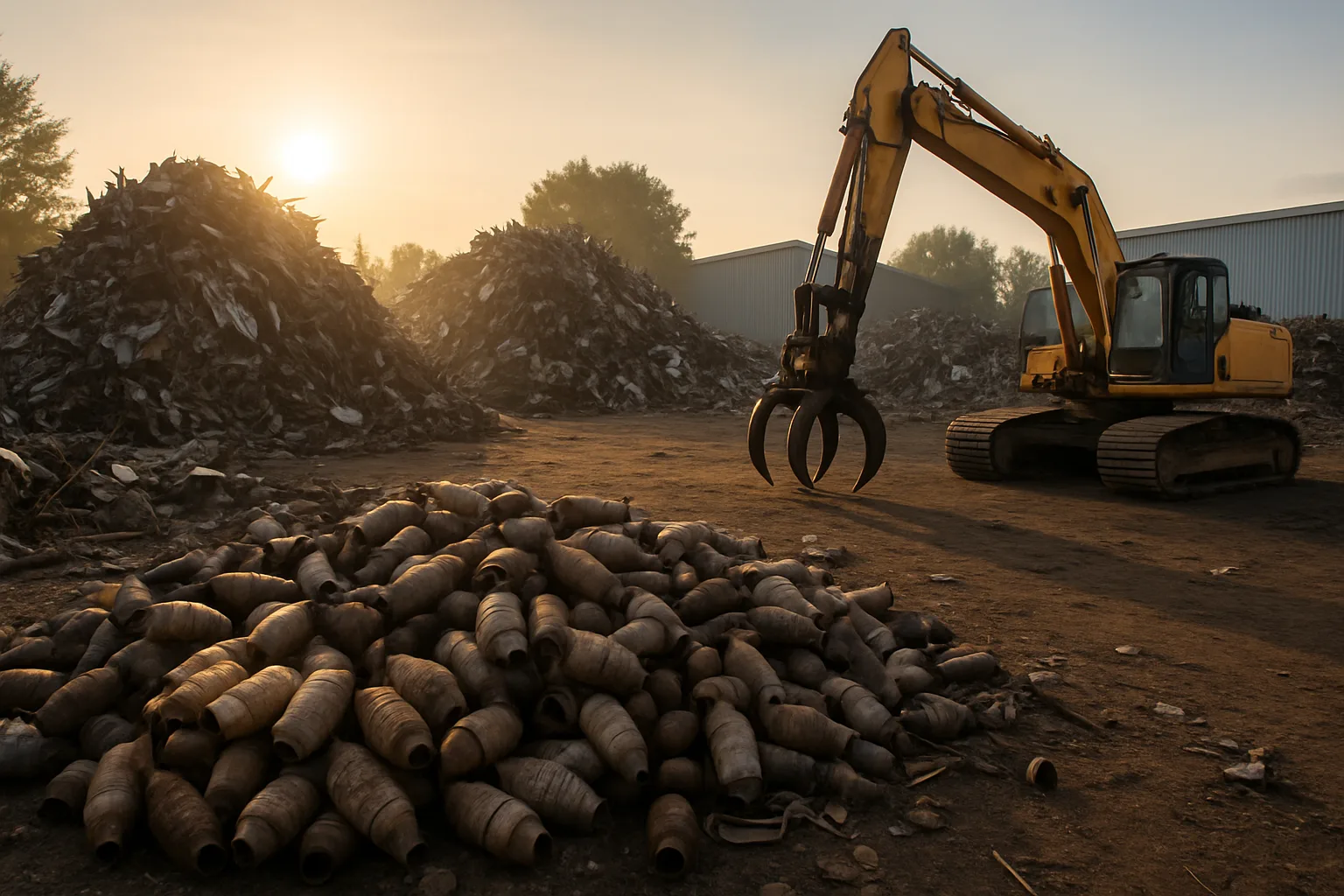
Why Your OEM Catalytic Converter Is Worth More Than You Think — And Your Aftermarket One Might Not Be
A yard operator in Chilliwack, British Columbia recently pulled two catalytic converters off a pair of identical Toyota Tacomas. Same year, same engine, same mileage. The scrap values came back completely different — one worth several times more than the other. The reason wasn't condition or location. It was what was inside.
One was original equipment manufacturer (OEM). One was aftermarket. That single difference explained everything. If you're sitting on a pile of cats and wondering why the quotes you're getting all over the map, this is the article you need to read. Understanding OEM catalytic converter value versus aftermarket is the difference between leaving money on the table and knowing exactly what you have.
The rhodium price today is just one piece of the puzzle — but it's a big one. And if your converter doesn't contain meaningful amounts of rhodium, platinum, and palladium, the scrap value drops fast. Let's break down why.
What's Actually Inside a Catalytic Converter — And Why It Matters for Scrap Value
Catalytic converters contain a ceramic or metalite substrate coated with platinum group metals (PGMs): platinum, palladium, and rhodium. These are some of the most valuable metals on the planet. The scrap value of any converter is almost entirely tied to how much of each PGM it contains and what those metals are trading for right now.
OEM converters are engineered to meet strict emissions regulations. Manufacturers load them with higher concentrations of PGMs to ensure performance and longevity over the vehicle's lifespan. That's where the value is. Aftermarket converters — the kind installed at muffler shops — are designed to meet minimum legal requirements at the lowest possible cost. They use significantly less platinum, palladium, and rhodium to keep prices down.
Here's what that means in practice:
- OEM converters from full-size trucks, SUVs, and luxury vehicles can contain two to four times more PGM loading than aftermarket equivalents
- Aftermarket converters often use cheaper substrate materials and diluted PGM coatings — sometimes less than a third of what an OEM unit carries
- The rhodium price today can swing the total scrap value of a single OEM cat by hundreds of dollars when rhodium concentrations are high
- Some low-end aftermarket units have scrap values so minimal they barely cover handling costs
This isn't speculation. It's the reality of the catalytic converter scrap market in 2026. If you want to find the best scrap converter prices in Canada, you need to know what you're selling before you make a single call.
How the Rhodium Price Today Amplifies the OEM vs. Aftermarket Gap
Rhodium is the wildcard in converter scrap pricing. It's rarer than platinum and palladium, and its price per troy ounce has historically been more volatile than either. When the rhodium price today spikes, OEM converters with high rhodium loading become significantly more valuable — almost overnight. Aftermarket units don't carry enough rhodium to benefit meaningfully from those moves.
Think about what that means for a recycler or seller in British Columbia. You might have a load of mixed cats sitting in your yard right now. Half could be OEM units off late-model Ford F-150s or Honda Pilots. The other half could be aftermarket replacements. If you're quoting the whole load at a flat rate or relying on one buyer's offer, you're almost certainly undervaluing the OEM material.
PGM prices move daily. Sometimes hourly. The scrap converter prices Canada market tracks these metals closely, and buyers who know their assay data will always outbid buyers who are guessing. To check current Canadian scrap converter prices, you need a pricing source that reflects actual market conditions — not yesterday's number or a buyer's margin-padded quote.
This is exactly the kind of information asymmetry that costs Canadian yards real money. One buyer with access to current PGM spot prices and assay data can buy your OEM cats cheap if you don't have that same information. The answer is transparency and competition — which brings us to how SMASH fits into this equation.
OEM Catalytic Converter Value: How to Identify What You Have
Before you can price correctly, you need to identify correctly. Here's a practical guide to telling OEM from aftermarket in the field:
- Check the substrate material. OEM converters typically use a ceramic honeycomb substrate. Many aftermarket units use metalite (metal foil) substrates, which are lighter and cheaper but contain less PGM loading.
- Look at the housing. OEM cats are welded directly into the exhaust system as part of the original design. They tend to be larger, heavier, and more complex in shape. Aftermarket units are often universal-fit with simpler housings.
- Use the serial number or part number. Most OEM converters carry a manufacturer stamp or part number on the housing. Cross-referencing that number against a converter database will tell you the make, model, and PGM loading range. Platforms like SMASH use serial tracking to help document this accurately.
- Weigh it. OEM converters are generally heavier than aftermarket equivalents from the same vehicle class. A heavier substrate often means more PGM material — though this isn't a rule without exceptions.
- Know the vehicle it came off. VIN lookup can tell you whether the original equipment converter was installed or whether the vehicle had a replacement at some point. SMASH's inventory tool supports VIN-based documentation for exactly this reason.
If you're a seller in Chilliwack or anywhere else in British Columbia trying to sort a mixed load, this identification step isn't optional. It's where your money is made or lost. Buyers who process volume know exactly what's in each unit. You should too.
Why Selling Through Competitive Auctions Changes the Outcome
Here's the old way: you call one local buyer, they quote you a number based on your description (or their best guess), and you take it or leave it. No data. No competition. No transparency. That's how yards leave money on the table — in Chilliwack, in Vancouver, in every market across British Columbia and beyond.
The SMASH way is different. When you list your converters — OEM lots, mixed loads, or specific high-value units — vetted buyers compete against each other. Competition can help reveal the market. Documented inventory with photos, serial numbers, and vehicle data gives buyers confidence to bid higher because the risk of misidentification drops. More buyers means better price discovery.
That's not marketing language. That's how auctions work. When buyers know exactly what they're bidding on and they're competing against other informed buyers, your material gets priced accurately — not at a discount that covers someone else's uncertainty. SMASH supports photo documentation, serial tracking, and auto-invoicing so the entire transaction is clean and defensible on both sides.
If you want to sell scrap metal online in a way that actually reflects what your material is worth, competitive auction format with full documentation is the structure that makes it happen. To read Canadian scrap converter pricing guides and understand how to prepare your inventory, there's a growing body of practical resources available for Canadian sellers.
What Sellers in Chilliwack and British Columbia Need to Know Before They Sell
The Lower Mainland and Fraser Valley scrap market is active. Yards in and around Chilliwack handle everything from light auto to industrial material, and catalytic converters are a significant revenue line for anyone processing end-of-life vehicles. The challenge is that most sellers are still relying on phone quotes from one or two buyers — which means they're getting whatever that buyer wants to pay, not what the market will actually bear.
British Columbia sellers also deal with the reality that the Canadian dollar affects how PGM prices translate into CAD payouts. When the USD/CAD rate moves alongside rhodium and platinum spot prices, your converter values can shift significantly even on days when the market feels quiet. Staying current on catalytic converter price Canada data isn't just good practice — it's how you protect your margins.
The practical steps for any seller in this market:
- Document your inventory before you sell — photos, part numbers, vehicle source where possible
- Separate OEM and aftermarket units before quoting — they're not the same product
- Get multiple bids — one offer is never the market, it's one buyer's number
- Use platforms built for converter sellers — smashrecycling.ca gives you access to vetted buyers and competitive auction format with no subscription fees
- Check PGM spot prices before you sell, not after
Whether you're clearing a single high-value OEM cat or moving a full pallet of mixed material, the process is the same. Know what you have. Document it. Put it in front of competition. That's how you get the best converter price Canada has to offer — not by getting lucky, but by running a structured process.
If you're ready to stop guessing and start selling with real market data behind you, now is the time to take a closer look at your options. Find the best Canadian scrap converter prices and get a free quote at best-scrap-converter-prices.ca — it costs nothing to find out what your material is actually worth.
Frequently Asked Questions
Q: Why is an OEM catalytic converter worth more as scrap than an aftermarket one?
OEM converters are built with higher concentrations of platinum, palladium, and rhodium to meet strict factory emissions standards over the vehicle's full service life. Aftermarket units use significantly less PGM material to keep replacement costs low. That difference in PGM loading directly drives the scrap value gap between the two types.
Q: How does the rhodium price today affect what my catalytic converter is worth?
Rhodium is one of the three key platinum group metals in a catalytic converter substrate. When the rhodium price today is elevated, OEM converters with meaningful rhodium concentrations can be worth substantially more than they were even a few weeks prior. Aftermarket converters typically carry so little rhodium that price swings have minimal impact on their scrap value.
Q: How do I find catalytic converter buyers near me in Chilliwack or British Columbia?
Local buyers exist throughout British Columbia, but the better question is whether a single local buyer is offering you a competitive price. Platforms like SMASH connect sellers with vetted buyers across Canada, which means competition — and competition is what drives accurate pricing. You don't have to settle for the first number you hear.
Q: Can I sell catalytic converters online in Canada?
Yes. Online auction platforms designed for the scrap and recycling industry let you document your converters, list them with photos and serial data, and receive competing bids from vetted buyers without leaving your yard. SMASH is built specifically for this, with no subscription fees and auto-invoicing once a sale closes.
Q: How do I know if the price I'm being quoted for my catalytic converter is fair?
Cross-reference the offer against current PGM spot prices and known PGM loading ranges for your specific converter type. If your buyer can't explain how they arrived at their number, that's a flag. Documented inventory and competitive bidding through platforms like SMASH remove the guesswork and let the market set the price.
Stay current on scrap metal market moves and converter pricing trends — follow SMASH on LinkedIn at linkedin.com/company/scrap-metal-auction-sales-hub for industry updates and market insights.