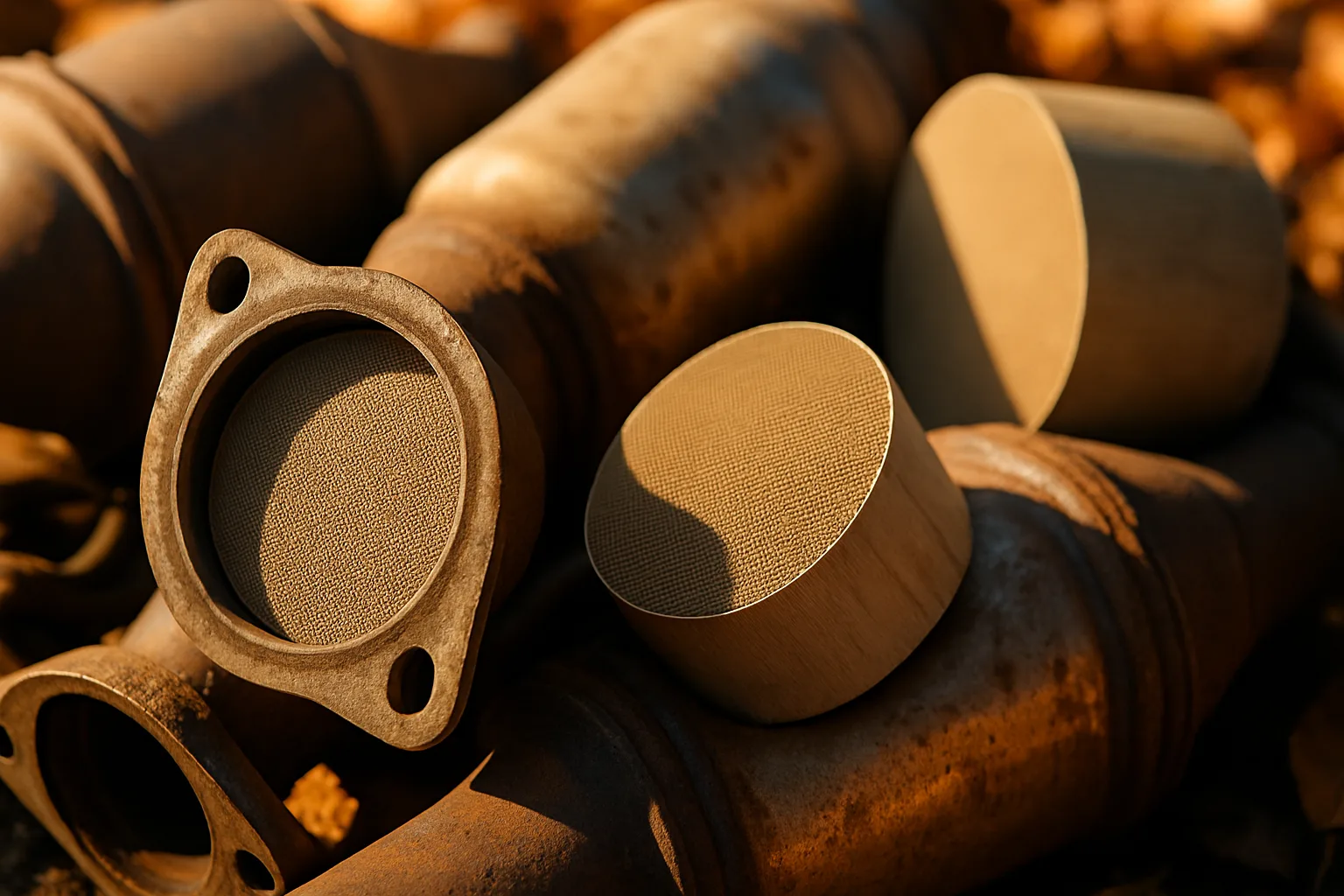
What's Actually Inside a Catalytic Converter — and Why It's Worth Real Money
Most people know a catalytic converter has value. Few know exactly why. The short answer: three precious metals sitting inside a ceramic or metallic substrate, doing chemistry at temperatures that would destroy most materials. When the vehicle life ends, those metals don't disappear — they're still there, still valuable, still recoverable. And right now, with the rhodium price today driving significant attention across the scrap market, knowing what's inside your converter is the difference between getting paid fairly and leaving money on the table.
This guide breaks down the precious metals inside catalytic converters, what they're worth, why prices move the way they do, and how sellers in Winnipeg and across Manitoba can get real market value — not a lowball guess from one buyer on the phone.
The Three Precious Metals That Drive Catalytic Converter Scrap Value
Inside every catalytic converter is a washcoat — a thin layer of material applied to the substrate — and embedded in that washcoat are platinum group metals (PGMs). These are platinum, palladium, and rhodium. All three are rarer than gold. All three are critical to the converter's function. And all three determine what your cat is worth when it comes time to sell.
Platinum (Pt)
Platinum was the original converter metal. It oxidizes carbon monoxide and unburned hydrocarbons into CO₂ and water. Diesel converters, in particular, tend to be heavier in platinum. OEM catalytic converter value from diesel applications is often higher than equivalent gasoline units — partly because of platinum loading, partly because of higher overall substrate density. Platinum trades in the hundreds of dollars per troy ounce range, but exact figures fluctuate daily with global supply and industrial demand.
Palladium (Pd)
Palladium took over from platinum in gasoline applications through the 1990s and 2000s. It performs better at the lower operating temperatures typical in gas engines. Most modern gasoline vehicle converters lean palladium-heavy. Palladium prices have been volatile — at times trading above platinum — which is a big reason catalytic converter theft became an epidemic in North American cities, including Winnipeg, over the past several years. Even with law enforcement crackdowns and tightened scrap regulations in Manitoba, the underlying driver (high palladium value) hasn't gone away.
Rhodium (Rh)
Rhodium is the smallest component by volume and typically the most expensive by weight. It handles the reduction of nitrogen oxides (NOx) — the emissions that contribute to smog. Without rhodium, converters can't meet modern emissions standards. Global rhodium supply is extremely limited. Most of it comes as a byproduct of South African platinum mining. That supply concentration makes the rhodium price today extremely sensitive to disruption — mine strikes, logistics issues, or shifts in vehicle production can move the price sharply in either direction. If you're wondering why two converters that look identical off the same vehicle can have different scrap values, rhodium loading variance is often the answer.
How OEM Catalytic Converter Value Is Actually Calculated
A scrap yard or processor doesn't just eyeball a converter and name a price. Legitimate pricing is tied to assay data — the measured PGM content recovered after the converter is processed. Refiners run the material through smelting and chemical separation to get exact platinum, palladium, and rhodium yields. Those yields, multiplied by current spot prices for each metal, determine the gross value. The buyer then builds in their margin and processing costs.
The problem with the traditional single-buyer model is that you never see that math. You get a number. Take it or leave it. There's no way to know if that number reflects actual market conditions or just what that one buyer thinks they can get away with paying. That's exactly why platforms that bring competition into the process — where multiple vetted buyers bid on your inventory — tend to produce better price discovery. When buyers have to compete, they have to price honestly.
A few factors that affect OEM catalytic converter value:
- Vehicle make and model — PGM loading varies significantly by manufacturer and emissions standard
- Engine size and age — larger engines, tighter emissions eras often mean higher loading
- OEM vs. aftermarket — OEM converters almost always carry more PGM content than aftermarket replacements
- Condition of the substrate — cracked, rattled-out, or melted substrates mean less recoverable metal
- Current spot prices — especially rhodium, which can swing the total value dramatically
If you're trying to find the best scrap converter prices in Canada, the starting point is understanding that every converter is different — and that the best way to know what yours is worth is to get multiple buyers looking at the same inventory at the same time.
Why the Rhodium Price Today Matters More Than You Think
Of the three PGMs, rhodium gets the least attention in mainstream financial media — but it moves scrap converter values more than any other single variable. Rhodium can trade at multiples of gold. It has also crashed dramatically in past cycles. That volatility is built into the market structure: extremely limited supply, no large investor stockpile to act as a buffer, and industrial demand tied directly to global vehicle production.
When automotive output rises — more cars being built, more converters going into new vehicles — rhodium demand tightens. When production slows or electric vehicle penetration accelerates, rhodium demand softens. The scrap side of the market (your spent converters) provides the only meaningful recycling supply. That's why refiners pay attention to converter volumes and why the rhodium price today has a direct line to what a buyer will offer you for a load of cats.
For sellers in Winnipeg and across the prairies, this means timing matters — but not in a "wait for the perfect day" sense. It means you should know what the market looks like before you accept any offer. Checking current market data, using platforms with transparent pricing, and getting competitive bids are all ways to make sure you're selling into the market — not below it.
Want to stay current on what's driving converter values? Read Canadian scrap converter pricing guides to track market trends over time.
How to Sell Catalytic Converters Online — and Why Documentation Changes Everything
The shift toward selling catalytic converters online has been significant. Yards, dismantlers, and collectors across Canada no longer have to rely on whoever is closest or whoever picks up the phone. Online platforms let you reach vetted buyers across North America, submit photos and documentation, and let competition do the work of establishing a fair price.
Documentation matters more than most sellers realize. A converter with a clear VIN tie, a photo showing the substrate is intact, and a serial or part number that maps to a known OEM unit is worth more to a buyer — not because the metal inside is different, but because the buyer's risk is lower. They know what they're bidding on. That confidence translates into stronger offers.
Here's what strong converter documentation looks like:
- Clear photos of the converter body, inlet/outlet, and substrate (if visible)
- Serial number or part number — cross-referenced to OEM specs where possible
- VIN of the vehicle it came from (for verified OEM units)
- Condition notes — rattling, damage, previous repairs
- Weight if available
Platforms like SMASH Recycling — where verified buyers bid on your metal are built around this exact model. Inventory tools, photo documentation, serial tracking — all of it exists to give buyers the confidence to bid competitively. When you want to sell catalytic converters online, the more complete your documentation, the better your outcome tends to be.
For sellers looking to sell catalytic converters Manitoba — whether you're running a dismantling operation, a repair shop with accumulating cores, or a small yard — the online model removes geography as a limiting factor. You're not stuck with whoever's in your city. Buyers across the country can see your inventory and compete for it.
Getting Real Value When You Sell Catalytic Converter for Cash in Winnipeg
Winnipeg's scrap market has matured significantly. Buyers are more sophisticated, regulations around converter documentation are tighter, and sellers who show up with organized, well-documented inventory consistently get better results than those walking in blind. If you're looking to sell catalytic converter for cash and you're operating in the Winnipeg area, the landscape rewards preparation.
A few things that matter locally:
- Manitoba's regulations around converter sales have tightened — expect to provide ID and vehicle documentation at legitimate buyers
- Aggregating volume before selling often produces better per-unit pricing than selling one or two at a time
- OEM converters from domestic trucks and SUVs — popular in the Manitoba market — tend to carry stronger substrate values
- Aftermarket "direct fit" replacements look similar but carry significantly less PGM content — know what you have before pricing
SMASH connects sellers with vetted buyers who bid competitively on converter inventory. No subscription fee. No guessing. The platform only works when sellers win — that alignment matters. If you're using Winnipeg scrap metal services and want to know you're getting a fair market rate, competitive bidding is the mechanism that gets you there.
When you're ready to check current Canadian scrap converter prices and understand what your inventory is actually worth, the process starts with good data — current spot prices for all three PGMs, knowledge of what you have, and access to buyers who are bidding against each other, not just against your lack of information.
Frequently Asked Questions
Q: What is the rhodium price today and how does it affect my catalytic converter's value?
Rhodium trades on global commodity markets and its price changes daily based on supply, demand, and automotive production trends. Because rhodium handles nitrogen oxide reduction in converters, it's a critical component — and its price can have an outsized effect on what your converter is worth. Checking current spot prices before accepting any offer is always a smart move.
Q: How do I know if I have an OEM catalytic converter or an aftermarket replacement?
OEM converters typically have a manufacturer part number stamped or welded into the body and are generally heavier than aftermarket units. Aftermarket converters may look similar externally but contain significantly less platinum, palladium, and rhodium. Using a serial or part number lookup can confirm which type you have — SMASH's inventory tools support this kind of verification.
Q: Can I sell catalytic converters online from Winnipeg or elsewhere in Manitoba?
Yes. Online platforms allow sellers in Winnipeg and across Manitoba to reach vetted buyers across North America without geographic limitation. Proper documentation — photos, part numbers, VIN linkage — is important for getting competitive bids. Regulations in Manitoba require seller identification and vehicle documentation, so have that ready before listing.
Q: Why do two catalytic converters from the same vehicle sometimes have different scrap values?
Most modern vehicles run multiple converters — a pre-cat (or manifold cat) close to the engine and an underfloor cat further back. Pre-cats typically carry higher PGM loading because they handle the heaviest emissions work at operating temperature. The substrate condition also matters — a cracked or rattled-out substrate means less recoverable metal, which lowers the offer.
Q: Is it better to sell catalytic converters individually or accumulate a larger load?
In most cases, accumulating volume before selling produces better per-unit pricing. Buyers making a bid on a full load of mixed cats are more incentivized to price competitively than on a single unit. That said, if you have high-value OEM units from specific vehicles, those can sometimes command strong individual bids — especially through a competitive auction format where multiple buyers are evaluating the same inventory.
If you're sitting on converter inventory — whether it's a few cores from a shop or a full pallet from a dismantler — you deserve to know what they're actually worth before you accept the first number someone throws at you. Precious metal prices move. Buyers compete. The market is there if you access it correctly. Start by getting current data and real bids: find the best Canadian scrap converter prices and get a free quote at best-scrap-converter-prices.ca.
Disclaimer: Catalytic converter scrap prices fluctuate daily based on platinum, palladium, and rhodium spot prices. Always verify current rates before selling.
Follow SMASH on LinkedIn for ongoing industry updates, market insights, and scrap metal pricing trends across North America.