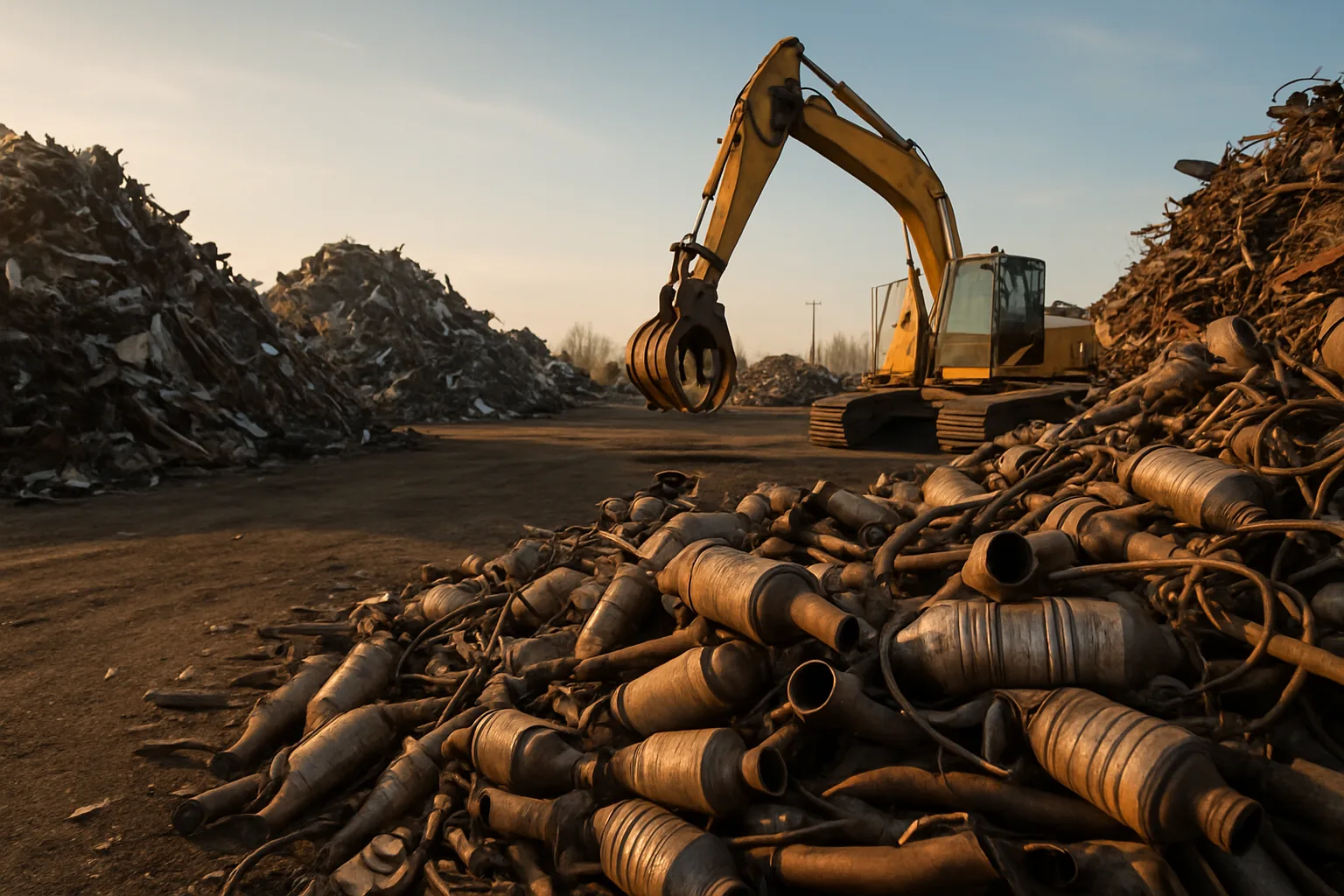
Most converter sellers have no idea that a mining disruption in South Africa or a shift in Japanese auto production can change what they pocket at the yard — sometimes by hundreds of dollars per unit. That's not an exaggeration. The catalytic converter scrap value you're quoted today is a direct reflection of what palladium, platinum, and rhodium traded for this morning on global commodity exchanges. If you're selling converters in Yorkton or anywhere across Saskatchewan without understanding that connection, you're flying blind.
This guide breaks down exactly how precious metal markets move converter prices — and how to position yourself to get the most out of every load you sell.
Why Precious Metals Drive Catalytic Converter Scrap Value
A catalytic converter isn't just a piece of exhaust hardware. Inside that canister sits a ceramic or metallic substrate coated with platinum group metals (PGMs) — palladium, platinum, and rhodium. These metals are the reason a single converter can be worth anywhere from $20 to over $800, depending on the unit and the current market.
Here's the critical piece most sellers miss: processors who buy your converters don't pay you for the steel shell. They pay you for those PGMs. And PGM prices are set internationally — on exchanges in London, New York, and Tokyo — not in Yorkton, not in Regina, not by your local yard. That means every quote you receive is upstream of forces completely outside your region's control.
- Palladium — used heavily in gasoline-engine converters. Historically volatile, with major price swings tied to Russian supply (Russia produces roughly 40% of global palladium).
- Platinum — more common in diesel converters. South African mining output has an outsized influence on platinum supply.
- Rhodium — used in small quantities but commands extraordinary prices. It's one of the rarest metals on earth, and its price can move by thousands of dollars in a single month.
When you find the best scrap converter prices in Canada, you're really finding the best reflection of that day's PGM spot price — translated through processing margins, assay data, and buyer competition. Understanding that chain puts you in a stronger negotiating position.
How the Palladium Price Today Affects What You're Quoted
Palladium is the PGM that most directly impacts the average gasoline-engine converter. Over the past decade, palladium has experienced some of the most dramatic price swings in commodity history — driven by supply deficits, sanctions activity, and the accelerating transition to electric vehicles reshaping long-term demand forecasts.
When palladium climbs, buyers can offer more per unit because the smelted output is worth more. When it drops, margins compress and quotes follow. This isn't the yard operator being difficult — it's the market passing through in real time. A $200/oz swing in the palladium price today can translate to a meaningful difference on a full pallet of mixed converters.
What does this mean practically for a seller in Saskatchewan? It means timing matters. Not in a speculative day-trading sense — but in the sense that selling during a sustained PGM rally versus a correction can make a real difference to your bottom line across a season of loads. Platforms like SMASH give sellers the market transparency to understand where prices sit before they commit to a deal.
Global Supply Chains and Their Local Impact on Converter Pricing
It might seem strange that a labour strike at a South African platinum mine affects what a Yorkton recycler receives for a pallet of catalytic converters. But that's exactly how commodity markets work — local prices are downstream of global supply and demand.
South Africa produces the majority of the world's platinum and a significant share of global rhodium. Supply disruptions there — whether from mining output issues, power grid instability, or export policy shifts — reduce available refined metal and push spot prices up. Buyers in North America respond by adjusting their converter price lists accordingly. Sellers who watch these signals read Canadian scrap converter pricing guides and understand the macro picture are better equipped to time their inventory decisions.
Similarly, demand signals matter. A surge in automotive production in Asia increases demand for PGMs used in new converters — and by extension, raises the incentive for processors to pay more for scrap converters that can be recycled into new catalyst material. The scrap loop feeds directly into the new-vehicle manufacturing cycle.
- South African mining output — affects platinum and rhodium supply globally
- Russian palladium exports — geopolitical shifts can tighten or loosen supply rapidly
- EV adoption rates — long-term demand softening for PGMs in new vehicles could eventually pressure scrap values
- Asian automotive production — drives demand for recycled PGM material used in new catalyst manufacturing
- Currency fluctuations (CAD/USD) — since PGMs trade in USD, the Canadian dollar exchange rate affects net payouts for Canadian sellers
What This Means If You're Trying to Sell Catalytic Converters in Saskatchewan
Sellers across Saskatchewan — including those running recycling operations near Yorkton — often deal with a geography problem. Fewer local buyers means less competition, which can result in lower offers. A single buyer with no pressure to compete has little incentive to pass market gains through to you. That's the core issue platforms like Canada's B2B scrap recycling marketplace SMASH were built to solve.
When you sell catalytic converters online through a vetted auction platform, you're no longer limited to whoever answers the phone in your region. Your inventory reaches qualified buyers across North America who are actively competing for loads. That competition is what drives price discovery — and it's the closest thing to a fair market that most sellers will ever access.
For a yard or collector operating out of Yorkton, this is a meaningful shift. You're not changing what the market pays — you're changing how many buyers are bidding to pay it. Yorkton scrap metal services connected to national buyer networks look very different from a single cold call to one local processor.
SMASH connects sellers with vetted buyers, documents inventory with photos and serial tracking, and handles auto-invoicing — so the process of getting a competitive quote is transparent from start to finish. More buyers means better price discovery. That's not a marketing line. It's how auctions work.
How to Read a Converter Price List and Understand What You're Looking At
You may have come across scrap catalytic converter price lists from various sources — some from processors in Canada, some international references like converter price list formats used in India or South Africa. These lists exist because converters are catalogued by OEM part number, and different makes and models contain different PGM loadings. A Toyota Prius converter contains significantly more palladium than a standard domestic sedan unit. That's why they command dramatically different prices.
When you check current Canadian scrap converter prices, you're looking at values derived from:
- Assay data — the actual PGM content of a given converter type, based on tested samples
- Current spot prices — what palladium, platinum, and rhodium are trading for today
- Processor margin — the cost of smelting, refining, and selling the recovered metal
- Buyer competition — more competitive markets compress processor margins and push more value to the seller
Price lists from other markets (like India or South Africa) can give you a sense of relative converter values — certain units consistently rank high across markets because PGM content is consistent regardless of where the vehicle was sold. However, Canadian sellers should always sell catalytic converters Saskatchewan-side through platforms that quote in CAD and account for the Canadian regulatory and tax environment. Values and payouts will differ from international lists due to currency, freight, and processing differences.
Disclaimer: Catalytic converter scrap values fluctuate daily based on precious metal spot prices. Always verify current rates before selling.
How SMASH Brings Market Transparency to Saskatchewan Converter Sellers
The old way of selling converters looks like this: call one buyer, get one number, take it or leave it. You have no way of knowing if that number reflects today's palladium market or last month's. You have no leverage. You have no comparison point.
SMASH changes that dynamic. As a B2B auction platform, SMASH puts your documented converter inventory in front of vetted buyers who submit competing bids. You see what the market is willing to pay — not just what one buyer chooses to offer. Photo documentation and serial tracking give buyers the confidence to bid aggressively on well-documented loads. That confidence translates to better outcomes for sellers.
There are no subscription fees. SMASH only wins when you win — a structure that aligns incentives the right way. For sellers across Saskatchewan who've historically had limited buyer access, this kind of transparent, competitive process is a genuine upgrade over the phone-call-and-hope approach.
If you're ready to stop guessing and start selling with the market behind you, find the best Canadian scrap converter prices and get a free quote at best-scrap-converter-prices.ca. You've done the hard work of collecting and storing inventory — make sure the selling side works as hard as you do.
Frequently Asked Questions
Q: What determines catalytic converter scrap value in Canada?
Catalytic converter scrap value is primarily driven by the precious metal content inside the converter — palladium, platinum, and rhodium. The specific PGM loading varies by vehicle make and model, and the payout reflects current spot prices for those metals on global commodity markets. Canadian sellers also need to factor in the CAD/USD exchange rate, since PGMs trade internationally in USD.
Q: Why does the palladium price today affect what I get paid for my converters?
Most gasoline-engine catalytic converters contain palladium as their primary active PGM. Processors who buy scrap converters ultimately sell the recovered palladium on the open market — so what they can pay you is directly tied to what that palladium is worth today. A significant move in the palladium spot price will show up in converter quotes within days, sometimes hours.
Q: Can I sell catalytic converters online if I'm based in Yorkton, Saskatchewan?
Yes. Platforms like SMASH allow sellers anywhere in Canada — including Yorkton and across Saskatchewan — to list converter inventory and receive competing bids from vetted buyers across North America. This removes the geographic limitation of relying solely on local buyers and opens your load to a wider, more competitive market.
Q: How is a Canadian converter price list different from international lists?
International price lists from markets like India or South Africa are based on local processing costs, currency values, and regional buyer competition — none of which apply directly to Canadian sellers. While relative converter rankings (which units are worth more) tend to be consistent globally due to PGM content, actual payouts in Canada will reflect Canadian market conditions, CAD/USD exchange rates, and domestic processing margins. Always use a Canadian-sourced quote for accurate comparison.
Q: How often do scrap catalytic converter prices change?
Converter prices can change daily — sometimes multiple times per day — because they're tied to live precious metal spot prices. This is why locking in a quote when the market is strong matters, and why using a competitive auction platform gives you better visibility into what buyers are actually willing to pay right now rather than relying on a static price sheet.
Stay current on precious metal markets and scrap converter pricing trends by following SMASH on LinkedIn — regular updates on scrap metal market conditions, industry news, and pricing insights for recyclers across North America.