What Actually Happens to Your Catalytic Converter After You Sell It
Most converter sellers focus on the quote. Few think about what happens next. But understanding how catalytic converter assaying and smelting works isn't just interesting — it's the reason prices vary so dramatically between buyers, and why knowing the process puts more money in your pocket.
If you've ever wondered why one catalytic converter buyer Fredericton offers you one number and another offers something completely different, the answer starts in the assay lab. The precious metals inside your converter — platinum, palladium, and rhodium — have to be measured before they can be priced accurately. How that measurement happens, and who controls the data, determines your payout.
This guide breaks down the full process: from the moment your converter leaves your hands to the moment precious metal values are calculated. No fluff. Just the mechanics of the process that drives converter scrap value across Canada.
What's Inside a Catalytic Converter That Makes It Valuable
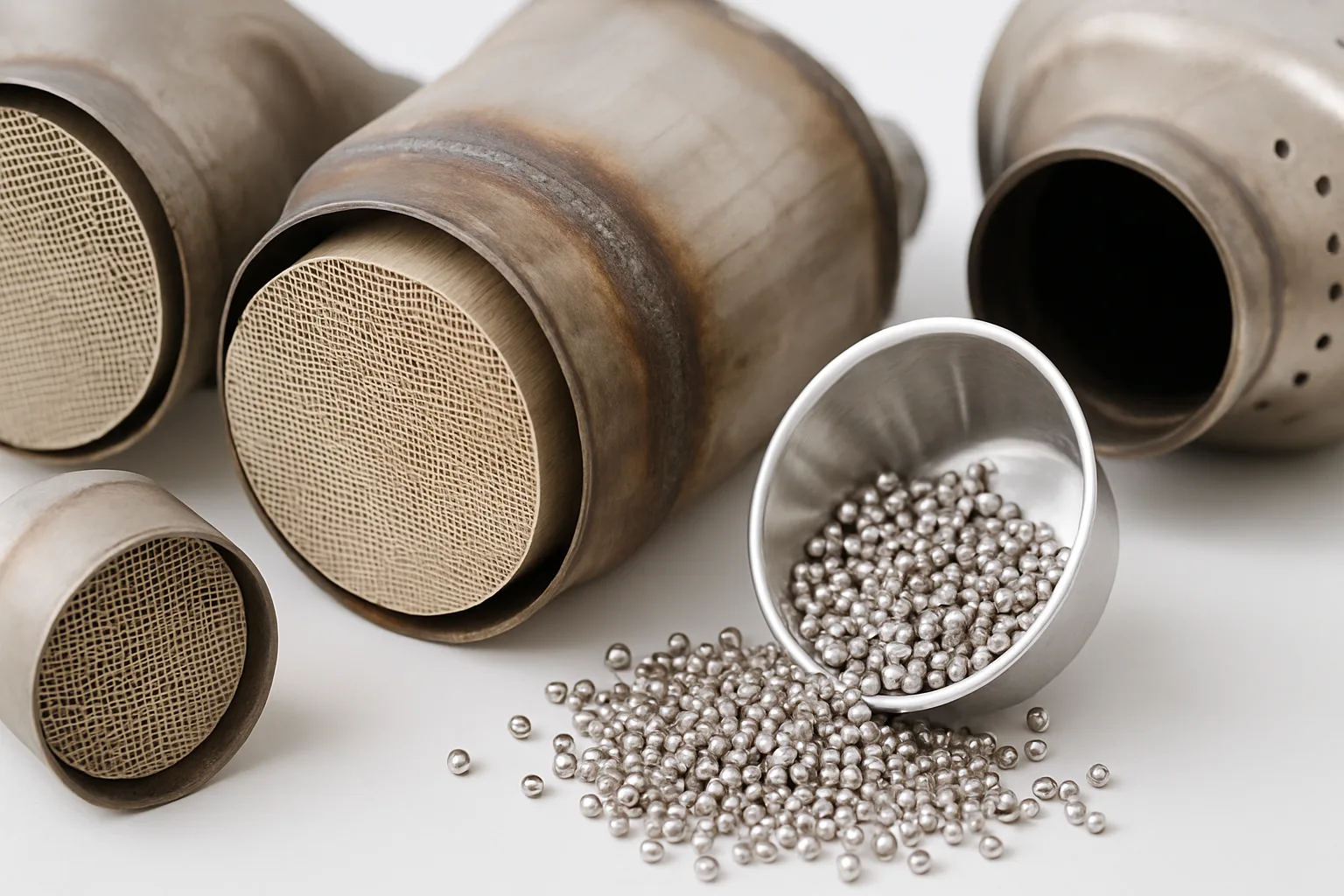
Before we get into assaying, it helps to understand what you're actually selling. A catalytic converter is a ceramic or metalite substrate coated with a precise mixture of platinum group metals (PGMs). These metals — platinum (Pt), palladium (Pd), and rhodium (Rh) — act as catalysts in the exhaust system, converting harmful gases into less harmful emissions.
The PGM loading varies significantly by converter type. A standard domestic catalytic converter might contain anywhere from a fraction of a gram to several grams of combined PGMs. High-value units — think late-model imports, larger trucks, or certain diesel aftertreatment systems — can carry substantially more. The substrate material, the vehicle it came from, and the age of the unit all influence what's inside.
Here's what makes this complicated for sellers:
- PGM content is invisible. You can't see platinum. You can't weigh it with a kitchen scale.
- The same vehicle model can have converter variants with different PGM loads depending on production year and engine spec.
- A converter that looks identical to another could be worth twice as much — or half as much.
- Market prices for Pt, Pd, and Rh fluctuate daily based on global commodity markets.
This is exactly why transparent assaying — not a buyer's gut feel — should drive your payout. When you find the best scrap converter prices in Canada, you're looking for buyers whose pricing is grounded in real assay data, not estimates pulled from a price sheet that hasn't been updated since last quarter.
The Assaying Process: How PGM Content Gets Measured
Assaying is the laboratory process used to determine the exact concentration of precious metals in your converter's substrate. There are two primary methods used in the recycling industry, and the one your buyer uses affects both the accuracy of your payout and how long you wait for it.
Fire Assay (the industry standard)
Fire assay is the gold standard — or more accurately, the platinum standard — for PGM analysis. Here's how it works:
- Sampling: The converter substrate is crushed and milled into a fine, homogeneous powder. This is critical. PGMs aren't distributed perfectly evenly through the substrate, so processors sample multiple points across the material to get a representative average.
- Fusion: A weighed sample of the powder is mixed with flux agents and melted at high temperatures (often exceeding 1,000°C). This fuses the material and concentrates the PGMs into a small bead called a prill.
- Cupellation: The prill is further processed to isolate the PGMs from base metals. The result is a tiny, pure bead of precious metal concentrate.
- Analytical measurement: The bead is dissolved in acid and analyzed using ICP-OES (Inductively Coupled Plasma Optical Emission Spectrometry) or ICP-MS to determine exact concentrations of Pt, Pd, and Rh.
Fire assay is accurate, repeatable, and widely accepted as the most reliable method. It takes time — typically several days to a couple of weeks from sample submission to results — but the data it produces is solid enough to settle multi-tonne lots worth significant sums.
XRF Screening (fast, but limited)
X-ray fluorescence (XRF) scanning is a faster screening tool. A handheld or bench-top XRF device can give a rough PGM reading in seconds by bombarding the substrate surface with X-rays and reading the energy signature of the emitted fluorescence. Many buyers use XRF for quick sorting and initial grading at the yard level.
The limitation: XRF reads the surface, not the full depth of the substrate. It's useful for sorting grades and flagging obvious high-value or low-value units, but it's not precise enough to base a final settlement on. Any reputable processor doing serious volume will fire assay before final payment.
Smelting: Turning Substrate into Recoverable Metal
Once assaying confirms what's in your material, smelting is how processors actually recover the PGMs from the substrate at scale. This happens downstream — typically at a dedicated precious metal smelter, not at the recycling yard itself.
The substrate, now confirmed by assay, goes into a high-temperature furnace along with other converters in the same lot. At temperatures above 1,600°C, the ceramic or metalite substrate melts and the PGMs are collected into a metal collector phase (often iron, copper, or lead-based depending on the process). The slag — the non-metallic waste — floats to the top and is removed.
The resulting metal alloy is then refined through hydrometallurgical processing (dissolving in acids and selective precipitation) to separate platinum, palladium, and rhodium into individual pure metal products. These refined metals are then sold back into the market — into automotive manufacturing, electronics, and industrial applications.
The entire chain from your converter to refined metal can take weeks to months when you factor in lot accumulation, transport, processing queues, and settlement timelines. This is why some buyers pay based on current spot prices at time of delivery, while others offer deferred settlement tied to actual refinery returns. Both models exist. Know which one you're dealing with before you sell.
Why This Process Directly Affects Your Scrap Converter Price in Canada
Here's where the process knowledge pays off for sellers in Fredericton and across New Brunswick. Every step in the assay and smelting chain involves costs and decisions that affect what ends up in your pocket:
- Sampling method: Buyers who only screen with XRF and don't fire assay may undervalue complex loads. They're managing their risk by paying less.
- Lot size: Smelters typically require minimum lot sizes to process efficiently. Smaller yards may have to aggregate material before sending to a smelter, which delays settlement.
- Precious metal spot prices: PGM prices move daily. A settlement tied to the spot price on delivery day is different from one settled weeks later at refinery return. Ask your buyer which applies.
- Refining recoveries: No smelter recovers 100% of the PGMs. Typical recovery rates are factored into your payout as a percentage deduction. This is normal — but the rate matters. Better processors achieve higher recoveries, which means more value passed back to you.
- Transparency: Buyers who share assay results with you, explain their deductions, and provide clear settlement statements operate differently than those who just hand you a flat offer per unit. One approach gives you data. The other asks you to trust a number.
Platforms like SMASH are built around this principle. Competition between vetted buyers means the data drives the price, not one buyer's margin. When you check current Canadian scrap converter prices and compare against what a single local buyer is offering, the gap is often significant — and assay transparency is a big reason why.
If you want a deeper breakdown of how pricing is calculated from PGM values, read Canadian scrap converter pricing guides that walk through the math behind per-unit and per-pound settlement models.
What Fredericton Sellers Should Know Before Approaching a Buyer
Selling converters in Fredericton is no different than selling in any other Canadian market in one key way: your payout is tied to global PGM prices, not local conditions. Palladium trading in London affects what a buyer in Fredericton can offer you today. That's just how commodity markets work.
What does vary locally is buyer access and competition. New Brunswick has fewer large-scale converter processors than major urban centers, which can mean fewer competing bids if you only shop locally. That's the problem that competition solves.
Before you approach any buyer — local or otherwise — do this:
- Know what you have. If you can identify the vehicle make, model, and year, a buyer with a solid database can give you a more accurate quote. VIN-based lookups help narrow down converter variants.
- Document your inventory. Photos of the converter, the substrate condition, and any serial numbers visible on the unit help buyers price accurately. Damaged substrates — cracked, missing, or rattled-out ceramic — are worth significantly less.
- Ask about settlement terms. Is the quote based on current spot prices? When is final settlement? Is there a fire assay, or is the buyer working from a price list?
- Get multiple bids. This is the single most important thing. A single offer from a single buyer tells you nothing about the market. You need competition.
SMASH connects sellers to vetted buyers across North America — not just the nearest one. For Fredericton scrap metal services, that access to a broader buyer pool is a real advantage. More bids means better price discovery. That's not a sales pitch — it's how auctions work.
You can also compare scrap metal bids from Canadian buyers to see what competitive pricing looks like for your loads before you commit to a single offer.
When you're ready to sell, find the best scrap converter prices in Canada and get a quote based on real market data — not a buyer's margin assumption.
Disclaimer: Catalytic converter prices fluctuate based on daily precious metal spot prices for platinum, palladium, and rhodium. All pricing information in this article is general and educational. Always verify current rates with a buyer before making any selling decisions.
Frequently Asked Questions
Q: How do I find a reliable catalytic converter buyer in Fredericton?
Look for buyers who can explain their pricing methodology — specifically whether they use fire assay results or a flat price list. In Fredericton and across New Brunswick, your best option is often to access multiple buyers through a platform rather than relying on a single local contact. Competition between buyers is what keeps pricing honest.
Q: How long does catalytic converter recycling take from drop-off to payout?
It depends on the buyer's process. Some buyers pay on-the-spot using XRF screening and a price list, which is fast but may not reflect the full value of your converters. Settlement based on fire assay and refinery returns can take several weeks but often reflects more accurate PGM recovery values. Ask your buyer upfront which model they use.
Q: Does a damaged or broken catalytic converter still have scrap value?
Yes, but significantly less. If the substrate inside is cracked, missing, or has been contaminated, the PGM content is reduced or unrecoverable. A converter with a fully intact substrate is worth considerably more than a hollow shell. Always document the condition of your units with photos before selling.
Q: What affects catalytic converter prices today in Canada?
The three biggest factors are: current spot prices for platinum, palladium, and rhodium on global commodity markets; the type and condition of the specific converter; and the number of buyers competing for your material. PGM prices can shift significantly day to day, so timing your sale to current market conditions matters.
Q: Is it worth selling a single catalytic converter, or should I wait and accumulate more?
A single converter can absolutely be worth selling, especially if it's a high-value unit from a late-model import or diesel vehicle. That said, some processors and smelters have minimum lot requirements, and accumulating material can sometimes improve your negotiating position. Platforms like SMASH work with sellers at various volume levels — it's worth getting a quote regardless of quantity.
Follow SMASH on LinkedIn for scrap metal market updates, PGM price trends, and industry insights that help you sell smarter.
```