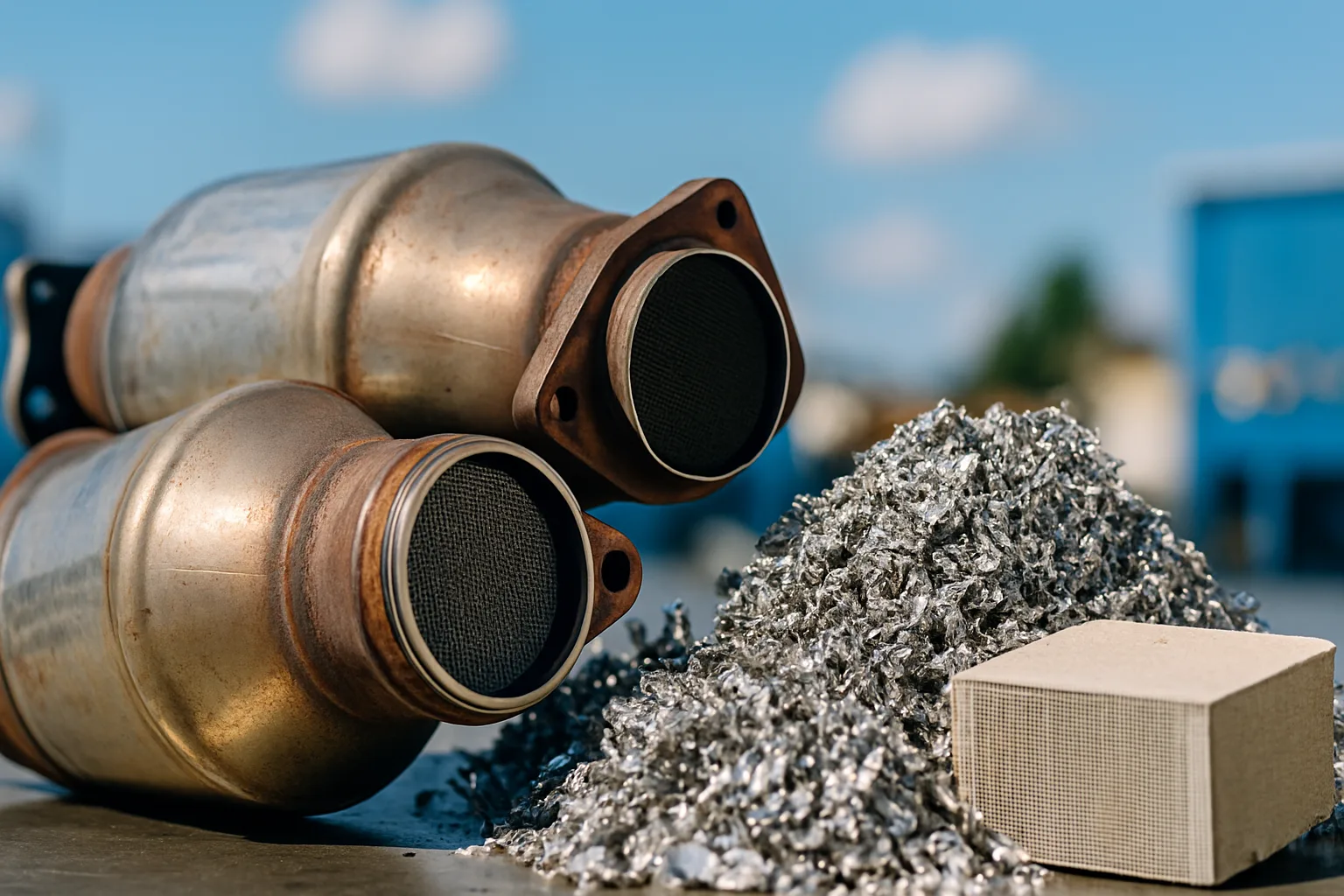
Some catalytic converters are worth $50 at the scrap yard. Others are worth over $500. The difference? It comes down to the vehicle it came off — and whether you know what you're holding before you sell.
If you're sitting on a pile of spent cats in Saint John and pricing them by feel, you're likely leaving real money on the table. Understanding cat converter prices Saint John starts with knowing which vehicles produce the most valuable cores — and why precious metal content drives everything.
This guide breaks down the most valuable catalytic converters by make and model, explains what drives catalytic converter scrap value, and shows you how to stop guessing and start getting paid properly. Platforms like SMASH Recycling — where verified buyers bid on your metal exist precisely because the old one-buyer, one-price system was costing sellers like you money every single day.
What Makes a Catalytic Converter Valuable? The Precious Metal Formula
Every catalytic converter contains a ceramic or metallic substrate coated with platinum group metals — platinum, palladium, and rhodium. These three metals do the actual emissions work. They're also what determine your converter's scrap value at the end of its life.
Rhodium is the wildcard. It routinely trades at multiples above gold and swings hard with industrial demand. Palladium has followed a similar trajectory over the past several years, and platinum — while more stable — still commands a strong price. The loading levels of these metals in any given converter depend on the engine size, emissions standards the vehicle was built to meet, and the manufacturer's design choices.
- Platinum (Pt): Common in diesel converters; more price-stable
- Palladium (Pd): Dominant in gasoline converters; high demand from auto manufacturers
- Rhodium (Rh): Present in small quantities but extremely valuable per gram
Larger engines, stricter emissions standards, and premium vehicle segments all tend to produce converters with higher precious metal loadings. That's why the make and model matters — not just the size of the converter itself. To find the best scrap converter prices in Canada, you need to identify your units accurately before you sell.
Most Valuable Catalytic Converters by Vehicle Make and Model
Not every converter is equal. Here's a breakdown of vehicle categories and specific makes known to produce high-value catalytic converter scrap — the kind of units buyers actively compete for.
Toyota and Lexus — Consistently High-Value Cats
Toyota Prius converters are among the most targeted and most valuable units in the scrap market. Hybrid systems run their catalysts harder at lower temperatures, which requires higher precious metal loadings to maintain efficiency. The result is a converter with notably elevated PGM content compared to a standard gasoline vehicle of similar size.
Lexus SUVs and performance sedans — particularly V6 and V8 applications — also produce premium units. The LS430, GX470, and LX470 platforms are well-known to serious converter buyers for their consistent scrap value.
Ford F-Series and Large American Trucks
High-displacement American trucks and SUVs — think Ford F-250 and F-350 Super Duty with gasoline V8 and V10 engines — carry large converters with proportionally higher metal content. The sheer volume of catalyst substrate means more PGMs per unit, even if the loading concentration isn't as extreme as a Prius.
Ford Excursion units and older Expedition V8s are also consistently valued by processors. If you're running a recycling yard in New Brunswick and pulling these trucks, you already know these are units worth tracking carefully.
BMW, Mercedes-Benz, and European Premium Vehicles
European manufacturers historically used higher platinum loadings, particularly in their diesel applications. Older BMW 5 Series and 7 Series gas engines produced solid-value converters. Mercedes E-Class and S-Class V6 and V8 units are well-regarded in the scrap converter market.
The caveat with European units: they're often harder to identify accurately without a serial number lookup. Mislabeling a European converter — or letting a buyer lowball it as "foreign small" — is a fast way to lose money. This is where proper documentation and competitive bidding make a measurable difference.
Dodge, Jeep, and Chrysler High-Displacement Engines
The Dodge Ram 1500 and 2500 with HEMI V8 engines, along with Jeep Grand Cherokee V8 applications, produce converters that trade well in the secondary market. Chrysler 300 V8 units are similarly valued.
These are common vehicles in Atlantic Canada — plenty of them end up at yards across New Brunswick — which means local sellers in Saint John can realistically accumulate meaningful volumes of these cores over time.
Honda and Acura — Smaller But Steady Value
Honda Accord and Honda CR-V converters don't command the same ceiling as a Prius or a V10 Super Duty, but they're consistent, well-documented, and common. Acura MDX and TL units typically sit in a mid-to-upper tier. Volume matters with these — if you're pulling ten Honda converters, knowing the accurate value on each unit adds up fast.
Cat Converter Prices Saint John: Why Local Sellers Often Undersell
Here's a pattern that plays out constantly: a seller in Saint John calls the one local buyer they know, gets a number, and takes it — because they have no baseline for comparison. That buyer may be legitimate and fair. Or they may be quoting below market because there's no competing offer in the room.
The problem isn't dishonest buyers. The problem is structural. One bid is not a market. It's a starting point.
Cat converter prices are directly tied to live precious metal spot prices. Rhodium, palladium, and platinum trade daily. A converter worth $320 on a Monday might fetch $340 on Friday if palladium ticks up. If your single buyer is using last week's numbers — or pricing conservatively to protect their margin — you won't know the difference.
Competitive bidding changes that equation. When vetted buyers compete for your inventory, price discovery happens in real time. That's the mechanic behind why sellers using auction-style platforms consistently get more clarity on true market value. You can read Canadian scrap converter pricing guides to understand current market conditions before you go to sell.
How to Maximize Your Catalytic Converter Scrap Value Before You Sell
Getting the best return on your converters isn't just about finding the right buyer. It's about showing up prepared. Here's what makes a difference:
- Identify your units accurately. Serial numbers on the converter body are the most reliable identifier. VIN-based lookup can confirm fitment and help cross-reference known PGM loadings. Don't rely on guesswork.
- Photograph everything. Clear images of the unit, the serial number, and the condition give buyers the confidence to bid higher. Uncertainty makes buyers discount. Documentation removes uncertainty.
- Sort by category. Domestic, foreign, large foreign, small foreign, exotic — these aren't arbitrary labels. They correspond to processing grades and PGM yield expectations. Selling a mixed, unsorted batch puts pricing control in the buyer's hands, not yours.
- Know the spot price context. You don't need to trade PGMs — but knowing whether palladium is trending up or down when you're selling helps you time larger lots strategically.
- Use competition, not convenience. If you're selling used catalytic converter scrap value based on whoever answers the phone first, you're optimizing for speed, not return.
SMASH brings vetted buyers to your inventory and lets competition do the pricing work. No subscription fees. No guessing. The platform only works when you do — that's the model.
Sell Catalytic Converter Online: What the Digital Shift Means for New Brunswick Sellers
The ability to sell catalytic converter online has fundamentally changed the math for recyclers outside major urban centers. A yard in Saint John used to be limited to whoever was reachable by phone within a reasonable trucking radius. That geographic constraint capped your buyer pool and, with it, your achievable price.
Online platforms that connect sellers to national buyer networks remove that ceiling. Your Saint John inventory becomes accessible to buyers in Toronto, Calgary, Vancouver — wherever the demand and the margin make the purchase worth pursuing. More buyers means better price discovery. That's not a sales pitch — it's how competitive markets work.
Check current Canadian scrap converter prices before committing to a sale. Knowing the market baseline before you negotiate is the single most effective thing you can do to improve your outcome. For yards across New Brunswick looking to move cats more efficiently, the combination of accurate identification, proper documentation, and competitive bidding through a platform like SMASH is the clearest path to better returns.
Ready to find out what your converters are actually worth? Get a free quote at best-scrap-converter-prices.ca — and stop leaving money on the table one load at a time.
Disclaimer: Catalytic converter scrap prices fluctuate daily based on live precious metal spot prices. Always check current rates before selling.
If you run Saint John scrap metal services or buy and sell converters regularly in the region, staying connected to live market data isn't optional — it's what separates the yards that get paid well from the ones that don't.
Frequently Asked Questions
Q: What are the most valuable catalytic converters to scrap in Canada?
Toyota Prius converters consistently rank among the highest-value units due to elevated precious metal loadings in hybrid systems. Large-displacement American truck converters (Ford F-250/F-350 V8/V10) and certain Lexus models also command strong prices. European diesel converters can carry significant platinum content as well. The specific value depends on live PGM spot prices at the time of sale.
Q: How do I get the best cat converter prices in Saint John?
Accurate unit identification, proper photo documentation, and competitive bidding are the three biggest factors. One-buyer pricing rarely reflects true market value. Platforms like SMASH connect Saint John sellers to vetted national buyers who compete for your inventory — that competition is what produces fair market pricing.
Q: Why do catalytic converter prices change so often?
Converter scrap value is directly tied to live precious metal spot prices — platinum, palladium, and rhodium trade daily on global commodity markets. A swing in rhodium or palladium prices can meaningfully change the value of your inventory within days. Always check current rates before committing to a sale.
Q: Can I sell my catalytic converter online from New Brunswick?
Yes. Online platforms for scrap metal recycling in Canada have removed the geographic limitations that once restricted Atlantic Canadian sellers to local buyers only. You can list, document, and sell converters through competitive auction-style platforms and reach buyers across the country.
Q: How do I identify what type of catalytic converter I have before selling?
The serial number stamped or etched on the converter body is the most reliable identifier. Many buyers and platforms offer serial number lookups or VIN-based reference tools to help match a converter to its vehicle application and known PGM grade. Never sell an unidentified converter as a generic unit — misclassification costs you money.
Follow SMASH on LinkedIn for ongoing industry updates, scrap metal market insights, and news that actually matters to recyclers and buyers across North America.
```