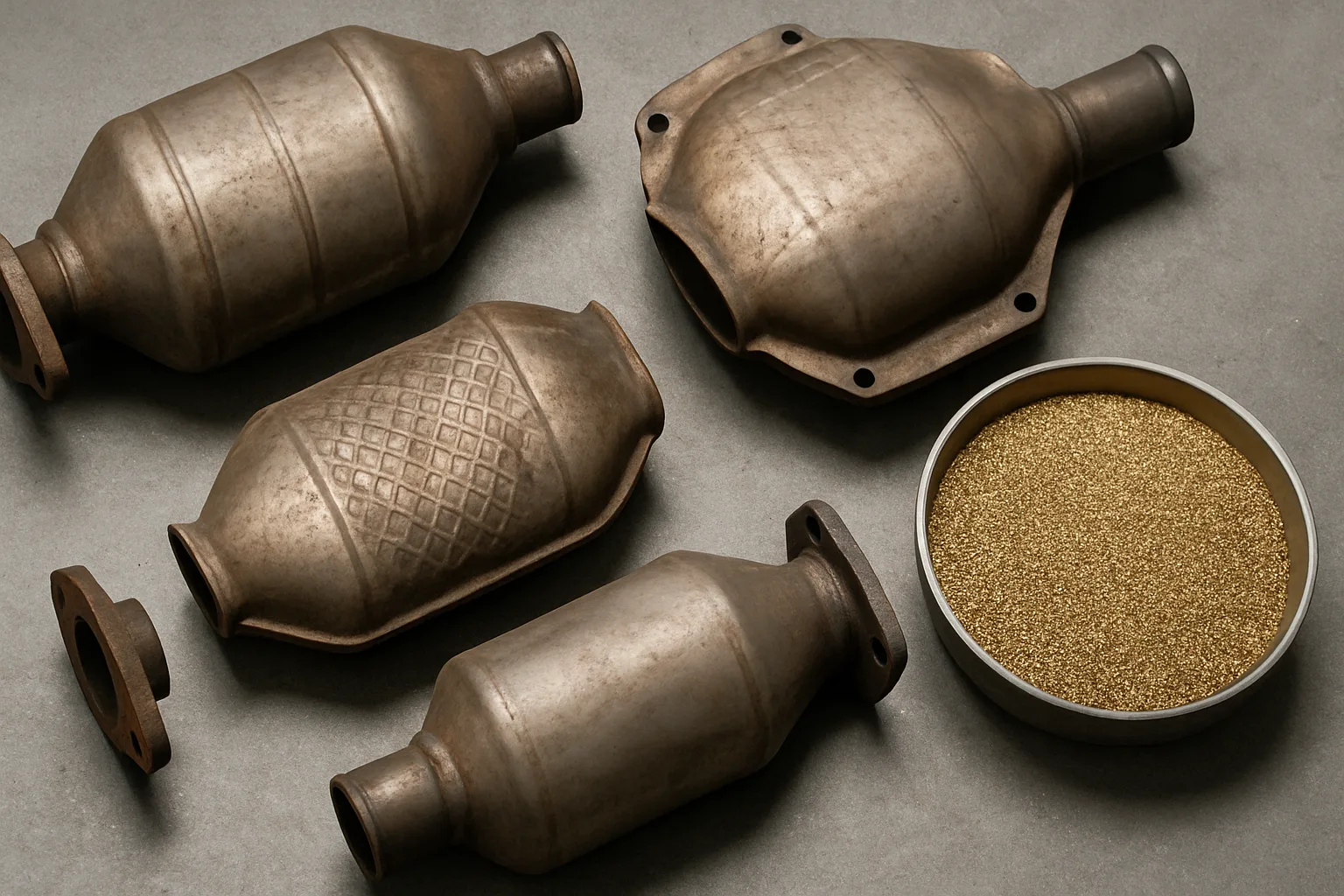
Diesel vs. Gasoline Catalytic Converters: What the Difference Means for Your Scrap Value
Most converter sellers assume all cats are created equal. They're not — and that assumption costs yards real money. The gap between what a diesel converter pays versus a gasoline converter can be significant, and if you don't know which one you're holding, you're already negotiating blind.
Understanding how diesel catalytic converters (DPF and DOC units) differ from gasoline converters isn't just a technical exercise. It directly affects catalytic converter scrap value, what buyers will pay, and how you should be sorting and presenting your inventory. This week's market recap breaks it down clearly so you walk into your next sale with real information.
Two Different Jobs, Two Different Converter Designs
Gasoline and diesel engines produce different exhaust profiles. A gasoline engine burns fuel hot and fast, producing hydrocarbons, carbon monoxide, and nitrogen oxides. A diesel engine runs cooler, produces more particulate matter (soot), and generates its own distinct mix of harmful emissions. Each engine type needs a different solution.
Gasoline catalytic converters use a three-way catalyst design. They simultaneously handle three pollutants — hence the name. The substrate inside (usually a ceramic honeycomb) is coated with a mix of platinum, palladium, and rhodium. These are the precious metals that give gasoline cats their scrap value, and their concentrations vary significantly by vehicle make, model, and year.
Diesel systems are more complex and typically split into two or three separate components:
- DOC (Diesel Oxidation Catalyst): Handles hydrocarbons and carbon monoxide. Contains platinum and palladium, but generally in lower concentrations than a gasoline three-way cat.
- DPF (Diesel Particulate Filter): Captures and burns off soot. Often made of silicon carbide or cordierite. May contain small amounts of platinum as a combustion catalyst, but the loading is typically minimal.
- SCR (Selective Catalytic Reduction): Found on many modern diesel trucks and equipment. Reduces nitrogen oxides using urea (DEF fluid). May contain vanadium or small amounts of platinum-group metals depending on the catalyst formulation.
Knowing which unit you're actually dealing with changes everything when it comes to valuation.
Why Catalytic Converter Scrap Value Differs Between Diesel and Gas Units
Here's the bottom line: gasoline three-way converters almost always carry higher PGM (platinum-group metal) loading than diesel DOCs or DPFs. The chemistry behind diesel after-treatment prioritizes particulate capture and urea-based NOx reduction over PGM-heavy catalyst reactions. That means less platinum, less palladium, less rhodium — and lower scrap value per unit on average.
That said, diesel units aren't worthless — not by a long shot. A DOC from a heavy-duty commercial truck can still carry meaningful PGM content, particularly in platinum. The volume of material in a large diesel DOC compensates somewhat for lower concentration. A DPF from a Class 8 truck is a different beast than one pulled from a passenger diesel car.
What actually determines your catalytic converter scrap value right now is a combination of:
- The palladium price today (drives gasoline cat values strongly)
- Current platinum spot price (more relevant for diesel DOCs)
- Rhodium pricing (volatile, but still a significant factor in gasoline cats)
- The specific vehicle application (OEM vs. aftermarket, heavy-duty vs. passenger)
- Physical condition — cracked, rattling, or gutted units pay significantly less
Palladium price today remains a key driver for anyone holding gasoline converter inventory. Palladium is heavily concentrated in gasoline three-way cats, and its market price directly moves what buyers will bid. If you're sitting on a mixed load of gas and diesel units without sorting them, you're leaving pricing clarity on the table — and likely getting an average offer that undervalues your gas cats.
How to Identify What You're Actually Holding
Sorting matters. Before you sell catalytic converters online or walk into any negotiation, you need to know what type you have. Here's a practical breakdown:
Gasoline converters are typically found on:
- Passenger cars and light-duty trucks with gasoline engines
- Hybrids (note: hybrid cats often have higher PGM loading due to frequent cold-starts)
- Motorcycles and smaller engines
Diesel DOCs are typically found on:
- Light-duty diesel trucks and SUVs (e.g., Ram 1500 EcoDiesel, older diesel pickups)
- Commercial vans and medium-duty vehicles
- Construction and agricultural equipment
Diesel DPFs are typically found on:
- Any diesel vehicle manufactured after approximately 2007 (when DPF requirements became standard in North America)
- Heavy-duty Class 6-8 trucks
- Heavy equipment with Tier 4 Final emission compliance
If you're dealing with a load that mixes all of these unit types, you need a buyer who can identify and price each category accurately. Platforms like SMASH connect you with vetted buyers who know how to value these units individually — not just by the pallet.
What Quebec and Montreal Scrap Yards Need to Know About Diesel Converter Markets
If you're operating in Montreal or elsewhere in Quebec, your diesel converter inventory profile likely reflects the regional equipment mix. Quebec's construction sector, agricultural industry, and commercial trucking fleet means many yards see a healthy volume of diesel DOCs and DPFs alongside standard gasoline cats.
That's both an opportunity and a pricing trap. Diesel units are easy to lump together and underprice when buyers aren't distinguishing between a high-platinum DOC from a heavy-duty application versus a low-value DPF from a passenger diesel. For yards looking to sell catalytic converters in Quebec, the discipline of sorting your diesel inventory before going to market is one of the most straightforward ways to improve your return.
Montreal scrap metal services have matured significantly in recent years, but the converter market specifically rewards yards that come to the table with documented, sorted inventory. A photo of a pile of mixed units gets you a hedged offer. A sorted load with unit identification, weights, and condition notes gets you a competitive one.
To find the best scrap converter prices in Canada, documentation and sorting are your leverage — not just market timing.
The Case for Auctioning Your Converter Load Instead of One-Call Selling
Here's the old way: you call one buyer, they quote you a number, you accept it or walk away. There's no reference point, no competition, no transparency. For mixed loads that include both diesel and gasoline units, that single-buyer model is particularly punishing — you're getting one blended number that rarely reflects the actual PGM value in your load.
The better approach is competitive bidding with documented inventory. When multiple vetted buyers see the same load — with photos, weights, unit types clearly identified, and condition noted — they bid against each other. That competition is what reveals the actual market. It's not magic; it's just how pricing discovery is supposed to work.
SMASH is built for exactly this. When you list your converter inventory through SMASH, vetted buyers across North America can see your load and submit bids. You're not guessing at value — you're letting the market tell you what your inventory is actually worth today. For yards in Montreal and across Quebec looking for Montreal scrap metal services, having that competitive structure behind your converter sales changes the math entirely.
To check current Canadian scrap converter prices before you list, get a baseline — then let the auction process do its job.
No subscription fees. SMASH only wins when you do.
Setting Up Your Converter Inventory the Right Way Before You Sell
Whether you're selling online or through a local buyer, how you present your inventory affects what you get paid. Here's what strong converter documentation looks like in practice:
- Sort by type: Separate gasoline cats, diesel DOCs, DPFs, and SCR units. Mixed pallets signal disorganization to buyers and invite conservative bids.
- Photograph everything: Both ends of each unit, the serial/OEM number visible where possible. Buyers evaluating your load remotely need clear images to bid confidently.
- Record weights: Full unit weight and, where possible, substrate-only weight if units are decanoed. This directly affects pricing for some buyers.
- Note condition: Physically intact, cracked housing, rattling substrate, or already cleaned out? Condition affects value — disclose it upfront rather than letting buyers hedge for risk.
- Use VIN or serial tracking where available: SMASH's inventory tools support serial tracking and photo documentation so your load is presented consistently to every buyer in the auction.
This level of preparation isn't just for large loads. Even a smaller converter haul presented this way signals professionalism and earns more competitive bids. For anyone new to selling converters, read Canadian scrap converter pricing guides to understand how to build this process into your yard workflow.
The scrap converter market in Canada — and particularly in Quebec — rewards yards that treat their inventory with the same discipline as any other commodity. Diesel and gasoline units are not the same. Price them like it, present them like it, and sell them like it. Find the best price for your scrap in Canada by putting your inventory in front of real competition, not just one phone call.
Disclaimer: Catalytic converter scrap prices fluctuate daily based on platinum, palladium, and rhodium spot prices. Always verify current rates before finalizing any sale. The information in this article reflects general market dynamics as of August 2026 and does not constitute a price guarantee.
Frequently Asked Questions
Q: Are diesel DPFs worth scrapping for their catalytic converter value?
DPFs do contain some PGM content, but typically at lower concentrations than gasoline three-way converters or diesel DOCs. Their scrap value depends heavily on the vehicle application — a heavy-duty truck DPF contains more material than one from a passenger diesel car. Sort them separately and get them appraised individually rather than lumping them into a mixed load.
Q: How does the palladium price today affect what I get for my gasoline catalytic converters?
Palladium is the dominant PGM in most gasoline three-way catalytic converters. When the palladium price moves up or down, it directly affects your converter's scrap value — sometimes significantly within a single week. Always check current spot prices before accepting any offer, and consider timing your sale around market movements if your volume justifies it.
Q: How do I find catalytic converter buyers near me in Montreal?
Local scrap yards in Montreal and across Quebec buy converters, but a single local offer rarely reflects the full market. Using a platform that connects you with multiple vetted buyers — including those outside your immediate area — gives you price discovery that one phone call can't provide. SMASH connects Canadian converter sellers with competitive buyers across North America.
Q: Can I sell catalytic converters online from Quebec?
Yes. Selling converters online has become standard practice for yards across Quebec and the rest of Canada. The key is using a platform that verifies buyers and provides a transparent bidding process. Document your inventory thoroughly with photos, weights, and unit types before listing — this directly affects the quality of bids you receive.
Q: What makes a catalytic converter high value versus low value at the scrap yard?
PGM concentration is the primary driver — higher platinum, palladium, and rhodium loading means higher value. Vehicle type matters enormously: exotic and luxury vehicle cats, certain Toyota and Honda OEM units, and specific truck applications are known for higher PGM loading. Physical condition also matters — cracked, rattled-out, or gutted units pay a fraction of intact ones. Sort, document, and sell competitively to get the most accurate return on your inventory.
Ready to stop guessing at converter prices? Find the best Canadian scrap converter prices — get a free quote at best-scrap-converter-prices.ca and put your inventory in front of real buyers today.
Stay ahead of the converter market — follow SMASH on LinkedIn for weekly scrap metal market updates, PGM price insights, and industry news that actually affects your bottom line.