Foil vs. Bead Catalytic Converters: What's the Difference and What Are They Worth?
Most converter sellers think a cat is a cat. Hand it over, get paid, move on. But the difference between a foil-style and a bead-style catalytic converter can mean a significant gap in OEM catalytic converter value — and if you don't know which one you're holding, you're walking into that conversation blind. That matters everywhere, but especially in a market like Barrie, Ontario, where scrap yards vary widely in how they assess and price converter types.
This guide breaks down what foil and bead converters actually are, how they differ in precious metal content, and what you need to know to get a fair price when you sell. Whether you're clearing out a shop, processing end-of-life vehicles, or running a recycling yard, understanding converter construction is step one.
What Is a Foil-Style Catalytic Converter?
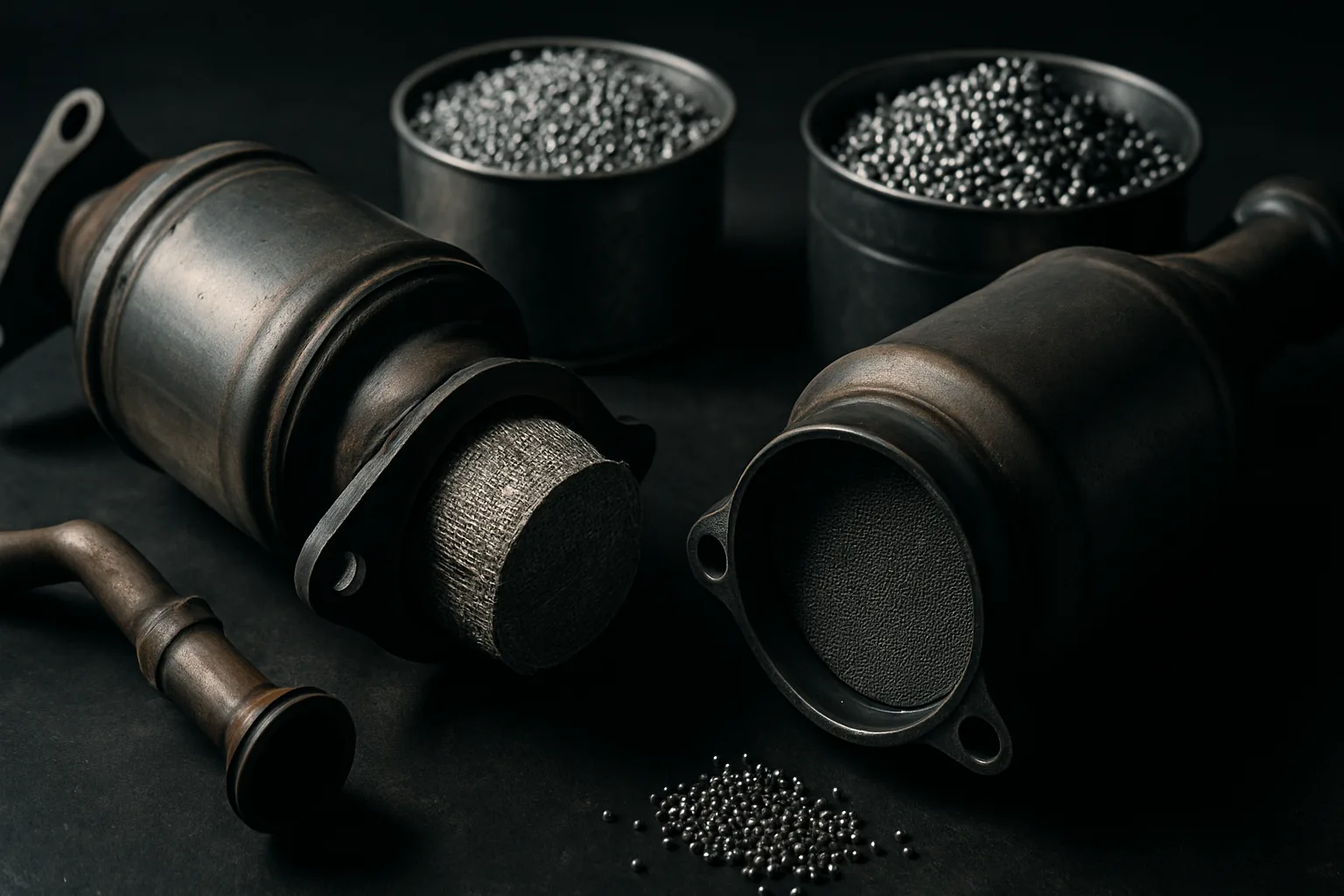
A foil-style catalytic converter uses a metallic substrate — thin corrugated foil, typically a stainless steel and aluminum alloy — wound into a honeycomb structure inside the housing. The precious metals (platinum, palladium, and rhodium) are coated onto the surface of that foil matrix. Foil substrates are common in high-performance applications and some European OEM designs because they flow exhaust gases more efficiently at high RPMs.
Here's what that means for scrap value: foil converters tend to have lower total precious metal content by weight compared to ceramic bead units, but the metals that are there can be more accessible during the smelting and refining process. Recovery rates can vary significantly depending on the refiner's process. Not all buyers assess foil cats the same way — which is exactly why price transparency matters when you're selling.
Key characteristics of foil converters:
- Metallic honeycomb interior (not ceramic)
- Lighter than ceramic substrate units of similar size
- Often found in European vehicles, motorcycles, and performance applications
- May rattle differently — or not at all — compared to broken ceramic cats
- Tend to look similar externally to standard OEM converters
The challenge with foil cats is that buyers who aren't set up to process them properly may undervalue them or group them into a generic "aftermarket" or "foreign small" category. That's a real problem if your load includes genuine OEM foil units with recoverable PGM content. Platforms like Canada's B2B scrap recycling marketplace connect sellers to vetted buyers who actually understand these distinctions — and price accordingly.
What Is a Bead-Style Catalytic Converter?
Bead-style converters use small ceramic or alumina beads as the catalyst substrate instead of a honeycomb. The precious metals are coated onto or embedded within these loose beads, which are packed inside the converter housing. They were more common in older North American vehicles — think GM, Ford, and Chrysler applications from the late 1970s through the 1990s — before honeycomb ceramic became the dominant OEM standard.
Bead converters have a very distinctive sound: shake one and you'll hear the beads moving inside. That rattle is an easy field identifier. The precious metal content in bead units can be significant, particularly in older, larger-displacement applications where emission control required heavier catalyst loading. However, the total PGM value depends heavily on vehicle application, mileage, and condition — a high-mileage bead cat from a neglected vehicle will have lower recoverable content than one from a well-maintained unit with fewer operating hours.
What to know about bead converters when selling:
- Usually heavier than foil units due to bead mass
- Common in older North American OEM applications
- Can have high PGM content — but condition matters
- Beads can be contaminated with oil or other substances, which affects recovery
- Some buyers will assay bead material separately from honeycomb loads
OEM Catalytic Converter Value: How Construction Affects Your Price
When buyers assess OEM catalytic converter value, they're ultimately calculating recoverable platinum, palladium, and rhodium — multiplied against current spot prices for each metal. But converter construction is a major variable in that calculation. A foil unit and a ceramic honeycomb unit from the same vehicle platform can have different PGM profiles even if they look similar from the outside.
This is where serial number and VIN data become critical. OEM converters come with manufacturer part numbers that connect to assay data — real-world recovery averages based on actual smelting results. Buyers who use a proper converter price list matched to OEM part data will give you a far more accurate number than those eyeballing the unit and offering a flat rate per pound. If you're in Barrie and you're selling a mixed load of foil, bead, and standard ceramic honeycomb converters, lumping them together at one price means someone in that transaction is losing money — and it's usually the seller.
To find the best scrap converter prices in Canada, you need buyers who are pricing to assay data, not guessing. That's the difference between price discovery and price acceptance — and it's a distinction that adds up fast across a full load.
Catalytic Converter Prices Today: What Drives the Market in 2026
Precious metal markets have been volatile through 2025 and into 2026. Palladium in particular has seen significant price movement as automotive production cycles shift and EV penetration continues to grow in certain vehicle segments. Rhodium, historically the most valuable of the three major PGMs used in catalytic converters, remains highly sensitive to supply chain dynamics tied to South African mining output — a factor that affects converter pricing globally, including in Canada.
For sellers in Ontario, catalytic converter prices today reflect a combination of global spot prices and local market conditions. A few things to watch in 2026:
- Palladium: Still the dominant PGM in gasoline engine converters, but prices have moderated from historical peaks. Still a major value driver for most OEM cats.
- Platinum: More prevalent in diesel applications. European OEM foil converters often carry higher platinum content.
- Rhodium: Extreme volatility continues. Buyers price rhodium-bearing units with caution — watch for buyers who shade rhodium value down to protect themselves.
- Currency: CAD/USD exchange rates affect converter prices in Canada. Buyers purchasing in CAD and selling refined metal in USD markets need to hedge that exposure — which can show up in the prices they offer sellers.
For buyers and sellers in Barrie and across Ontario, staying current on precious metal spot prices isn't optional — it's how you know whether the offer on the table is fair. Read Canadian scrap converter pricing guides to track the factors that move converter values week to week.
How SMASH Helps Barrie Converter Sellers Get Competitive Prices
The old model for selling converters in Barrie looked like this: call your usual buyer, take their number, load the truck. No comparison. No data. No way to know if the price was fair. If you happened to be their best customer, maybe you got bumped up a few dollars. Maybe you didn't. Either way, you had no leverage.
SMASH is built around a different model. It's a B2B scrap metal marketplace — a vetted auction platform where your converter load gets in front of multiple qualified buyers who compete for it. More competition means better price discovery. It doesn't guarantee you'll always get a higher number, but it does mean you're not leaving money on the table by defaulting to a single buyer with no incentive to sharpen their pencil.
SMASH also supports the documentation side of converter selling — photo documentation, serial tracking, VIN lookup — the tools that give buyers confidence in what they're bidding on. A well-documented load of OEM foil and bead converters with part numbers attached will attract more serious bids than an undocumented pile. That documentation work pays off. Platforms like SMASH make it straightforward to build out that documentation before your load goes to auction.
For yards and dealers using Barrie scrap metal services, connecting to a broader network of vetted buyers through SMASH means your converters are priced against real market competition — not against a single buyer's margin target. No subscription fees. SMASH only wins when the seller wins.
If you're ready to check current Canadian scrap converter prices and understand what your foil or bead units are actually worth, starting with real data and real competition is the only approach that makes sense.
What to Do Before You Sell Your Converters
Whether you're in Barrie, anywhere else in Ontario, or across Canada, the process before selling matters as much as the sale itself. Sellers who do the preparation work consistently get better outcomes — not because they're lucky, but because they give buyers more to work with.
Before your converters go to market:
- Identify the converter type. Foil, bead, or ceramic honeycomb? Each category is priced differently. If you're unsure, look at the weight and listen for the bead rattle.
- Document serial numbers and part numbers. OEM part data connects to real assay averages. That data is your leverage.
- Photograph each unit. Buyers want to see condition. Missing shields, damaged substrates, and signs of tampering all affect bids.
- Sort your load. Don't mix OEM foil and bead units with aftermarket or damaged cats unless you're prepared for the whole load to be priced at the lowest common denominator.
- Check current spot prices. Know where platinum, palladium, and rhodium are trading before you take any offer. An offer that sounded good last month may be low today — or vice versa.
- Get competitive bids. One offer is not a market. It's one buyer's number. Use a platform that creates competition.
The scrap converter market in Canada rewards sellers who show up prepared. Good documentation, sorted loads, and competitive auction formats are the tools that close the gap between what you assume your converters are worth and what buyers will actually pay.
Frequently Asked Questions
Q: How do I know if my catalytic converter is foil-style or bead-style?
Bead-style converters have a distinctive rattle when shaken — you can hear the loose ceramic beads inside. Foil-style converters are typically lighter, have a metallic substrate interior rather than ceramic, and are common in European OEM vehicles and high-performance applications. If you're unsure, a knowledgeable buyer or a converter identification tool using part numbers can confirm the type before you sell.
Q: Do foil catalytic converters have the same OEM catalytic converter value as ceramic honeycomb units?
Not necessarily. Foil and ceramic honeycomb converters can have very different precious metal profiles depending on vehicle application and OEM design. Foil units may have lower total PGM content by weight, but the recoverable value depends on the specific metals present and current spot prices. Pricing should always be based on part-number-specific assay data, not a flat rate per unit.
Q: Where can I find catalytic converter buyers near me in Barrie, Ontario?
Barrie has local scrap yards that accept converters, but local doesn't always mean best price. Connecting to a broader network of vetted buyers through a platform like SMASH gives you access to competitive bids beyond your immediate area. More buyers competing for your load creates better price discovery than calling one yard and taking their number.
Q: How do precious metal spot prices affect what I get paid for my converters in Canada?
Converter buyers base their offers on the recoverable platinum, palladium, and rhodium in each unit, priced against current spot markets. In Canada, the CAD/USD exchange rate is also a factor, since PGMs trade globally in USD. When palladium or rhodium prices move significantly, converter values follow — which is why checking current rates before selling is essential.
Q: Why are bead-style catalytic converters sometimes harder to sell than honeycomb units?
Bead converters require different processing than honeycomb ceramic units — not all refiners handle them the same way. Some buyers aren't set up to accurately assess bead material and may underprice or avoid them. Finding buyers who specifically handle bead converters and understand their PGM content is key to getting fair value. This is one area where a B2B marketplace with vetted, specialized buyers makes a real difference.
If you're processing foil or bead converters in Barrie or anywhere else in Ontario, don't guess at the value and don't settle for a single buyer's number. The market is more competitive than that — you just need the tools to access it. Find the best Canadian scrap converter prices and get a free quote at best-scrap-converter-prices.ca — because knowing your converter's real value before you sell is the only way to make sure you're getting it.
Prices fluctuate with precious metal spot markets. Always check current rates before selling your converters.
Follow SMASH on LinkedIn for ongoing scrap metal market insights, converter pricing updates, and industry news across Canada.