Most converter sellers leave money on the table — not because they got a bad price, but because they couldn't identify what they had. If you're sitting on a pile of cats and you can't read the serial numbers, you're negotiating blind. Buyers know exactly what they're looking at. You should too.
Whether you're a yard operator in Fort McMurray pulling converters off oil field trucks or a dismantler working through a batch of imports, knowing how to read a catalytic converter serial number is the single fastest way to gain leverage when you sell catalytic converters online. This guide breaks it down — no guesswork, no jargon overload.
---What Is a Catalytic Converter Serial Number and Why Does It Matter?
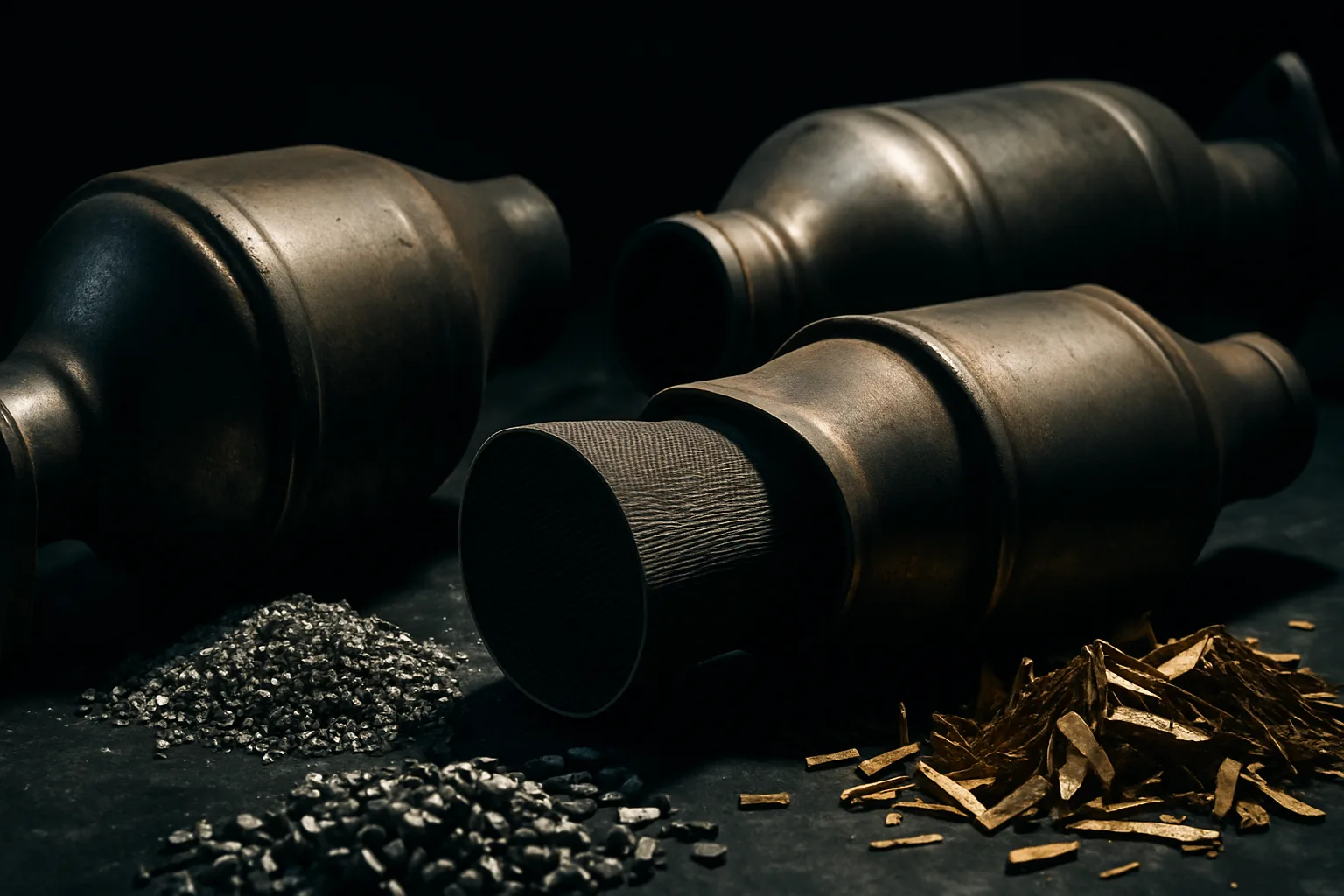
A catalytic converter serial number — sometimes called a substrate code, OEM number, or part number — is a stamped, etched, or printed identifier on the converter's body or heat shield. It's not decorative. That number tells a trained buyer the exact substrate inside: the size, the wash coat composition, and the approximate loading of platinum, palladium, and rhodium (PGMs) in that unit.
When you find the best scrap converter prices in Canada, you'll notice that two converters that look nearly identical on the outside can have wildly different scrap values. The difference often comes down to what the serial number reveals about the PGM loading inside. A GM large breadloaf with one serial versus another can swing by $50 or more per unit. That gap compounds fast when you're moving volume.
Understanding serial numbers also protects you. It's harder for a buyer to lowball a "mystery unit" if you already know what the number points to. Knowledge is margin.
---Where to Find the Serial Number on a Catalytic Converter
Location varies by manufacturer, vehicle type, and production era. Here's where to look:
- Stamped on the body: Most OEM converters have the number stamped directly into the steel shell, usually on the side or the end cap. Look for a combination of letters and numbers — often 8 to 12 characters.
- On the heat shield: Some units carry a stamped or riveted heat shield with the number on it. Note: heat shields get swapped. Always cross-reference with the shell itself.
- Laser-etched or printed labels: Aftermarket and some Asian-market converters use printed labels. These are less reliable for grading because aftermarket cores vary widely in PGM content.
- Embossed on the inlet/outlet pipe: Rare but present on certain Ford and Chrysler units — check the pipe collar near the weld seam.
- Under the vehicle: Before you cut anything, photograph the converter in-situ. The number may be more legible before removal, especially on rusted units common in Alberta winters.
Dirt, rust, and carbon buildup are your enemies. In Fort McMurray's climate — freeze-thaw cycles, road salt, and industrial grime — serial numbers on older units can be nearly unreadable. A wire brush and a flashlight go a long way. So does photographing converters immediately after removal before the surface oxidizes further.
---How to Decode What You're Looking At
Serial numbers aren't standardized across manufacturers, which is the frustrating part. Each OEM has its own coding logic. Here's a practical breakdown by major manufacturer group:
General Motors (GM)
GM serial numbers often begin with a letter-number combination referencing the plant and production sequence. Common prefixes include codes starting with "25" or "3" followed by 6 digits. GM units are among the most graded and catalogued — most reputable buyers and platforms can look these up instantly. The large "breadloaf" foil units from full-size trucks are some of the most valuable in the market.
Ford
Ford converters typically carry an OEM part number formatted as a series of letters and numbers with dashes — example format: F7AZ-5E212-AA. The letter at the start often indicates the decade of design. Ford units from F-250s and F-350s with diesel retrofits carry different substrate specs than passenger car units. Don't assume size equals value.
Toyota and Honda
Japanese OEM converters are heavily catalogued and tend to carry consistent PGM loadings. Toyota's codes are typically numeric strings, while Honda uses alphanumeric codes stamped near the inlet flange. These are popular in Canadian markets — Fort McMurray yards see significant volume of these from Japanese imports and used imports from BC and Ontario.
Chrysler / Stellantis
Chrysler units often carry a number starting with "5" or "6" followed by 9 digits. The Ram 1500 and 2500 units are high-volume in Alberta given the number of trucks on the road. Know your Ram cat codes — they appear regularly and buyers have clear price tiers for them.
Aftermarket / Generic Units
If you see a serial number that references a well-known aftermarket brand (think Walker, Magnaflow, AP Exhaust), these are not OEM cores. Their PGM loading is typically lower than OEM, and they price accordingly. Never mix aftermarket and OEM in the same lot without disclosing it — buyers notice, and it damages your credibility.
---The Platinum Price Today Connects Directly to Your Serial Number's Worth
Here's where serial identification becomes a live financial exercise. The platinum price today — along with palladium and rhodium — moves daily based on global commodity markets. When you know your serial number, you can map it to a known PGM assay (the estimated troy ounce content per unit). From there, the math is straightforward: assay value × current metal price = theoretical gross value, minus processing and refining margins.
That's exactly the calculation serious buyers are running when they quote you. If you don't know what serial you have, you can't verify whether the offer reflects actual metal content or a buyer's best guess in their favour. Check current Canadian scrap converter prices to understand where the market sits before you approach any buyer.
Platforms like smashrecycling.ca operate as a B2B scrap metal marketplace built around transparency. When buyers bid competitively on documented lots, the pricing pressure they apply is grounded in real assay data — not a single buyer's unchallenged offer. That's the structural difference between the old phone-and-guess system and what a competitive auction environment produces. More buyers bidding on a documented load means better price discovery.
---How to Document Serial Numbers Before You Sell
Proper documentation is what separates a casual seller from a professional one. When you're ready to sell catalytic converter Canada — whether you're moving 10 units or 10,000 — documentation is how you justify your ask and protect yourself against lowball offers or post-sale disputes.
Here's a practical documentation workflow:
- Photograph every unit individually — top, bottom, and both ends. Capture the serial number clearly in at least one frame.
- Record the serial number in writing — a simple spreadsheet works. Include unit condition (foil vs. ceramic, intact vs. de-canned), approximate vehicle source if known, and any visible damage.
- Group by grade or type — don't mix high-value OEM foil units with aftermarket ceramics in the same bag or pallet without clear separation.
- Cross-reference with a price guide or lookup tool — SMASH and similar platforms offer tools that help you connect serial numbers to known converter categories.
- Generate a packing list — a basic BOL or packing list with unit counts and serial references protects both parties and speeds up the transaction.
If you're sourcing converters in Fort McMurray or anywhere across Alberta, this process is especially useful when dealing with mixed loads off industrial equipment — where vehicle provenance and OEM specs aren't always obvious.
---Using a B2B Scrap Metal Marketplace to Get Real Competitive Offers
Here's the honest problem with the traditional approach: you call one buyer, they give you a number, and you have no idea if it's fair. You might shop it to one or two other yards, but you're still working on incomplete information and personal relationships that may not favour you.
A B2B scrap metal marketplace like SMASH changes that dynamic. When you upload a documented lot — serial numbers, photos, unit counts — vetted buyers across North America can see exactly what you have and compete to win it. The transparency of the process is the point. Documented inventory gives buyers more confidence to bid higher. Competition can help reveal the market. No subscription fees — SMASH only wins when you do.
If you're in Fort McMurray or anywhere in Alberta looking for a reliable path to sell catalytic converters online, this is the infrastructure that was missing from the industry for years. You can also read Canadian scrap converter pricing guides to stay current on market conditions before you list.
Ready to move your load with full transparency and competitive offers? Get a free quote at best-scrap-converter-prices.ca and see what your documented converters are actually worth in today's market.
---Disclaimer: Catalytic converter scrap prices fluctuate daily based on platinum, palladium, and rhodium spot markets. All price references are general in nature. Always check current rates before finalizing any sale.
---Frequently Asked Questions
Q: Can I sell catalytic converters online without knowing the serial number?
You can, but you'll likely get a lower offer. Buyers price unknown units conservatively because they're absorbing the identification risk themselves. Knowing your serial number — even a partial one — gives buyers the data they need to bid confidently and competitively.
Q: What if the serial number is worn off or unreadable?
Start with a wire brush and good lighting — rust and grime hide a lot. If the number is genuinely gone, photograph the unit from multiple angles. Experienced buyers can sometimes identify converters by body shape, size, pipe diameter, and heat shield style. It's not perfect, but it's better than nothing.
Q: How do I find the best scrap converter prices in Fort McMurray, Alberta?
The best approach is to document your units properly and get multiple offers. Relying on a single local buyer limits your leverage. Platforms like SMASH connect you with vetted buyers across North America who compete on price — which tends to produce better outcomes than a single phone call to a nearby yard.
Q: Does the platinum price today affect what I get for my converters?
Directly, yes. Platinum, palladium, and rhodium spot prices move daily, and converter scrap values move with them. A serial number tied to a high-PGM substrate will track those metals closely. Checking spot prices before you sell helps you understand whether the market is in your favour right now.
Q: Is there a difference between selling to a catalytic converter scrap yard near me versus selling online?
Local yards offer convenience, but they're typically a single offer from a single buyer. Selling online through a documented auction process exposes your lot to multiple competing buyers. For high-value or high-volume loads, the difference in price discovery can be significant. Both have a place, but volume sellers consistently benefit from competitive bidding environments.
---Follow SMASH on LinkedIn for industry updates, scrap metal market insights, and platform news: linkedin.com/company/scrap-metal-auction-sales-hub.