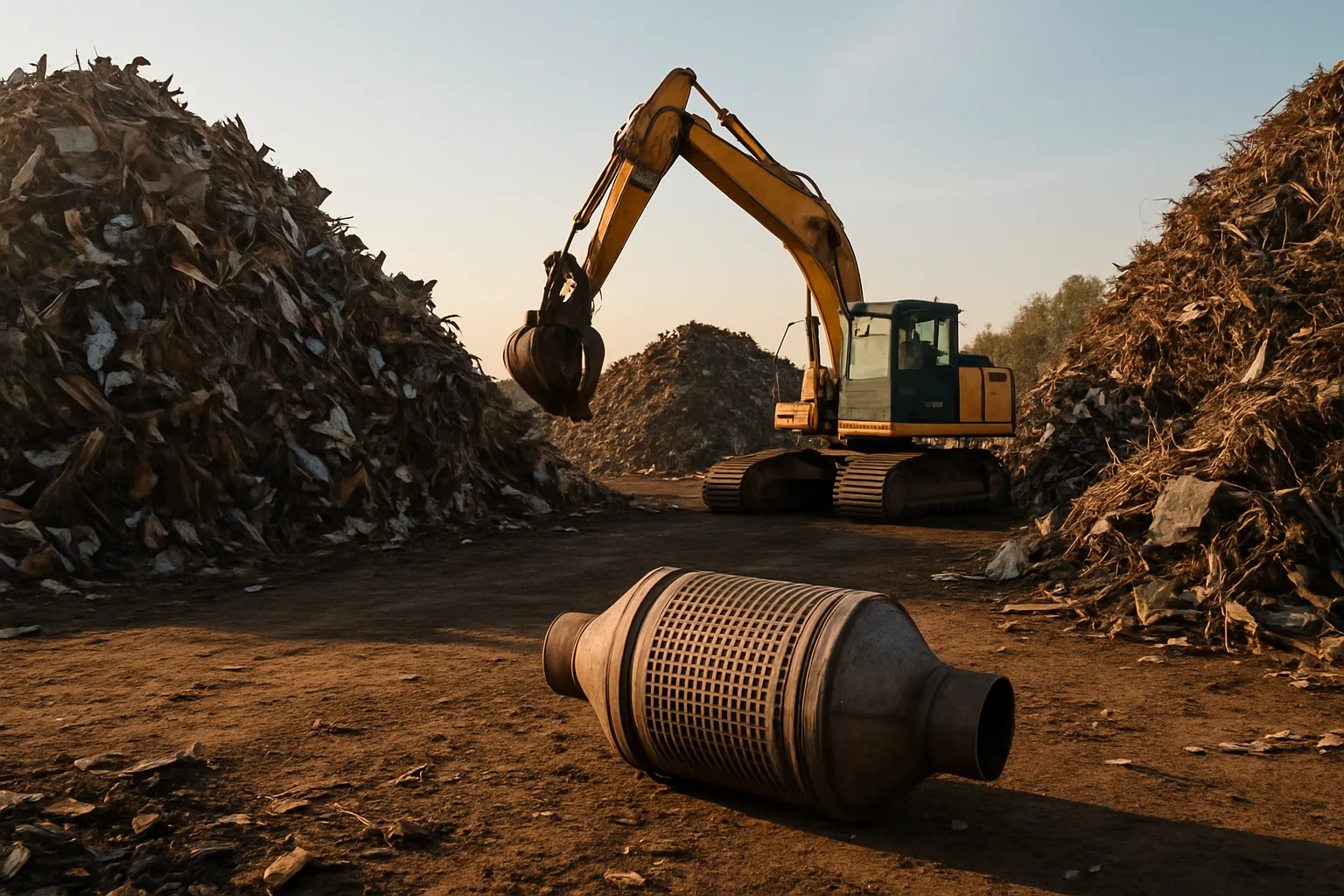
Why Your Converter's Value Starts Thousands of Miles Away
Most sellers think a catalytic converter's scrap value is set by whoever buys it locally. It isn't. The real number starts in London, Zurich, and Shanghai — where platinum, palladium, and rhodium trade on open markets every business day. If you're trying to find a reliable catalytic converter buyer Windsor and you don't understand how those markets move, you're walking into a negotiation blind.
This guide breaks down exactly how global precious metal markets flow downstream into the price you get quoted at the yard — and how to use that knowledge to sell smarter. Whether you're clearing a single converter or moving a pallet of cores, the same fundamentals apply.
The Three Metals That Drive Every Converter Quote
Catalytic converters work because of three platinum group metals (PGMs): platinum (Pt), palladium (Pd), and rhodium (Rh). Each one does a specific job in the catalyst washcoat. Each one trades independently on global commodity markets. And each one swings in price based on completely different supply and demand forces.
Here's a quick breakdown of how each metal behaves:
- Platinum: Historically the most recognized PGM. Supply is heavily concentrated in South Africa (roughly 70–80% of global mine output). Demand comes from diesel vehicles, jewelry, hydrogen fuel cells, and industrial applications. Platinum often trades at a discount to palladium, which surprised a lot of people who remembered when it commanded a massive premium.
- Palladium: Dominant in gasoline-engine converters. Russia and South Africa together account for the bulk of global mine supply — which means geopolitical disruptions can spike the price hard and fast. Palladium saw historic highs in recent years before correcting as automakers worked to substitute platinum in some applications.
- Rhodium: The wild card. Found in small quantities in the converter washcoat but can be worth multiples of platinum or palladium per troy ounce. Rhodium supply is extremely thin and almost entirely tied to South African platinum mining as a byproduct. When rhodium spikes, converter scrap values move dramatically — sometimes overnight.
The ratio of these three metals in any given converter varies by make, model, engine type, and year. That's exactly why how much is my catalytic converter worth by serial number is one of the most searched questions in the scrap industry — because serial numbers let experienced buyers look up the assay data tied to that specific unit without cutting it open first.
How Market Prices Flow Downstream to Your Yard
Here's the chain. Spot prices for platinum, palladium, and rhodium are set daily on the London Platinum and Palladium Market (LPPM) and tracked in real time on commodities platforms globally. Processors — the large facilities that actually smelt and refine converter material — use those spot prices to calculate what they'll pay per unit for specific converter types. That data flows to mid-level buyers and recycling operations. Eventually, it reaches whoever is quoting you locally.
The problem? Every link in that chain takes a margin. And if your local buyer isn't updating their pricing against live market data — or if they're the only buyer you've called — you may be getting quoted last week's price, or a number built around their margin, not the current market. This is where transparency breaks down completely for individual sellers in markets like Windsor and across Ontario.
Platforms like SMASH Recycling — where verified buyers bid on your metal exist specifically to collapse that chain. Instead of one buyer quoting you a number with no context, multiple vetted buyers compete based on the same documented inventory. That's what actual price discovery looks like — and it's the difference between guessing and knowing.
Comparing Converter Types: Why Not All Scrap Is Created Equal
Once you understand that PGM markets drive value, it becomes obvious why converter scrap prices vary so dramatically by unit. A diesel converter from a European passenger car might carry more platinum. A high-flow converter from a performance SUV might carry elevated palladium and rhodium. A spent OEM unit from a late-model truck may still hold more recoverable PGMs than a cheap aftermarket replacement from the same vehicle.
This is one reason catalytic converter recycling Windsor sellers often get inconsistent quotes — they're not comparing apples to apples, and neither are the buyers. Without proper identification and assay data, quoting is guesswork on both sides. Here's what affects value most:
- Serial number and make/model: Allows cross-referencing against known assay databases. Legitimate buyers use this. If your buyer won't quote by serial, ask why.
- Substrate condition: A shattered or melted substrate loses recoverable PGMs. Physical damage matters.
- OEM vs. aftermarket: OEM converters consistently carry higher PGM loadings than aftermarket units. Aftermarket pieces are often worth a fraction of the OEM equivalent.
- Vehicle origin and engine type: Diesel vs. gasoline, domestic vs. import, light-duty vs. heavy-duty — all affect which metals are present and in what concentrations.
- Market conditions at time of sale: Rhodium at a high means certain units spike in value. Palladium in correction means others soften. Timing is real.
To find the best scrap converter prices in Canada, you need buyers who are actually working from current market data and proper unit identification — not ballpark estimates from memory.
Is Platinum Recyclable — and Does It Actually Get Recovered?
Is platinum recyclable? Absolutely — and it's one of the most efficiently recycled metals on the planet. Recovery rates for PGMs from catalytic converters run high precisely because the economics justify the sophisticated smelting and refining process. Secondary supply (recycled PGMs) plays a meaningful role in global market balance. When primary mine supply tightens, recycling supply becomes even more critical — which pushes processor demand for converter scrap higher.
For sellers, this matters because it means the market for your converters isn't going away. Automakers, refineries, and industrial manufacturers actively need secondary PGMs. The recycling chain exists, it's functioning, and it pays — provided you're selling to buyers who are actually connected to that chain and quoting you based on real recovered metal value.
What you want to avoid are intermediaries who aren't transparent about how they're pricing your units relative to spot. A reputable catalytic converter buyer Windsor should be able to tell you which metals they're looking at and how current market prices inform their number. If they can't or won't, that's a signal worth paying attention to.
What "Scrap Metal Prices Today" Actually Means for Converter Sellers
When people search scrap metal prices today, they're often looking for a single number. That's not quite how it works with converters. Your converter isn't priced like a pound of copper wire. It's priced based on its specific PGM loading, the current spot prices for each of those metals, processing costs, and what a buyer calculates as their margin.
What you can track as a seller:
- Daily spot prices for platinum, palladium, and rhodium (publicly available through LPPM and major commodity platforms)
- General market direction — is palladium trending up or down this week?
- Rhodium volatility — even small moves in rhodium can shift converter values meaningfully
- Currency exchange — since PGMs trade in USD globally, CAD/USD movement affects what Canadian sellers see in domestic quotes
For Windsor sellers specifically, currency plays a real role. Scrap metal prices today in CAD terms shift even when PGM spot prices are flat, purely because the exchange rate moved. A strong USD means more CAD per ounce recovered. A weaker USD compresses the number. This is another layer of market exposure that most local buyers don't explain — but it's baked into every quote you receive.
To check current Canadian scrap converter prices with live market context, you need a pricing tool or platform that updates based on real PGM spot data — not a static price list that gets updated whenever someone remembers to change it.
How to Sell Smarter in Windsor and Across Ontario
You now know that your converter's value is driven by three globally traded metals, flows through a chain of buyers and processors, varies dramatically by unit type and condition, and shifts daily based on spot markets and currency. So what do you actually do with that?
A few practical steps for sellers in Windsor and across Ontario:
- Document your units properly. Serial numbers, photos, vehicle information. This isn't bureaucracy — it gives buyers the data they need to quote accurately, which benefits you.
- Get multiple quotes. One buyer quoting you a number is not a market. It's an offer. Competition is what reveals whether that offer is fair.
- Watch PGM markets before you sell. If rhodium has been climbing for two weeks, waiting a few days might be worth something. If palladium just dropped hard, selling into that correction may not be the right move.
- Understand OEM vs. aftermarket before you sort. Don't mix high-value OEM units with low-value aftermarket pieces and accept a blended price on the lot.
- Use platforms built for this. SMASH was built specifically for scrap and recycling operations. Vetted buyers, documented inventory, competitive bidding — that's how you stop guessing at price and start discovering it.
Local Windsor scrap metal services connected to a broader buyer network give you far more pricing leverage than a single call to whoever happens to be nearby. And for sellers who want to go deeper on how pricing works before their first sale, you can read Canadian scrap converter pricing guides that break down the mechanics in plain language.
The market is real, the metals are valuable, and the information exists to help you sell well. You just have to use it. When you're ready to stop leaving money on the table, the place to start is best-scrap-converter-prices.ca — where you can get a free quote built on current PGM market data, not guesswork.
Frequently Asked Questions
Q: How does the price of palladium affect what a catalytic converter buyer in Windsor will pay me?
Palladium is one of the three primary PGMs in catalytic converters, and it's especially prevalent in gasoline-engine vehicles. When palladium spot prices rise, buyers with access to current market data will quote higher on palladium-heavy units. If your local buyer isn't updating quotes against live spot prices, you may not see that increase reflected in your offer — which is exactly why getting multiple quotes matters.
Q: How much is my catalytic converter worth by serial number?
Serial numbers allow buyers to cross-reference your specific converter against published assay databases that show the expected PGM loading for that unit. This gives a far more accurate quote than visual inspection alone. The actual dollar value depends on current platinum, palladium, and rhodium spot prices at the time of sale, so the number changes day to day.
Q: Is platinum recyclable from catalytic converters?
Yes — platinum is one of the most efficiently recycled metals in the world, and catalytic converters are a primary source of secondary platinum supply globally. The smelting and refining process used by processors recovers platinum (along with palladium and rhodium) at high rates. This is why converter scrap commands real value in the recycling market.
Q: Why do scrap converter prices in Windsor vary so much between buyers?
Different buyers have different levels of access to current PGM market data, different relationships with processors, and different margin structures. Some buyers update pricing daily against live spot markets; others work from older price lists. Using a competitive platform like SMASH forces buyers to sharpen their numbers — because they know other buyers are bidding on the same load.
Q: Does the CAD/USD exchange rate affect what I get for my catalytic converter in Canada?
It does. Platinum, palladium, and rhodium all trade globally in USD. When Canadian sellers receive quotes in CAD, those numbers are influenced by the current exchange rate. A stronger USD relative to CAD means more Canadian dollars per ounce of recovered PGMs — even if the USD spot price didn't move. It's one more reason to track market conditions before you sell.
Disclaimer: Precious metal spot prices fluctuate daily. All converter values referenced in this article are for illustrative purposes only. Always check current PGM market rates and get live quotes before selling.
Follow SMASH on LinkedIn for ongoing market updates, scrap metal pricing insights, and industry news across North America.