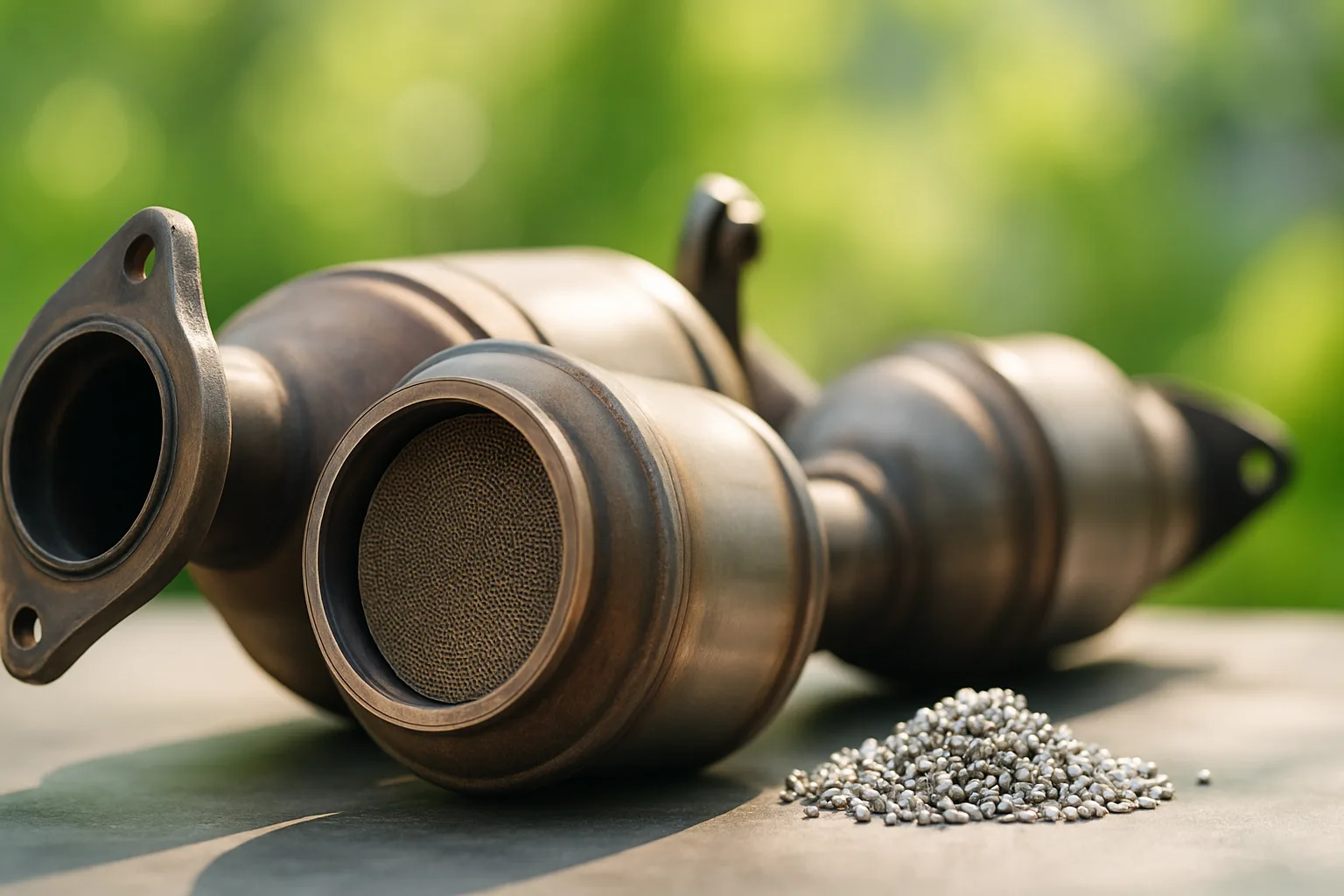
Why Hybrid Catalytic Converters Are Worth More at the Scrap Yard — August 2026 Market Recap
Most converter sellers focus on what's sitting in their yard right now. But here's what's changing the market in 2026: hybrid vehicles are aging out of their first and second ownership cycles, and the cats coming off them are consistently more valuable than what you'd pull from a comparable gas-only vehicle. If you're in Medicine Hat trying to understand cat converter prices and why your quote looks different depending on the vehicle, this is the piece you need to read.
This week's roundup breaks down why hybrid cats carry higher catalytic converter scrap value, what's inside them that drives that premium, and how to make sure you're getting a price that actually reflects what you're holding.
What's Actually Inside a Hybrid Catalytic Converter
A catalytic converter does one job: convert toxic exhaust gases into less harmful emissions before they leave the tailpipe. To do that, it relies on a washcoat loaded with platinum group metals — platinum (Pt), palladium (Pd), and rhodium (Rh). These are the metals that get priced, tracked, and traded on the global spot market every single day. The converter's scrap value is almost entirely a function of how much of these metals it contains.
Hybrid vehicles change the equation. In a hybrid drivetrain, the combustion engine doesn't run continuously — it shuts off when the electric motor takes over, then restarts. That stop-start cycle means the engine regularly operates at lower temperatures, which creates a dirtier, more variable exhaust stream during cold-start and restart events. To compensate, hybrid cats are engineered with a denser, more concentrated precious metal loading so they can hit emissions compliance targets even under those less-than-ideal thermal conditions.
The result: hybrid cats from vehicles like the Toyota Prius, Honda Accord Hybrid, Ford Escape Hybrid, and similar platforms often contain meaningfully higher loadings of palladium and platinum per unit than a standard cat from a gas-only vehicle of similar displacement. That's not speculation — it's an engineering requirement baked into the original design.
How Palladium and Rhodium Prices Affect Your Catalytic Converter Scrap Value in Alberta
Precious metal markets don't sit still. Palladium and rhodium in particular have a history of sharp swings, and those swings hit converter prices directly. Rhodium, while used in smaller quantities, has at times commanded prices that dwarf gold — and hybrid cats tend to carry a slightly elevated rhodium loading compared to standard units for the same emissions control reasons outlined above.
For sellers in Alberta, this matters because your local scrap price isn't set by your buyer — it's set by the global spot market for Pt, Pd, and Rh, then adjusted for assay results, processing fees, and the buyer's margin. If you're selling based on a flat rate posted on a whiteboard at a local yard, you may not be seeing the actual market. That gap between what you're offered and what the market supports is exactly what transparent pricing platforms exist to close.
Want to understand where the market sits today? You can find the best scrap converter prices in Canada and compare what you're being offered against current precious metal benchmarks before you accept a quote.
The broader trend for scrap metal recycling Canada-wide in 2026 is increased buyer sophistication. Processors are getting better at assaying quickly and bidding accordingly. That's good news for sellers — but only if you're selling into a competitive environment rather than accepting the first number you hear.
Cat Converter Prices Medicine Hat: What Local Sellers Should Know This Week
Medicine Hat is an active market. The region has a solid industrial and agricultural base, and as hybrid adoption climbs — even in pickup-heavy Alberta markets — more hybrid cats are entering the scrap stream. Dealerships cycling out trade-ins, independent mechanics, and fleet operators are all sitting on converters they may not be pricing correctly because they assume a cat is a cat.
It isn't. Not even close. Here's what creates the spread in cat converter prices Medicine Hat sellers are seeing right now:
- Vehicle platform matters. A Prius Gen 3 cat and a base-model Corolla cat are not worth the same. The hybrid unit will consistently assay higher.
- Condition affects value. Cracked substrates, heat damage, or rattling internals reduce the recoverable PGM content. Intact, undamaged cats command better prices.
- Your buyer's access to assay data matters. A buyer who can reference real assay history for your specific unit will price it more accurately — in your favour — than one guessing from a generic price list.
- Competition drives price. A single buyer giving you a number off the top of their head is not price discovery. Multiple buyers bidding on your inventory is.
If you're moving volume — multiple units per week or per month — you need a system, not a phone call. Read Canadian scrap converter pricing guides to understand how assay-based pricing works and why it almost always outperforms flat-rate buying.
Why the Hybrid Cat Premium Is a 2026 Story Worth Paying Attention To
Hybrid vehicle sales peaked in Canada over the past four years, and those vehicles are now hitting the age range where they enter the scrap stream in meaningful numbers. A 2018 or 2019 hybrid that's been through two or three owners, accumulated 200,000+ kilometres, and finally reached end-of-life in 2026 still has a fully viable cat on it — often with significant recoverable PGM value.
The scrap industry hasn't fully priced this in at the retail level. Yards that are still relying on decade-old price lists or generic catalytic converter scrap price list references may be significantly undervaluing hybrid units. That's an opportunity for informed sellers and a risk for anyone selling without doing their homework first.
Platforms like SMASH connect sellers with vetted buyers who bid competitively based on current assay data — not outdated flat rates. When you document your inventory properly (photos, VIN, unit condition), buyers have the information they need to bid with confidence, and competition can help reveal what the market actually supports. That's how sell your scrap metal on SMASH Recycling works — structured, transparent, and built for volume sellers who are done leaving money on the table.
For anyone in Medicine Hat or elsewhere in Alberta who hasn't explored auction-based selling for converters, now is the right time. The hybrid cat supply is growing. Buyers want access to quality units. That's a seller's market — if you're set up to take advantage of it.
How to Sell Your Hybrid Cats for the Best Scrap Converter Price in Canada
Knowing your converter is worth more is only half the battle. Getting paid what it's worth requires a process. Here's what actually moves the needle for sellers looking to maximize their catalytic converter scrap value:
- Identify your units accurately. Hybrid cats are often identifiable by the vehicle VIN, the converter serial number, or the physical size and configuration of the unit. Guessing is expensive. Use a lookup tool or a platform with serial tracking.
- Document everything. Photos of the substrate, the housing, and any identifying markings give buyers the confidence to bid higher. A mystery unit with no documentation gets discounted. A clean, documented unit gets competed over.
- Don't accept the first number. Whether you're in Medicine Hat or anywhere else in Canada, the first number you're offered is rarely the best number available. Get multiple buyers involved.
- Check the spot market. Platinum, palladium, and rhodium prices are publicly available. If your offered price doesn't move when spot prices move, you're not selling into a transparent market.
- Use platforms built for this. SMASH brings vetted buyers to your inventory through a competitive auction format. No subscription fees — they only earn when you sell. That alignment matters.
Before your next load moves, check current Canadian scrap converter prices to benchmark what you should be expecting. Walking into a negotiation with market data is not optional if you're serious about getting fair value.
Closing Thoughts: The Market Rewards Informed Sellers
The shift toward hybrid vehicles has quietly changed the scrap converter market. The cats coming off aging hybrids in 2026 aren't average units — they're engineered with higher precious metal loadings, and the global market prices that accordingly. If you're a seller in Medicine Hat, or anywhere across Alberta and beyond, treating every cat the same is costing you money.
Stay informed. Document your inventory. Sell competitively. The old way — one buyer, one phone call, one number — doesn't serve sellers. The market has moved on, and your pricing process should too. If you want to understand what your hybrid cats are actually worth in today's market, the right place to start is to find the best Canadian scrap converter prices — get a free quote at best-scrap-converter-prices.ca.
Stay ahead of the market — follow SMASH on LinkedIn for weekly scrap metal market insights, converter pricing trends, and industry updates you can actually use.
Frequently Asked Questions
Q: Why are hybrid catalytic converter prices higher than standard converters in Medicine Hat?
Hybrid cats are engineered with higher concentrations of platinum group metals — platinum, palladium, and rhodium — because hybrid engines run at lower and more variable temperatures that require denser precious metal loadings to meet emissions standards. That higher PGM content translates directly into higher catalytic converter scrap value at the yard.
Q: How do I find the best cat converter prices in Medicine Hat?
The best approach is to avoid single-buyer quotes and instead sell into a competitive environment. Platforms like SMASH connect you with vetted buyers who bid against each other based on real assay data. You can also benchmark your offers against current market rates at best-scrap-converter-prices.ca before accepting any quote.
Q: Does the condition of my hybrid cat affect the scrap price in Alberta?
Yes — significantly. A cracked or rattling substrate means damaged or lost precious metal material, which lowers the recoverable PGM content and reduces your payout. Clean, intact converters with documented condition information consistently command stronger prices because buyers can bid with confidence rather than discounting for uncertainty.
Q: What's the best way to identify a hybrid catalytic converter for accurate pricing?
Use the vehicle VIN and the converter's serial number to identify the specific unit. Many pricing platforms and buyers maintain assay databases tied to serial numbers, which allows for much more accurate pricing than visual inspection alone. Documenting the unit with clear photos also helps buyers verify what they're bidding on.
Q: Do scrap converter prices in Canada change based on the precious metals market?
Yes, and this is one of the most important things a seller can understand. Converter prices move with the daily spot prices for platinum, palladium, and rhodium on global commodity markets. If a buyer is offering you a flat rate that never changes regardless of what the market is doing, you're not getting a market-based price. Always check current rates before selling.
Disclaimer: Scrap converter prices fluctuate daily based on global precious metal spot prices. All price references in this article are general in nature. Always check current rates before selling your converters.