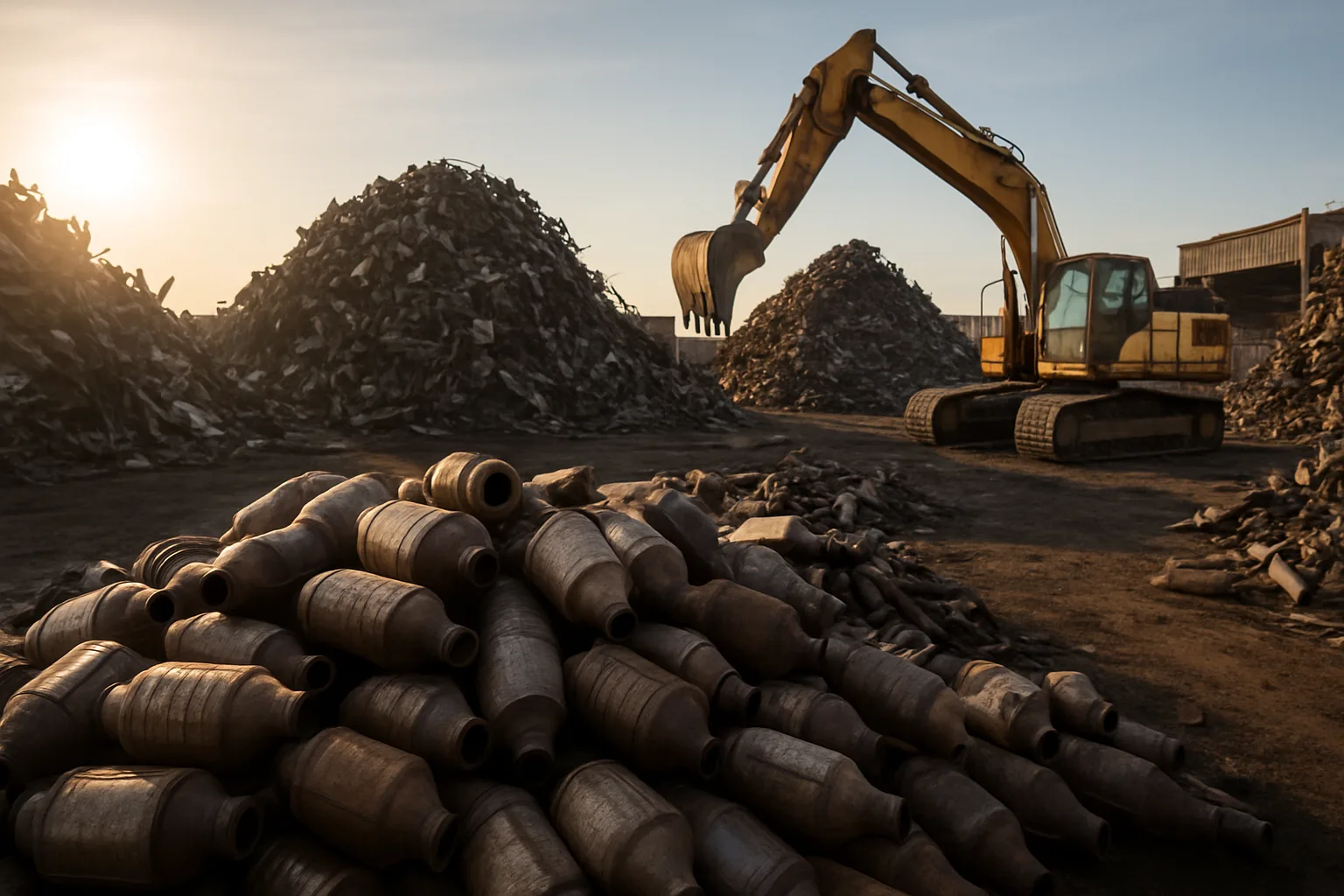
Most converter sellers focus on one number: what the buyer is willing to pay today. But very few understand why that number is what it is — and that gap costs them money. Understanding how catalytic converter scrap value gets determined, from the moment a cat leaves your yard to the moment a refinery produces a final settlement, gives you real leverage. It tells you what buyers are actually paying for, what moves the price, and where you stand in the chain.
This isn't theory. It's the process that drives every quote, every settlement, and every negotiation in the converter market — including right here in Kamloops and across British Columbia.
---What's Actually Inside a Catalytic Converter
Before getting into assaying and smelting, you need to understand what refineries are chasing. A catalytic converter contains a ceramic or metallic substrate coated with a washcoat that holds platinum group metals (PGMs) — specifically platinum (Pt), palladium (Pd), and rhodium (Rh). These three metals are the entire reason your scrap converter has value.
The concentration of PGMs varies significantly depending on the vehicle make, engine type, model year, and whether the unit is a diesel oxidation catalyst (DOC), a standard gasoline three-way cat, or a diesel particulate filter (DPF). A standard domestic cat might carry a modest PGM load, while a high-performance or emissions-critical unit can carry a load worth several times more. This is exactly why serial number identification matters — it connects a specific unit to known historical assay data, letting buyers estimate PGM yield before the converter ever reaches a furnace.
- Platinum: Used more heavily in diesel converters. Prices fluctuate with industrial and automotive demand.
- Palladium: Dominates gasoline converter formulations. The palladium price today is one of the strongest single indicators of what your gasoline cats are worth.
- Rhodium: Present in smaller quantities but historically the most volatile of the three — it can swing dramatically and accounts for a disproportionate share of value in many units.
No two converters are identical. Even two units with the same serial number from the same production run can vary slightly in PGM loading. This is why the assay process exists — it removes the guesswork and replaces it with chemistry.
---How Catalytic Converter Assaying Works: The Lab Process
Once a load of converters reaches a processor or refinery, the assay process begins. This is where catalytic converter scrap value gets measured with precision rather than estimated from a price sheet.
Here's the actual sequence:
- Decanning: The outer steel shell is cut or crushed to extract the ceramic or metallic substrate (the "brick" or "honeycomb"). The steel casing itself has ferrous scrap value, but the substrate is what matters here.
- Crushing and homogenization: The substrate is crushed into a fine powder. Large processors run thousands of units together, blending the material into a homogeneous lot. This is called "lot sampling." The larger the lot, the more statistically reliable the sample.
- Sampling: A representative sample is extracted from the blended lot. Typically, multiple samples are pulled from different points in the blended material to ensure accuracy. This sample weight is a small fraction of the total lot weight.
- Acid digestion and ICP analysis: The sample is dissolved in acid (typically aqua regia — a mixture of nitric and hydrochloric acids — which dissolves PGMs). The resulting solution is analyzed using Inductively Coupled Plasma (ICP) spectrometry, which identifies and quantifies each metal present at the parts-per-million level.
- Settlement calculation: The assay results are applied to the full lot weight to calculate total recoverable PGMs. After accounting for processing losses and refinery payables (typically expressed as a percentage of assayed content), the final settlement value is calculated.
This process typically takes 2–6 weeks depending on the refinery's throughput, the size of the lot, and any dispute sampling requested by the seller. Larger processors with established refinery relationships often have faster cycle times. If you're shipping converters from Kamloops or elsewhere in British Columbia, ask your buyer directly: what's the settlement timeline, and do they share assay certificates?
Transparency here is non-negotiable. A buyer who can't show you assay data is a buyer you should think twice about.
---Smelting and Refining: Turning Assay Data Into Actual Metal
Assaying tells you what's there. Smelting and refining are how you actually get it out.
After the assay lot is processed, the bulk material goes through pyrometallurgical smelting — high-temperature furnace processing that reduces the ceramic substrate to slag while concentrating the PGMs into a metallic collector phase (often a copper or iron alloy "matte"). This matte is then refined further through hydrometallurgical processes (acid leaching, solvent extraction, precipitation) to isolate pure platinum, palladium, and rhodium.
The key point for sellers: refinery payables are the percentage of assayed PGMs that the refinery actually pays out after accounting for process losses. A typical payable range is 85–97%, depending on the refinery, the contract terms, and the material quality. The difference between 87% payables and 95% payables on a large lot is significant real money. This is one reason why the processor you sell to — and who they process with — directly affects your bottom line.
When you get competitive bids for your scrap in Canada, you're not just shopping the spot price. You're also, indirectly, shopping refinery relationships, payable percentages, and settlement timelines. That context matters.
---How Serial Numbers and Databases Connect to Catalytic Converter Scrap Value
Before a converter reaches the assay floor, buyers use serial number databases to estimate value. Every major OEM converter has a known PGM loading based on design specs and historical assay averages. Processors and platforms maintain these databases to generate quotes without waiting weeks for lab results.
This is why how much is my catalytic converter worth by serial number is one of the most searched questions in this industry. A serial number lookup cross-references the unit against known assay averages and current PGM spot prices — platinum, palladium, and rhodium — to generate an estimated value. It's not the final settlement number, but it's a transparent starting point grounded in real data rather than a buyer's gut feel or margin target.
For sellers in Kamloops and across British Columbia, this matters practically. If you're sitting on a mixed load of domestic, import, and specialty units, serial-level identification helps you understand which units are carrying the most value — and whether a lump-sum offer from a single buyer is actually fair.
Platforms like SMASH are built around this kind of transparency. Instead of accepting one buyer's estimate at face value, you put your documented inventory — serial numbers, photos, weights — in front of multiple vetted buyers and let competition do the work. That's how you find the best scrap converter prices in Canada without leaving value on the table.
---What Moves Catalytic Converter Scrap Value Day to Day
Even with perfect assay data and a reliable refinery, your final settlement is still tied to live PGM markets. This is the variable nobody fully controls — but everyone needs to understand.
The three metals move independently based on different demand drivers:
- Palladium tracks closely with gasoline vehicle production and emissions regulations. The palladium price today can shift meaningfully on automotive sector news, supply disruptions from mining regions, or currency movements.
- Rhodium is thinly traded and highly volatile. It's produced in very small quantities as a byproduct of platinum and palladium mining, so supply shocks hit the price hard and fast.
- Platinum is influenced by diesel vehicle demand, industrial applications (including hydrogen fuel cells and glass manufacturing), and investment flows.
Most buyers price converters at a discount to spot — they need margin to cover processing costs, refinery fees, and settlement risk during the weeks between purchase and final assay. The more transparent the buyer is about their pricing formula, the better positioned you are to evaluate the offer fairly.
If you want to check current Canadian scrap converter prices and understand how today's PGM markets are affecting your load's value, don't rely on a single phone call. Use data. Use competition. Use platforms that show you what multiple buyers are willing to pay for documented inventory.
To go deeper on converter pricing methodology and market trends, read Canadian scrap converter pricing guides that break down the variables in plain language.
---Why Transparent Process Knowledge Helps You Sell Smarter
Understanding assaying and smelting isn't just academic. It directly changes how you approach selling. When you know that PGM payables vary by refinery, you ask better questions. When you know that serial number data drives pre-assay estimates, you document your inventory properly. When you know that palladium prices moved 4% this week, you time your sale with intent instead of habit.
Sellers who treat converters like any other scrap — weigh it, take whatever's offered, move on — consistently undervalue their loads. Sellers who understand the chain from brick to bullion negotiate from a position of knowledge.
For Kamloops scrap metal services, the same principle applies locally. Whether you're a yard operator sitting on a pallet of mixed cats or a shop accumulating cores over time, knowing how the assay process works tells you exactly what your buyer is calculating — and gives you the tools to push back when the offer doesn't reflect the chemistry.
SMASH exists to put that leverage in your hands. Vetted buyers, competitive auction format, documented inventory, no subscription fees. If you're ready to sell catalytic converters in British Columbia with the transparency the process actually deserves, that's the platform built for it.
When you're ready to move your load, get a free quote and find the best scrap converter prices in Canada — because the chemistry is working for you whether or not the buyer's offer reflects it.
Disclaimer: Catalytic converter scrap values fluctuate daily based on live PGM markets. All prices referenced are illustrative. Check current rates before making selling decisions.
---Frequently Asked Questions
Q: How does a refinery determine my catalytic converter's scrap value?
Refineries crush and blend converter substrates into a homogeneous lot, extract representative samples, and analyze PGM content using ICP spectrometry. The assay results — combined with your lot weight and the refinery's payable percentage — determine the final settlement. This is why lot size, documentation, and refinery relationships all affect your actual payout.
Q: How accurate are serial number price lookups for catalytic converters?
Serial number databases pull from historical assay averages for a given converter model and cross-reference current PGM spot prices to generate an estimate. They're useful as a pricing benchmark but aren't the same as a final assay settlement. Actual PGM loading can vary unit to unit, so serial-based quotes are best treated as a transparent starting point, not a guarantee.
Q: How long does it take to get paid after selling scrap converters in Kamloops or British Columbia?
Settlement timelines vary by processor and refinery. Upfront or "quick pay" offers give you cash faster but typically at a lower value than waiting for full assay results. Assay-based settlements usually take 2–6 weeks. Ask your buyer upfront what their settlement structure is and whether they provide assay certificates.
Q: What's the difference between palladium price and the price I get for my converters?
The spot price of palladium is the raw market price for pure palladium metal. What you receive for your converter is based on the estimated or assayed palladium content of that unit, multiplied by the spot price, then adjusted for refinery payables, processing fees, and the buyer's margin. The palladium price today sets the ceiling — your payout is a percentage of what's recoverable.
Q: Can I sell scrap catalytic converters online in British Columbia?
Yes. Platforms like SMASH let you list documented converter inventory — with serial numbers, photos, and weights — and receive competitive bids from vetted buyers across North America. This is increasingly how yards in British Columbia and across Canada are moving loads, particularly for sellers who want transparent price discovery rather than a single take-it-or-leave-it offer.
---Follow SMASH on LinkedIn at linkedin.com/company/scrap-metal-auction-sales-hub for industry updates, PGM market insights, and scrap metal news across North America.