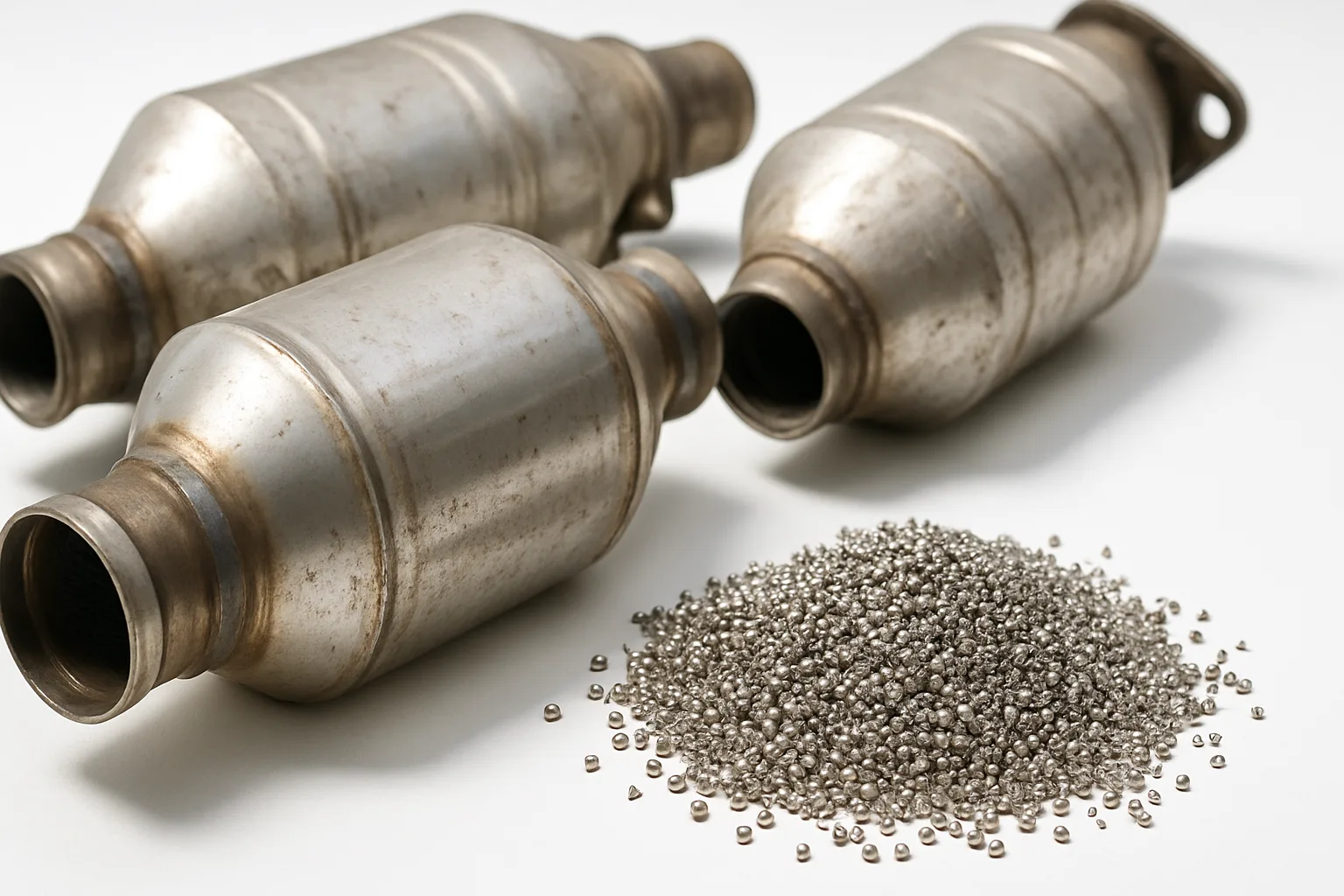
Rhodium, Palladium, and Platinum: Why Your Converter Is Worth More Than You Think
Most people selling a catalytic converter think about palladium. Few think about rhodium — and that gap costs them money. Rhodium is, by a significant margin, the most valuable precious metal loaded inside your converter. Understanding why it commands such a premium is the difference between selling blind and selling smart.
If you're holding scrap converters in Langley or anywhere else in British Columbia, this matters. The catalytic converter scrap value you're quoted by a single buyer may have almost nothing to do with what the actual metals inside are worth on the open market. Let's break down why rhodium sits at the top of the food chain — and what that means for your payout.
What Rhodium Actually Does Inside a Catalytic Converter
A catalytic converter does one job: convert toxic exhaust gases into less harmful emissions before they leave the tailpipe. That process requires specific chemistry, and rhodium is uniquely suited for one critical part of it. Rhodium handles the reduction of nitrogen oxides (NOx) — one of the most regulated pollutants in modern vehicle emissions standards.
Platinum and palladium oxidize hydrocarbons and carbon monoxide. Rhodium handles NOx. All three metals work together inside the ceramic or metallic substrate, but rhodium's role cannot easily be replaced. That irreplaceability is the first driver of its value.
- Platinum: Oxidation catalyst — handles hydrocarbons and CO in diesel and some gas converters
- Palladium: Oxidation catalyst — dominant in gasoline vehicles, lighter and efficient at lower temperatures
- Rhodium: Reduction catalyst — targets NOx specifically, used in virtually every three-way catalytic converter
There is no commercially viable substitute for rhodium in this application at scale. Automakers and chemical engineers have been searching for one for decades. That search has not succeeded. As long as internal combustion engines are on the road — and millions still are in 2026 — rhodium stays critical.
Why Rhodium Commands a Massive Price Premium Over Palladium and Platinum
Rhodium's scarcity is almost hard to comprehend. Global annual production of rhodium sits around 30 metric tons. Compare that to gold, which sees thousands of metric tons mined every year. Rhodium is a byproduct of platinum and palladium mining, primarily from South Africa's Bushveld Complex. There is no significant primary rhodium mining operation anywhere on Earth.
That supply structure makes rhodium extraordinarily sensitive to any disruption — labor strikes, power outages, political instability, or shifts in South African mining output. When supply tightens and demand holds firm (or increases, as tightening emissions regulations tend to drive), the price spikes hard. It has done exactly that multiple times over the past decade, and it will do so again.
The palladium price today reflects strong industrial demand and limited supply, but rhodium takes that dynamic to another level entirely. On a per-troy-ounce basis, rhodium has traded at multiples of both platinum and palladium during peak cycles. Even in quieter markets, it remains the most expensive of the three by a meaningful margin.
For you as a converter seller, here is the practical implication: a converter that carries a higher rhodium loading — typically a late-model, emissions-compliant vehicle from a major automaker — carries a meaningfully higher scrap value than an older, lower-loading unit. Knowing which you have, and finding a buyer who prices rhodium content accurately, is the whole game.
How Rhodium Content Varies Across Converter Types — and What That Means for Scrap Value
Not all catalytic converters carry the same precious metal loadings. The catalytic converter scrap value of any given unit depends on the vehicle it came from, the engine type, the model year, and the specific emission tier it was engineered to meet. Rhodium loading in particular has trended upward as emissions standards have tightened globally.
Here's a general breakdown of how converter types differ:
- Domestic (North American) full-size trucks and SUVs: Often carry two converters — front and rear. Higher overall precious metal content, including rhodium, to handle large-displacement engine output.
- Foreign (Japanese and European) vehicles: Often have high precious metal loadings relative to size, particularly for emissions-stringent markets. Some foreign cats are among the most valuable on the scrap market.
- Diesel converters: Typically lower in rhodium, higher in platinum. Diesel oxidation catalysts (DOCs) handle different chemistry and may include a separate DPF (diesel particulate filter) with no precious metals at all.
- Pre-OBD2 converters (pre-1996): Older units with lower precious metal loadings overall. Scrap value is generally lower.
- High-performance and late-model vehicles: Often carry the highest loadings across all three metals to meet strict modern standards.
Serial number and VIN-based lookup tools make it possible to identify specific converter grades without guessing. If you're finding the best scrap converter prices in Canada, that kind of precision matters — especially when you're selling multiple units and small per-unit differences add up fast.
Why Single-Buyer Pricing Leaves Rhodium Value on the Table
Here's the problem with the traditional way of selling scrap converters: you call one buyer, they quote you a price, and you take it or leave it. That buyer knows the rhodium content of your unit. You probably don't. That information gap is where margin gets extracted — from your pocket into theirs.
A buyer quoting you on a high-rhodium converter has every incentive to price it as a mid-grade unit. There's no competition forcing them to be accurate. No transparency. No second opinion. You're negotiating blind against someone who handles converters every day.
The SMASH platform was built to fix exactly this dynamic. Instead of one buyer setting your price, vetted buyers compete for your load. Competition, not charity, is what drives accurate pricing. More buyers bidding means better price discovery — and for high-value metals like rhodium, that discovery gap can be significant.
If you want to get competitive bids for your scrap in Canada, the auction model is the most transparent path available. You're not guessing. You're seeing what the actual market will pay for what you have.
Selling Catalytic Converters in Langley and British Columbia: What to Know Before You Sell
British Columbia has a robust recycling economy, and Langley sits in a well-connected corridor between Vancouver and the Fraser Valley — close to industrial buyers, processing facilities, and transportation hubs. If you're sitting on a pile of cores in Langley, you have geographic advantages. The question is whether you're using them.
Many converter sellers in Langley and across British Columbia are still doing this the old way: calling around to a handful of local buyers, comparing verbal quotes, and making a decision based on incomplete information. That method works. It just doesn't work well — not when rhodium content alone can swing a converter's value dramatically.
Platforms like SMASH connect Canadian sellers directly to vetted buyers across North America, creating a competitive environment rather than a single-buyer negotiation. You document your inventory — photos, serial numbers, converter grades — and let buyers compete. The photo documentation and serial tracking features mean buyers can price with confidence, which often translates to better offers.
Whether you're selling one load or dozens of cats, checking current Canadian scrap converter prices before you pick up the phone gives you context. You should know roughly what rhodium is trading at, what palladium is doing, and what grade of converter you're holding. That's not insider information — it's basic preparation.
For deeper context on how to approach this, reading Canadian scrap converter pricing guides is a practical starting point. The more you understand about what drives your converter's value, the harder it is for any single buyer to low-ball you.
How to Use Precious Metal Market Data to Negotiate Better Converter Prices
You don't need to become a metals trader to sell converters intelligently. You need a few data points and a basic understanding of how they connect to your inventory.
Here's a practical framework:
- Track the spot price of rhodium, palladium, and platinum. These are publicly available daily. Knowing whether rhodium is up or down from last week gives you context when a buyer quotes you a flat price per unit.
- Identify your converter grades. Use serial numbers and VIN lookups to categorize your inventory before quoting. High-grade, mid-grade, and low-grade converters are priced very differently.
- Document everything. Photos and serial tracking build buyer confidence. A well-documented load gives buyers fewer reasons to discount their bids.
- Use competition, not goodwill. Don't rely on a buyer being fair. Rely on multiple buyers competing. That's what drives accurate pricing on rhodium-heavy loads.
- Watch the trend, not just the day. Rhodium's price is volatile. Timing your sale during a high-rhodium price environment — even partially — can materially affect your return.
This is not complicated. It's the same logic any commodity seller uses. Apply it to your converter inventory and the results speak for themselves.
Disclaimer: Precious metal prices — including rhodium, palladium, and platinum — fluctuate daily based on global market conditions. All pricing references in this article are general in nature. Always check current market rates before selling.
Frequently Asked Questions
Q: Why is rhodium more valuable than palladium or platinum in a catalytic converter?
Rhodium is the only commercially viable metal for reducing nitrogen oxides (NOx) in three-way catalytic converters. Its global supply is tiny — roughly 30 metric tons per year — and it cannot be easily replaced. That combination of irreplaceability and scarcity drives its price well above both palladium and platinum.
Q: How does rhodium content affect the catalytic converter scrap value of my units?
Higher rhodium loading means a higher scrap value, sometimes significantly. Late-model vehicles and emissions-stringent foreign vehicles tend to carry more rhodium per unit. Identifying your converter grade before selling — using serial numbers or VIN lookups — helps ensure you're priced accurately for that content.
Q: Where can I sell catalytic converters in Langley, British Columbia?
Langley has local scrap and recycling buyers, but local options don't always mean competitive pricing. Platforms like SMASH connect you with vetted buyers across North America, creating real competition for your load. For the best outcome, get multiple bids rather than accepting the first offer you receive.
Q: Does the palladium price today affect what I get for my converters?
Yes — palladium is a significant component of catalytic converter scrap value, particularly for gasoline-engine vehicles. When palladium prices rise, converter values tend to follow. But rhodium moves independently and often more dramatically, so tracking both gives you a clearer picture of your inventory's worth.
Q: Is it better to sell catalytic converters online or to a local buyer near me?
It depends on how you sell online. A local buyer offers convenience but typically one price with no competition. Selling through a vetted auction platform means multiple buyers compete for your load, which creates better price discovery — especially for high-value units with significant rhodium content. The best result usually comes from transparency and competition, not proximity.
If you're holding scrap converters and want to know what they're actually worth in today's market, don't guess — find the best scrap converter prices in Canada and get a free quote at best-scrap-converter-prices.ca.
Follow SMASH on LinkedIn for ongoing industry updates, precious metal market insights, and scrap pricing intelligence across North America.