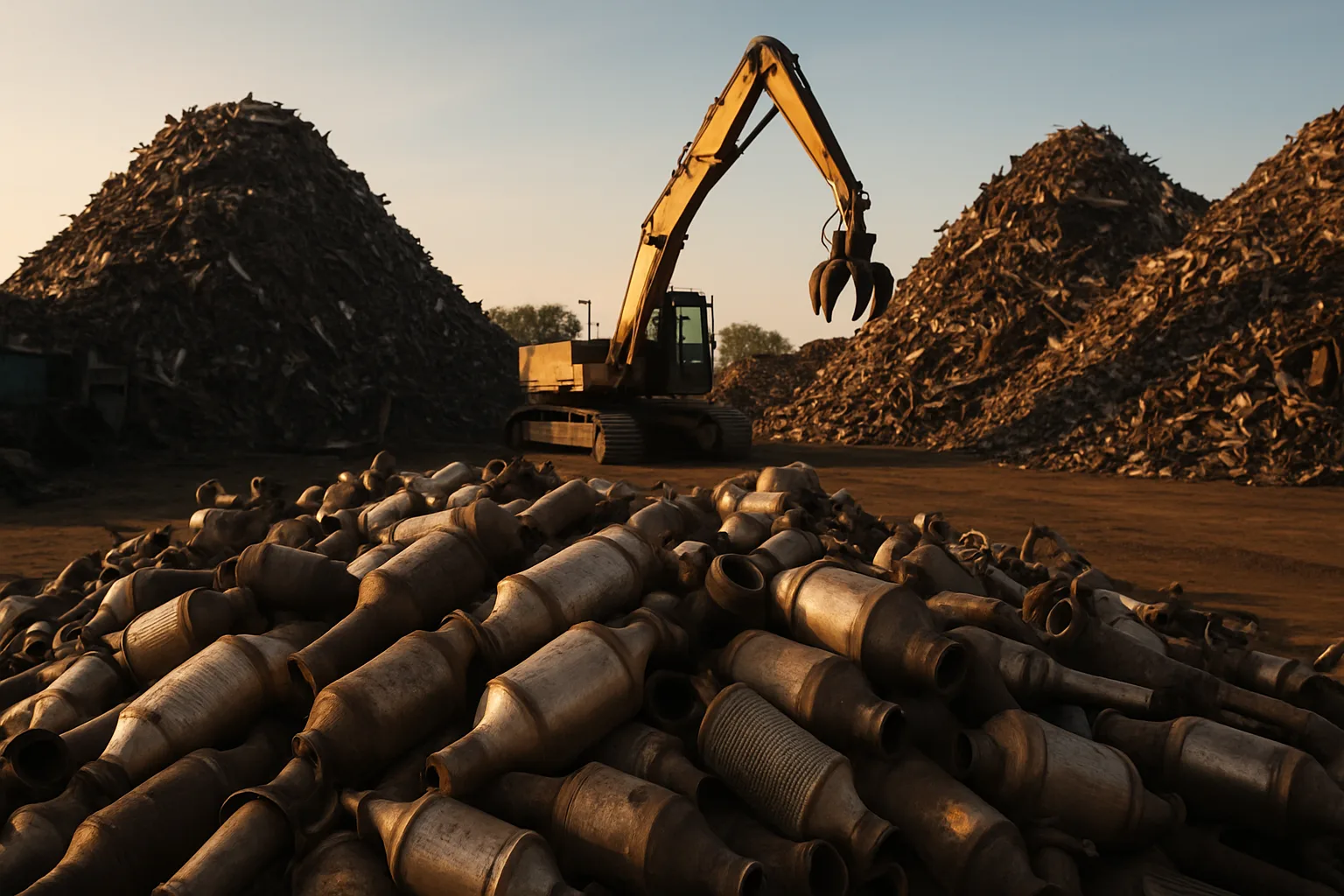
Most auto shops leave serious money on the table when they sell scrap catalytic converters. Not because they're doing anything wrong — but because they've never had a real system. One buyer, one price, no comparison. That's not a market. That's a guess.
If your shop pulls converters regularly — whether from trade-ins, insurance write-offs, or end-of-life vehicles — you're sitting on a recurring revenue stream that deserves more attention than a quarterly call to whoever picks up the phone. Catalytic converter prices today are directly tied to platinum group metals (PGMs): platinum, palladium, and rhodium. Those markets move daily. The price you accepted six months ago may look nothing like what your next load is actually worth.
This roundup breaks down practical tips for auto shops that want to stop guessing and start getting paid properly — including how tools like Canada's B2B scrap recycling marketplace can put real competition behind every load you sell.
Know What's Actually Inside the Converter Before You Quote It
The biggest mistake bulk sellers make is treating all converters the same. They're not. A converter off a 2019 diesel pickup carries a very different PGM loading than one pulled from a compact hybrid. The substrate material, the wash coat, the manufacturer, the engine size — all of it affects scrap value. If you're quoting by feel or by the pound, you're almost certainly leaving money behind on the high-value units.
This is where serial number lookup becomes essential. Knowing how much is my catalytic converter worth by serial number free isn't just a consumer question — it's a professional tool. Serial tracking lets you identify the converter model, cross-reference known PGM loadings, and present buyers with documented inventory instead of a mystery pile. That documentation changes the conversation. Buyers pay more when they know what they're getting.
- Pull the serial number from every converter before it goes into a bin
- Use a lookup tool to identify make, model, and approximate PGM range
- Document with photos — substrate condition, shell integrity, no de-canning damage
- Group converters by type for more accurate bulk pricing
When you find the best scrap converter prices in Canada, it starts with knowing exactly what you have. Guessing is not a pricing strategy.
Why Bulk Selling Without Competition Is a Losing Game
Here's the uncomfortable truth about single-buyer relationships: they're convenient for the buyer, not for you. When one buyer knows you'll call them every time, they have zero incentive to sharpen their offer. They're not competing. They're waiting. And that dynamic costs shops real dollars every single quarter.
The scrap converter market in Alberta — including shops pulling loads out of Lethbridge and surrounding areas — is active enough that competitive pricing is absolutely achievable. PGM prices don't care about geography. A converter worth a strong price in Calgary is worth the same in Lethbridge. What changes is whether anyone is bidding against each other to buy it. That's the gap a catalytic converter auction format closes directly.
Platforms like SMASH are built specifically for this. Instead of calling one buyer and hoping the offer is fair, you post your load, vetted buyers compete, and the market sets the price. More buyers means better price discovery. That's not a marketing line — it's basic economics. SMASH scrap auctions remove the single-buyer bottleneck that's been costing shops like yours money for years.
How to Document and Prep a Bulk Converter Load the Right Way
Documentation isn't just paperwork. It's leverage. A well-documented load moves faster, attracts more serious buyers, and supports a stronger final price. Auto shops that invest fifteen minutes per load in proper documentation consistently outperform shops that don't — not because the metal changed, but because the buyer's confidence is higher.
Here's what proper bulk converter documentation looks like for a serious sale:
- Serial number log — every unit recorded, no exceptions
- Photo set — top, bottom, substrate visible, no de-canned or hollowed units mixed in
- Converter type breakdown — domestic, foreign small, foreign large, diesel, DPFs listed separately
- Approximate count and weight — even rough weights help buyers plan logistics
- Condition notes — intact substrate, cracked substrate, or aftermarket (these price differently)
If you're selling regularly out of a Lethbridge shop, keeping a simple running spreadsheet of pulls by week makes this easy. You'll build a historical record, track your per-unit averages over time, and show buyers you run a professional operation. That reputation compounds. Serious catalytic converter buyers Alberta side-wide will prioritize your loads when you make their job easier.
You can also read Canadian scrap converter pricing guides to stay current on what documentation standards serious buyers expect in today's market.
Understanding How Catalytic Converter Prices Today Are Set
Catalytic converter prices today aren't arbitrary. They follow a formula tied directly to real-time PGM spot prices, and understanding that formula gives you negotiating power. The basic calculation works like this: the processor assays (tests) the substrate to determine exact PGM content, then pays based on those metals' current spot values minus processing, refining, and margin.
The three metals you care about are:
- Platinum (Pt) — used heavily in diesel converters and many domestic units
- Palladium (Pd) — dominant in gasoline converters, particularly foreign-make vehicles
- Rhodium (Rh) — present in smaller amounts but historically the highest-value of the three per ounce
PGM markets move every trading day. A load you quoted on Monday may price differently by Friday. This is why shops that sell on a fixed schedule without checking current rates often leave money behind — especially after a sharp upward move in palladium or rhodium. The habit of checking current Canadian scrap converter prices before you negotiate is worth developing. It takes two minutes and it reframes every conversation you have with a buyer.
The scrap catalytic converter price by model approach also matters here. High-load converters — think certain luxury SUVs, performance vehicles, or specific hybrid models — carry significantly more PGM per unit than economy car converters. Knowing your mix before you sell means you can sort your load to maximize how it's presented, rather than letting a buyer average down your best units against your lowest-value ones.
Building a Repeatable Selling Process for Your Shop
Shops that maximize their converter revenue don't just sell better once — they build a repeatable process that compounds over time. The goal is consistency: same documentation habits, same timing, same competitive channel every load. When that becomes routine, you spend less time managing it and more time confident you're being paid fairly.
A practical monthly rhythm for Lethbridge auto shops might look like this:
- Pull and log converters weekly as vehicles come through
- Run serial lookups on high-value or unfamiliar units
- Batch converters into a monthly or bi-monthly load (frequency depends on your volume)
- Document the load fully — photos, serial log, type breakdown
- Post through a competitive channel like SMASH to let buyers compete
- Review your per-unit average against previous loads to track performance
That sixth step is underrated. Tracking your averages creates accountability — to yourself and to the buyers you work with. If your per-unit average drops without a corresponding drop in PGM prices, something changed. Either your mix shifted or your pricing channel isn't performing. You won't catch that without data.
For shops managing Lethbridge scrap metal services alongside their primary auto work, having this process documented also makes it easy to hand off to another staff member without losing consistency.
What to Look for in a Serious Catalytic Converter Buyer
Not every buyer is worth working with. The converter market has enough complexity — and enough margin potential — that the buyer you choose matters as much as the price they quote. Serious buyers are transparent about how they price, prompt on payment, clear on logistics, and consistent across loads. Red flags are equally obvious: vague pricing explanations, slow payment, or quotes that seem to ignore current PGM moves.
Vetted buyer networks change this dynamic. When buyers have been screened before they can participate in an auction, you skip the tire-kickers and deal with professionals who close. That's a different experience than cold-calling recyclers from a web search and hoping someone makes a reasonable offer.
The best catalytic converter price Lethbridge shops can access isn't locked behind a geography advantage — it comes from creating real competition among vetted buyers, presenting well-documented loads, and selling at the right time relative to PGM market conditions. All three are controllable. None require luck.
Disclaimer: Catalytic converter prices fluctuate daily based on PGM spot markets. All pricing references in this article are general and informational. Always check current rates before finalizing any sale.
Frequently Asked Questions
Q: How are catalytic converter prices today calculated in Canada?
Prices are based on the platinum group metal (PGM) content inside the converter — specifically platinum, palladium, and rhodium. Buyers reference current PGM spot prices, then subtract processing, refining, and margin to arrive at a payout. Because PGM markets trade daily, converter prices move with them. Checking current rates before you sell is always worth doing.
Q: How do I find out how much my catalytic converter is worth by serial number for free?
Serial number lookup tools cross-reference the converter's manufacturer code against known PGM loading data for that specific model. Many platforms offer this at no cost. It gives you a realistic value range before you approach any buyer — which means you negotiate from a position of knowledge rather than guessing. Platforms like SMASH use serial tracking as part of documented inventory management.
Q: What's the best way for auto shops in Lethbridge to sell converters in bulk?
Document your load fully — serial numbers, photos, type breakdown — and sell through a competitive channel rather than a single buyer. A catalytic converter auction format puts real market competition behind your load, which drives better price discovery than a one-call negotiation. Shops in Lethbridge and across Alberta can access the same buyer networks as larger urban centers through platforms like SMASH.
Q: Does the make and model of a vehicle affect the scrap converter price?
Yes, significantly. PGM loading varies widely by manufacturer, engine type, and model year. Certain luxury vehicles, performance SUVs, and hybrids carry substantially more PGM per unit than economy cars. Sorting your load by converter type before selling — rather than mixing everything together — helps ensure your high-value units aren't averaged down against lower-value ones.
Q: Why should I use a catalytic converter auction instead of my current buyer?
A single buyer has no incentive to sharpen their offer if they know you'll sell to them regardless. An auction creates competition — multiple vetted buyers bid against each other, and the market sets the price. That's not guaranteed to be higher every time, but it removes the ceiling that a single-buyer relationship naturally creates. Competition can help reveal the true market value of your load.
If your shop pulls converters regularly, the process you use to sell them is either working for you or costing you. Documenting loads properly, understanding how PGM markets move, and creating real buyer competition are the three levers that actually move the needle. You can start putting all three to work today — just head over to best-scrap-converter-prices.ca to get a free quote and find the best scrap converter prices in Canada for your next load.
Stay current on market moves and industry updates by following SMASH on LinkedIn — practical scrap metal market insights, no filler.
```