The palladium price today is moving markets — and most converter sellers don't know why it matters to them. If you're sitting on a pile of cats and wondering what they're actually worth, this article breaks down exactly what's inside those units and how the precious metals market drives every quote you get.
Understanding what's inside a catalytic converter isn't just nerdy metallurgy. It's the difference between getting a fair price and getting low-balled. Whether you're running a scrap yard, pulling cores from trade-ins, or selling off a collection in St. Catharines scrap metal services, knowing your material puts you in control of the conversation.
What's Actually Inside a Catalytic Converter?
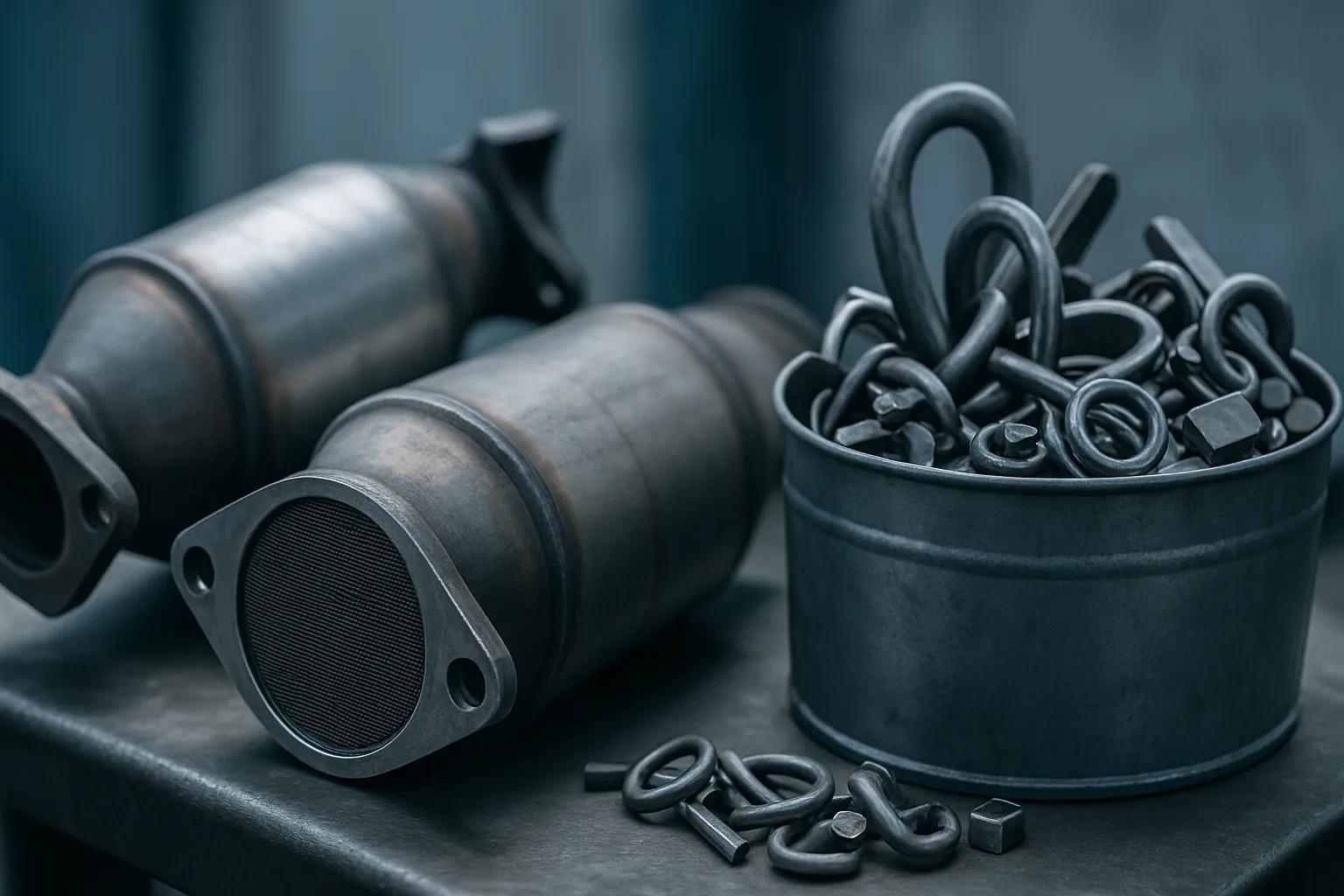
Cut one open and you'll find a ceramic or metallic substrate — typically a honeycomb structure — coated with a thin wash of platinum group metals (PGMs). Those PGMs are the whole story. The steel shell and the substrate carrier have minimal scrap value. What you're really selling is the precious metal loading inside.
Three metals drive converter value:
- Platinum (Pt) — Used across a wide range of converters, particularly in diesel applications and older gasoline vehicles. Platinum has historically been the backbone of converter chemistry, though its role has shifted as vehicle technology evolved.
- Palladium (Pd) — Now the dominant metal in most modern gasoline catalytic converters. Palladium is highly effective at converting hydrocarbons and carbon monoxide in petrol engines. It's also volatile in price, which makes the palladium price today one of the most-watched numbers in the converter recycling business.
- Rhodium (Rh) — Present in smaller quantities but punches far above its weight in terms of value per troy ounce. Rhodium handles NOx (nitrogen oxide) conversion. Even trace amounts matter at the refinery level.
The ratio of these three metals varies enormously by vehicle make, model, year, and emissions standard. That's why a catalytic converter price list by number exists — each converter part number corresponds to a known PGM loading profile, refined through assay data accumulated over years of processing.
Why the Palladium Price Today Drives Your Converter Quote
Palladium is the wild card. It's predominantly mined in Russia and South Africa, with limited supply diversification. That makes it sensitive to geopolitical events, mining disruptions, and industrial demand shifts from the automotive sector. In 2026, tightening emissions regulations across North America and continued EV adoption complexity have kept PGM demand for hybrid and ICE vehicles elevated — but the market still moves fast.
When you call a buyer and ask for a quote, they're running math in real time. They check the spot price for platinum, palladium, and rhodium, apply a recovery factor (what percentage of the loaded metals they can actually extract), factor in refining fees, and back-calculate what they'll pay you. The palladium price today can shift that number meaningfully — even intraday.
This is exactly why transparency matters. If you're selling through a single buyer with no competitive pressure, you have no way of knowing whether the quote reflects the market or reflects their margin. Platforms like find the best price for your scrap in Canada put multiple vetted buyers against each other — that competition is how price discovery actually works.
How PGM Loading Varies by Converter Type
Not all cats are created equal. A high-emitting truck converter from a large domestic V8 will carry a different PGM profile than a compact Japanese vehicle's primary cat. Here's a general breakdown of the categories that processors and buyers use:
- Domestic / North American cats — Often larger units with higher loading. Full-size trucks and SUVs from U.S. and Canadian manufacturers frequently carry heavier PGM content.
- Foreign / import cats — Typically smaller with lower loading by unit, but volume sellers in the used vehicle market. Price per unit is lower, but they move in high quantity.
- Pre-OBD converters (pre-1996) — Older units that predate modern emissions standards. Often platinum-dominant. Lower volume in today's market.
- High-value / specialty units — Certain European makes, large diesel applications, and aftermarket replacements designed for performance or stricter emissions standards. These can carry outsized PGM loading.
- Aftermarket / direct-fit replacements — Generally low PGM loading. Buyers discount these significantly versus OEM units.
- DPFs (Diesel Particulate Filters) — Not traditional converters but increasingly processed for PGM recovery. Different pricing logic applies.
Using a catalytic converter price list by number and a reliable catalytic converter scrap price lookup tool lets you identify where each unit you're holding falls on this spectrum before you take any offer. Selling blind is how yards leave real money on the table. You can read Canadian scrap converter pricing guides to get sharper on how these categories are priced in the Canadian market.
Scrap Catalytic Converter Prices in St. Catharines and Ontario
If you're operating in St. Catharines or anywhere in the Niagara region of Ontario, you're in a competitive secondary metals market. Southern Ontario has a dense concentration of automotive dismantlers, recycling yards, and buyers — which is good news for sellers who know how to work it.
Local scrap catalytic converter prices in St. Catharines track global PGM spot markets, but your effective yield depends on which buyer you access and how well your inventory is documented. A load of mixed, unsorted cats submitted with no part numbers, no photos, and no assay data will get priced conservatively. The buyer is managing their risk by pricing yours in.
Flip that dynamic. Document your units. Use VIN lookup and serial tracking where possible. Sort by known categories. That's not extra work — it's how you access the top tier of the market. Ontario sellers who treat their converter inventory as a managed asset consistently do better than those who dump and hope.
To find the best scrap converter prices in Canada, you need both price transparency and competitive access. Those two things together are what move the needle on your returns.
Scrap Metal Inventory Management — Why It Matters for Converter Sales
Here's where yards often leave money on the table: they focus on price but neglect documentation. Scrap metal inventory management for catalytic converters means building a trackable record of what you have before you go to market — not after.
Good inventory practice for converter sellers includes:
- Photo documentation — Both ends of the unit, the honeycomb face, and any visible part number or OEM stamp.
- Part number capture — Even a partial number helps a buyer cross-reference the unit against known assay data.
- VIN or vehicle source logging — Knowing the donor vehicle improves confidence in the unit's identity, especially for high-value domestic cats.
- Sort and batch by category — Mixing high-value and low-value units in one lot drags your average price down. Sort before you sell.
- Weight documentation — Total lot weight and unit count. Buyers need this to structure offers.
SMASH's inventory tool is built for exactly this workflow. You can document your converter inventory before listing, giving buyers the data they need to bid with confidence. More confidence from buyers means tighter spreads and stronger competition on your loads. That's how the system is supposed to work — and why scrap metal inventory management isn't a back-office chore. It's a revenue lever.
How to Get the Best Converter Scrap Value in Canada
The market is available to everyone. The question is whether you're accessing it well or leaving return on the table. Here's what top-performing converter sellers do differently:
- They watch the palladium price today the same way a commodity trader watches futures. Not obsessively, but regularly. When PGMs are elevated, they move inventory. When markets are soft, they hold if possible.
- They don't sell to the first buyer who calls. They generate competition. Multiple offers reveal the real market. One offer reveals one buyer's margin target.
- They document everything. Photos, part numbers, weights, vehicle source. Documentation is leverage.
- They use platforms that work for them. SMASH puts your documented converter inventory in front of vetted buyers who compete for it. No subscription fees. The model only works when you win.
If you're in St. Catharines, Ontario, or anywhere across Canada, the path to better converter returns runs through better information and better access — not luck. To check current Canadian scrap converter prices and understand what your material is actually worth, start with real data and real competition.
When you're ready to sell, don't guess. Get documented, get competitive quotes, and make the market work for you. Start at best-scrap-converter-prices.ca for a free quote on your converter inventory — no obligation, no subscription, just real pricing from a market that has to compete for your business.
Frequently Asked Questions
Q: How does the palladium price today affect what I get paid for my scrap catalytic converters?
Palladium is the dominant precious metal in most modern gasoline catalytic converters. Buyers calculate your offer using live PGM spot prices — platinum, palladium, and rhodium — against the estimated metal loading in your units. When the palladium price today is high, your cats are worth more. When it drops, your offers follow. Watching spot prices before you sell helps you time the market and negotiate from a position of knowledge.
Q: Where can I find a catalytic converter price list by number in Canada?
Reliable converter price databases cross-reference part numbers against assay data to estimate PGM loading and assign a price range. Several online lookup tools exist, but accuracy varies. For Canadian sellers, platforms like SMASH connect you to buyers who use current market pricing, not outdated lists. The best approach is to combine a lookup tool with competitive quotes to validate what you're seeing.
Q: What are scrap catalytic converter prices like in St. Catharines right now?
Converter prices in St. Catharines track global PGM markets the same as anywhere in Ontario — local variation comes from which buyers you have access to, not a fixed regional premium or discount. The key is generating competition among buyers. A single local buyer sets the price. Multiple vetted buyers competing for your load reveals the actual market. Visit best-scrap-converter-prices.ca for current pricing context.
Q: Does documenting my converter inventory actually change what buyers offer?
Yes — significantly. Buyers price risk. If they can't identify your units, they assume lower value and widen their margin buffer. Documented inventory with photos, part numbers, and vehicle source data gives buyers confidence to bid tighter. Better documentation consistently supports stronger offers, especially on high-value domestic and specialty converter units.
Q: What's the difference between OEM and aftermarket catalytic converters for scrap value?
OEM (original equipment manufacturer) converters carry significantly higher PGM loading than aftermarket replacements. Aftermarket cats are designed to meet minimum emissions standards at lower cost — that means less precious metal per unit. When sorting your inventory, separate aftermarket units clearly. Mixing them with OEM units in a single lot pulls your average price down. Most experienced buyers will identify the mix anyway and adjust their offer accordingly.
Follow SMASH on LinkedIn for industry updates, scrap metal market insights, and converter pricing news across North America.