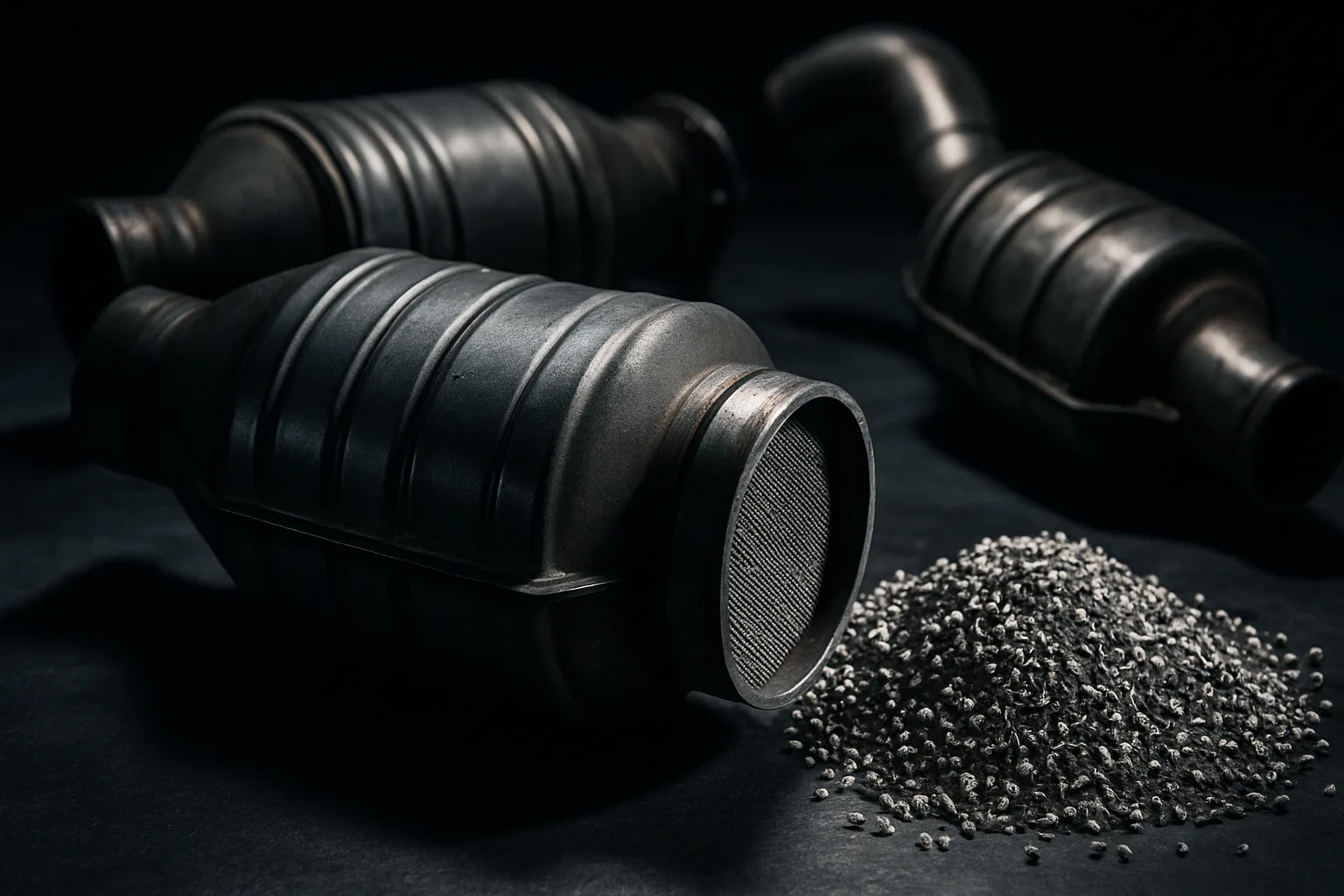
What's Actually Inside Your Catalytic Converter — and Why It's Worth Real Money
Most people have no idea that the converter bolted to their exhaust system contains some of the most valuable metals on earth. Platinum, palladium, and rhodium — three precious metals mined in some of the world's most remote deposits — are packed into a ceramic substrate the size of a coffee can. If you're in Dartmouth trying to get the best catalytic converter price Dartmouth yards will offer, understanding what drives that price puts real money back in your pocket.
This isn't abstract chemistry. The precious metal content inside your cat determines its scrap value almost entirely. Get that number wrong — or let a single buyer low-ball you without competition — and you leave serious cash on the table. Here's how the pricing actually works, and how to make sure you're not the one getting the short end of it.
The Three Metals That Determine Your Converter's Scrap Value
Every catalytic converter contains some combination of platinum (Pt), palladium (Pd), and rhodium (Rh). These metals act as catalysts — they trigger chemical reactions that convert harmful exhaust gases into less harmful emissions. That function makes them irreplaceable in automotive manufacturing. It also makes spent converters worth recycling.
Here's what you need to know about each metal:
- Platinum: The most historically well-known of the three. Diesel converters tend to be heavier in platinum content. Prices fluctuate based on mining output (primarily South Africa and Russia), industrial demand, and investor sentiment. Platinum has historically traded at a significant discount to palladium over the past several years, a reversal from the early 2000s.
- Palladium: Dominant in gasoline-engine converters, which covers most vehicles on Canadian roads. Palladium saw dramatic price spikes in the early 2020s driven by supply constraints and surging gasoline vehicle production. It remains a high-value metal and a major contributor to converter scrap value.
- Rhodium: The wildcard. Rhodium concentrations are tiny — often a fraction of a gram per converter — but rhodium prices can dwarf both platinum and palladium on a per-troy-ounce basis. The rhodium price today is one of the most volatile data points in the converter market. Small price moves in rhodium create significant swings in scrap converter value.
The actual gram loading of each metal varies enormously by vehicle make, model, engine type, and year. A converter from a late-model import SUV won't carry the same value as one from a heavy-duty pickup. That variation is exactly why a generic "price list" — regardless of where you saw it — can't replace assay-based pricing tied to real market data.
How Scrap Yards Calculate What They'll Pay You
Legitimate converter buyers aren't guessing. They're working from one of two pricing methods: a published converter grade list (which assigns grades like "regular domestic," "large domestic," or "foreign cat" categories), or direct assay-based pricing where the converter is physically sampled and its precious metal content is measured.
Grade-list pricing is faster but less precise. Assay pricing is slower but reflects actual metal content. The gap between those two approaches — and between individual buyers — is where your money either gets protected or lost.
Most converters are priced using the following formula:
- Identify the converter type — often by serial number, OEM part number, or visual inspection. Platforms with serial tracking and photo documentation make this step faster and more accurate.
- Reference current precious metal spot prices — platinum, palladium, and rhodium are priced in USD per troy ounce on global commodity markets. These numbers change daily.
- Apply recovery rates — smelters don't recover 100% of the metal. Buyers build in processing costs and recovery factors.
- Subtract processing and handling margins — the buyer's cut for sourcing, shipping, and smelting.
What's left is your offer. The problem? If only one buyer runs this math on your load, you have no way to know if their margins are fair or inflated. That's the core issue with the old model — one call, one number, take it or leave it.
Why Dartmouth Sellers Should Never Rely on a Single Quote
Dartmouth is a working industrial port city. Scrap moves here. There are yards operating in the region, and buyers are active. But geography has historically worked against sellers in Atlantic Canada — fewer local buyers means less natural competition, which compresses offers.
If you're selling converters in Dartmouth or anywhere in Nova Scotia, you're not limited to the closest catalytic converter scrap yard near me result on your phone. Online auction platforms have changed that equation. When your load goes to competitive bidding, buyers from across North America can price it. That's a fundamentally different outcome than a single yard offer.
Platforms like get competitive bids for your scrap in Canada — SMASH runs vetted buyers through an auction format, so your converters aren't priced by whoever answers the phone first. The market sets the number. You see the bids. You decide.
That transparency matters even more when rhodium prices are moving. If rhodium spiked yesterday and your local yard is still quoting last week's rate, you're the one absorbing that gap. Real-time market-linked pricing closes it.
Precious Metal Volatility and What It Means for Your Timing
Converter scrap value doesn't stay still. It moves with the spot markets — sometimes daily, sometimes dramatically. Rhodium in particular has seen price swings of hundreds of dollars per troy ounce within single trading weeks. Palladium has its own cycles tied to automotive production forecasts and Russian supply dynamics. Platinum trends closely with diesel vehicle adoption and South African mining output.
For sellers, this creates a real timing question. Do you sell now or hold? There's no universal right answer — that depends on your read of the market and your cash flow situation. What you can control is making sure that whenever you do sell, you're getting offers anchored to current spot prices, not a flat rate a buyer set three months ago.
To check current Canadian scrap converter prices, you need a source that updates with the markets — not a static price list. If a buyer can't explain how their offer connects to today's platinum, palladium, and rhodium spot prices, that's a red flag worth noting.
The scrap metal recycling Canada market has matured significantly. Buyers are sophisticated. The pricing infrastructure exists to be transparent. The question is whether you're plugged into it or still operating on the old handshake model.
Documentation: The Hidden Factor That Affects Your Price
Here's something most sellers overlook. The condition and documentation of your converter load affects what buyers are willing to pay — and how confidently they bid.
A load of converters with clear photo documentation, serial numbers recorded, and accurate packing lists gets priced differently than a pile of mystery cats in a drum. Buyers assume risk when they can't assess what they're buying. They price that risk in — meaning lower offers for undocumented loads, higher offers when the inventory is clean and verifiable.
Smart sellers document their loads before they go to market:
- Photograph each converter individually, including both ends and any visible markings
- Record serial numbers or OEM part numbers where legible
- Note the vehicle make, model, and year if known (especially for high-value foreign cats)
- Keep an accurate count and note any damaged, cut, or de-canned units separately
SMASH builds this into the platform. The inventory tool and photo documentation features exist specifically to give buyers enough information to bid aggressively. More buyer confidence, more competitive bidding — that's how documentation translates directly into better price discovery for you. To find the best scrap converter prices in Canada, the quality of your documentation is one lever you actually control.
How SMASH Changes the Game for Canadian Converter Sellers
The traditional converter sale goes like this: you call a yard, they give you a number, you either take it or you don't. If you don't, you start over with someone else. By the time you've made three calls, the market may have moved and your information is stale.
The SMASH scrap metal auction model runs differently. Your load is listed, documented, and put in front of multiple vetted buyers simultaneously. Those buyers compete. You see real bids. No subscription fees — SMASH only earns when you sell. That alignment matters.
For sellers in Dartmouth and across Nova Scotia, this isn't just convenient — it's a structural fix to a market access problem that geography used to create. You're not limited to buyers who can physically reach you. Any vetted buyer on the platform can price your load.
Want to read Canadian scrap converter pricing guides to understand more about how the market works before you sell? Start there. Then, when you're ready to move your load, the platform is built to handle the rest — from inventory documentation through to auto-invoicing.
If you're holding converters and wondering whether now is the right time to sell, the best move is getting real offers from real buyers against today's spot prices. That's what competitive pricing looks like. Find the best Canadian scrap converter prices and get a free quote at best-scrap-converter-prices.ca — no guesswork, no single-buyer guessing games.
Frequently Asked Questions
Q: How do I get the best catalytic converter price in Dartmouth?
The single biggest factor is competition. One local buyer quoting you a flat rate is not the market — it's one opinion. Getting your converters in front of multiple vetted buyers through an auction platform gives you actual price discovery. Document your load well, know your converter types, and anchor your expectations to current platinum, palladium, and rhodium spot prices.
Q: Why does the rhodium price today matter so much for my converter's value?
Rhodium is present in tiny quantities in most converters, but it trades at an exceptionally high price per troy ounce — often multiples of platinum or palladium. Small daily moves in the rhodium spot price can meaningfully shift the value of a full load of converters. Any buyer quoting you a static price without referencing current rhodium levels is likely not giving you a market-accurate offer.
Q: Is there a catalytic converter price list with pictures I can use to identify my converter's value?
Visual price lists exist, but they're approximations — and they go stale quickly as precious metal markets move. A converter that looks identical to a reference photo may have different metal loading depending on its production run or vehicle application. Serial tracking and platform-based identification tools give you a more accurate read than any static picture-based list.
Q: Can I sell catalytic converters from Nova Scotia to buyers outside the province?
Yes. Online auction platforms connect sellers in Nova Scotia — including Dartmouth — with vetted buyers across Canada and North America. Geography no longer limits your buyer pool the way it once did. This is one of the most significant advantages of the auction model for Atlantic Canadian sellers who historically had fewer local buyers to create competitive tension.
Q: What's the difference between scrap metal recycling Canada regulations and how they affect converter sales?
Canadian provinces have varying regulations around catalytic converter sales, particularly around documentation requirements to combat theft-related activity. In Nova Scotia, staying compliant means keeping records of where your converters came from and maintaining clear documentation — something that also benefits you commercially, since well-documented loads attract better bids. Always confirm current provincial requirements before selling a large volume of units.
Follow SMASH on LinkedIn for ongoing scrap metal market insights, precious metal pricing updates, and industry news relevant to converter sellers across Canada.
Disclaimer: Catalytic converter scrap prices fluctuate daily with platinum, palladium, and rhodium spot markets. All price references in this article are general in nature. Always verify current rates before selling.