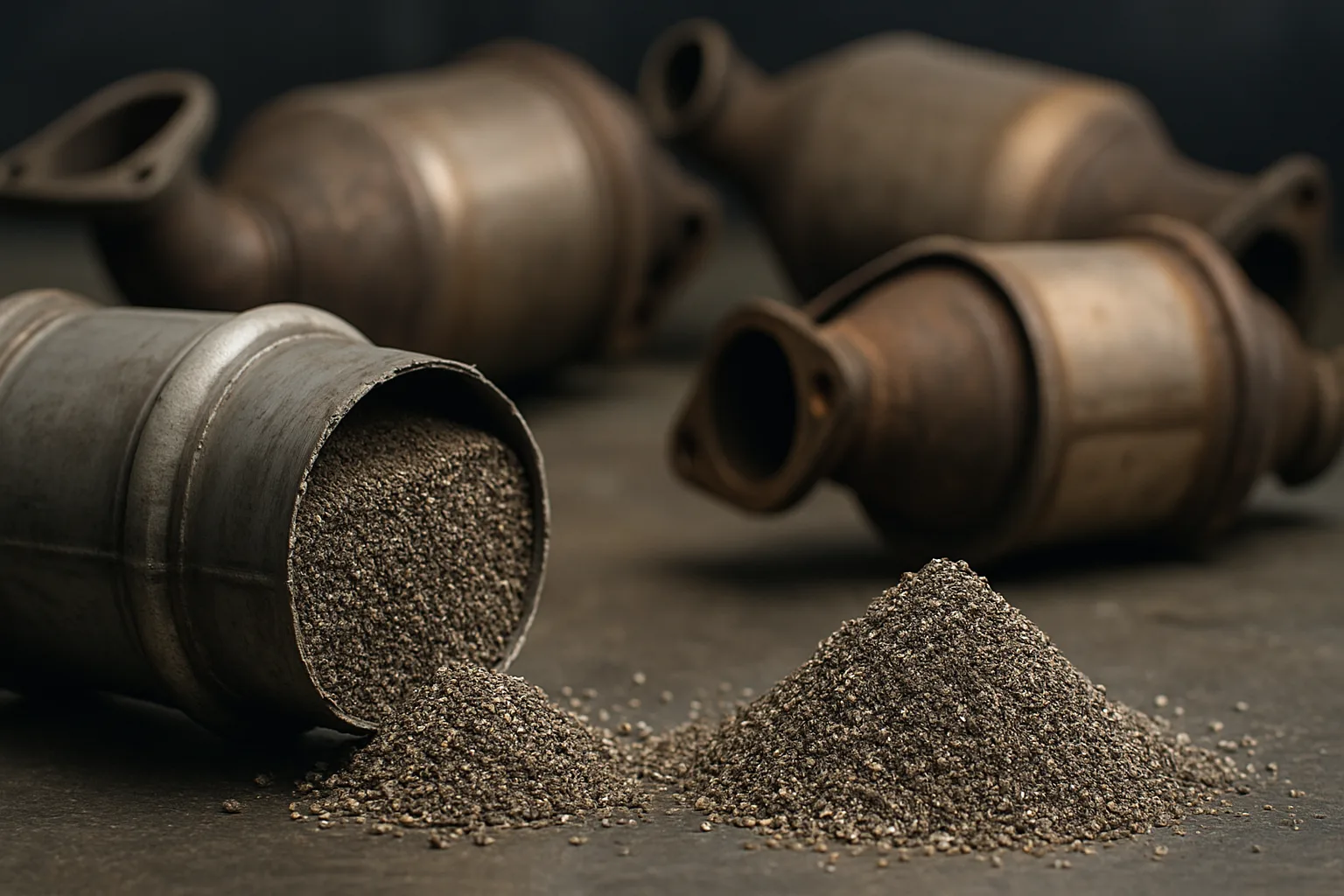
Most converter sellers in Scarborough have no idea what happens to their cats after they hand them over. They get a number, take the cash, and walk away — never knowing if that number was fair. That gap between what you're offered and what your converter is actually worth comes down to two processes: assaying and smelting. Understanding how those work is the fastest way to stop leaving money on the table when you sell catalytic converters in Ontario.
This is a case study in how the converter supply chain actually operates — from the moment your cat leaves your yard to the moment a refinery extracts the platinum, palladium, and rhodium locked inside it. If you want to find the best scrap converter prices in Canada, you need to know what drives the number you're quoted.
---What Is Catalytic Converter Assaying — And Why Does It Matter for Scrap Value?
Assaying is the chemical analysis process that determines the exact precious metal content of a catalytic converter's ceramic substrate — also called the honeycomb. This is where the real catalytic converter scrap value lives. Platinum group metals (PGMs) — platinum, palladium, and rhodium — are the only reason a scrap converter is worth anything at all. The steel shell is largely irrelevant.
Here's how the assay process works in practice:
- Decanning: The steel outer shell is cut away to isolate the ceramic substrate. This is done mechanically at the processor level.
- Crushing and milling: The ceramic honeycomb is crushed into a fine powder. Every gram of substrate needs to be homogenized so the sample is representative.
- Sampling: A statistically valid sample is pulled from the bulk powder — typically following agreed sampling protocols between the processor and the refinery.
- Fire assay or ICP analysis: The sample is dissolved using acid fusion or flux-based fire assay techniques. The resulting solution is analyzed using Inductively Coupled Plasma (ICP) spectrometry to measure PGM concentrations in parts per million (ppm).
- Final valuation: The ppm results are multiplied by the weight of the full lot, then priced against the spot market — including the palladium price today and current platinum and rhodium rates.
Accuracy matters enormously here. A 10 ppm difference in palladium reading across a 500 kg lot can represent hundreds of dollars in value. Buyers who do their own in-house assay — without third-party verification — have a built-in incentive to quote low. That's exactly why transparency at this stage is non-negotiable if you want a fair return.
---Smelting: Turning Ceramic Powder Into Recoverable Precious Metal
Once assaying confirms the PGM content, the powder moves to the smelting stage. This is where the precious metals are physically separated from the ceramic carrier material and concentrated into a recoverable form.
The smelting process typically works like this:
- Flux addition: The crushed substrate is blended with fluxing agents — materials that lower the melting point and help separate metal from slag.
- High-temperature furnace treatment: The blend goes into a smelting furnace operating at temperatures exceeding 1,500°C. At this heat, PGMs migrate into a collector metal (often copper or iron), while the ceramic material becomes slag and floats to the top.
- Collector separation: The molten collector metal — now loaded with concentrated PGMs — is tapped from the furnace and separated from the slag.
- Refining: The PGM-rich collector goes through hydrometallurgical refining (acid leaching, solvent extraction) to isolate individual metals — platinum, palladium, and rhodium — at high purity levels.
- Sale to end market: The refined metals are sold to chemical manufacturers, auto manufacturers, and commodity traders based on current spot prices.
The entire cycle — from your converter leaving the yard to refined metal being sold — can take anywhere from 60 to 120 days depending on lot size, refinery capacity, and contract terms. This processing window is one reason many buyers quote based on projected spot prices, not just today's number. If you're tracking the palladium price today to benchmark your offer, make sure you understand that the buyer is also hedging against price movement during that processing window.
---How Your Converter's Scrap Value Is Actually Calculated
Now that you know what happens inside the refinery, let's connect it back to the number you actually see. Every legitimate offer for a used catalytic converter scrap value is a function of three variables:
- PGM content (ppm): Determined by assay. Varies significantly by vehicle make, model, engine size, and the converter's age and condition. A Toyota Prius converter typically carries far more palladium than a standard domestic sedan unit.
- Spot metal prices: Platinum, palladium, and rhodium are traded commodities with real-time pricing. A converter worth $180 today could be worth $210 in three weeks if palladium rallies. That's not a sales pitch — it's just how commodity markets work.
- Processor margin: The buyer's cut for decanning, crushing, sampling, smelting, refining, and logistics. Legitimate processors are transparent about this. Opaque middlemen are not.
The formula looks like this (simplified): (PGM ppm × lot weight × recovery rate × spot price) − processing costs = your return. When buyers keep the assay results private, you have no way to verify that math. That's the old way. Transparent, assay-backed pricing is what separates a fair deal from a guessed number. To check current Canadian scrap converter prices before you accept any offer, make sure you're working with a platform that actually shows you the data.
---Why Scarborough Sellers Get Undercut — And How to Fight Back
Sellers in Scarborough and across Ontario often operate in markets where a handful of local buyers dominate. When you only have one or two options within reach, competition disappears — and so does your leverage. The buyer knows you're not driving three hours to find a better rate. So they quote conservatively, bank the spread, and you never know the difference.
This dynamic is especially costly with catalytic converters because the price variance between buyers can be dramatic. Two buyers quoting the same converter can easily differ by $50 to $150 per unit — sometimes more on high-value cats — because they're applying different margin assumptions, using different assay data, or simply because one of them knows you have no other option.
The fix is competition. When multiple vetted buyers bid on your load simultaneously, the margin compression works in your favor. Platforms like SMASH are built around this exact mechanic — bringing documented converter lots in front of multiple buyers so the market sets the price, not one buyer's gut call. If you're in Scarborough searching for catalytic converter buyers near me, expanding your reach beyond the local handful is one of the highest-leverage moves you can make. You can sell your scrap metal on SMASH Recycling and let buyers compete for your load instead of the other way around.
Documentation matters here too. Buyers bid higher on lots they can evaluate clearly. Photos, VIN-linked converter identification, weight documentation, and serial tracking all reduce buyer uncertainty — and lower uncertainty means tighter margins and better offers. SMASH's inventory tools are built to make that documentation fast and consistent, even if you're running a high-volume operation and cataloging dozens of units a week.
---What This Means If You Want to Sell Scrap Metal Online
The assay and smelting process used to be invisible to sellers. You handed over your cats, a buyer disappeared into the backend, and you got a check weeks later with no visibility into how the number was calculated. That information asymmetry existed because it was profitable for processors to maintain it.
Online platforms have changed that equation. When you sell scrap metal online through a competitive, documented auction environment, you're no longer dependent on a single buyer's willingness to be honest. The market determines value. Assay transparency — or at least assay-referenced pricing — becomes a selling point rather than a trade secret.
For Ontario sellers who want to go deeper on how pricing works across different converter types and market conditions, the read Canadian scrap converter pricing guides resource is worth bookmarking. Understanding the upstream mechanics — assaying, smelting, spot price hedging — makes you a smarter seller at every stage of the transaction.
The market for platinum group metals is global and genuinely volatile. The catalytic converter scrap value of the load sitting in your yard right now reflects real-time trading activity across London, Zurich, and New York. You deserve pricing that reflects that reality — not a flat number from a buyer who's banking on you not knowing the difference.
---Frequently Asked Questions
Q: How does assaying affect my catalytic converter scrap value?
Assaying determines the exact platinum, palladium, and rhodium content of your converter's ceramic substrate. The result — measured in parts per million — is multiplied by the lot weight and current spot prices to calculate your return. Buyers who won't share assay results are keeping that math hidden from you, which rarely works in your favor.
Q: How long does the smelting and refining process take?
Depending on the refinery, lot size, and contract terms, the full cycle from converter receipt to refined metal settlement typically runs 60 to 120 days. Most buyers quote on a spot-price-at-time-of-settlement basis, so metal price movement during that window affects the final return.
Q: Why do catalytic converter prices vary so much between buyers in Scarborough?
Local buyers in Scarborough — and across Ontario — apply different margin assumptions, use different assay data, and operate with different levels of refinery access. When you have one buyer quoting you, you have no way to know where you sit relative to the market. Competitive platforms like SMASH close that gap by bringing multiple buyers to the table simultaneously.
Q: Does the palladium price today affect what I get paid for my converters?
Yes — directly. Palladium is one of the three primary PGMs recovered from catalytic converters, and it's the most commonly dominant metal in modern gasoline converters. When palladium spot prices rise, converter values follow. Tracking current spot prices before you accept any offer gives you a meaningful benchmark.
Q: What's the best way to sell catalytic converters in Ontario if I want a fair price?
The most reliable path to fair pricing is documented inventory plus buyer competition. Photograph your units, record weights and VINs where applicable, and use a platform that puts your lot in front of multiple vetted buyers at once. That combination — documentation and competition — is what drives price discovery instead of guesswork.
---If you've been accepting single-buyer quotes on your converter loads without knowing what the assay says, now you know what you've been missing. The refinery math is real, the spot markets are real, and the gap between a guessed offer and a market-competitive offer is real too. When you're ready to get a number that's grounded in actual data, find the best scrap converter prices in Canada and get a free quote at best-scrap-converter-prices.ca. The market knows what your metal is worth — you should too.
Disclaimer: Catalytic converter scrap values fluctuate daily based on platinum, palladium, and rhodium spot prices. Always verify current rates before accepting any offer.
Stay ahead of the scrap metal market — follow SMASH on LinkedIn for real-time industry updates, converter pricing insights, and North American scrap market news.