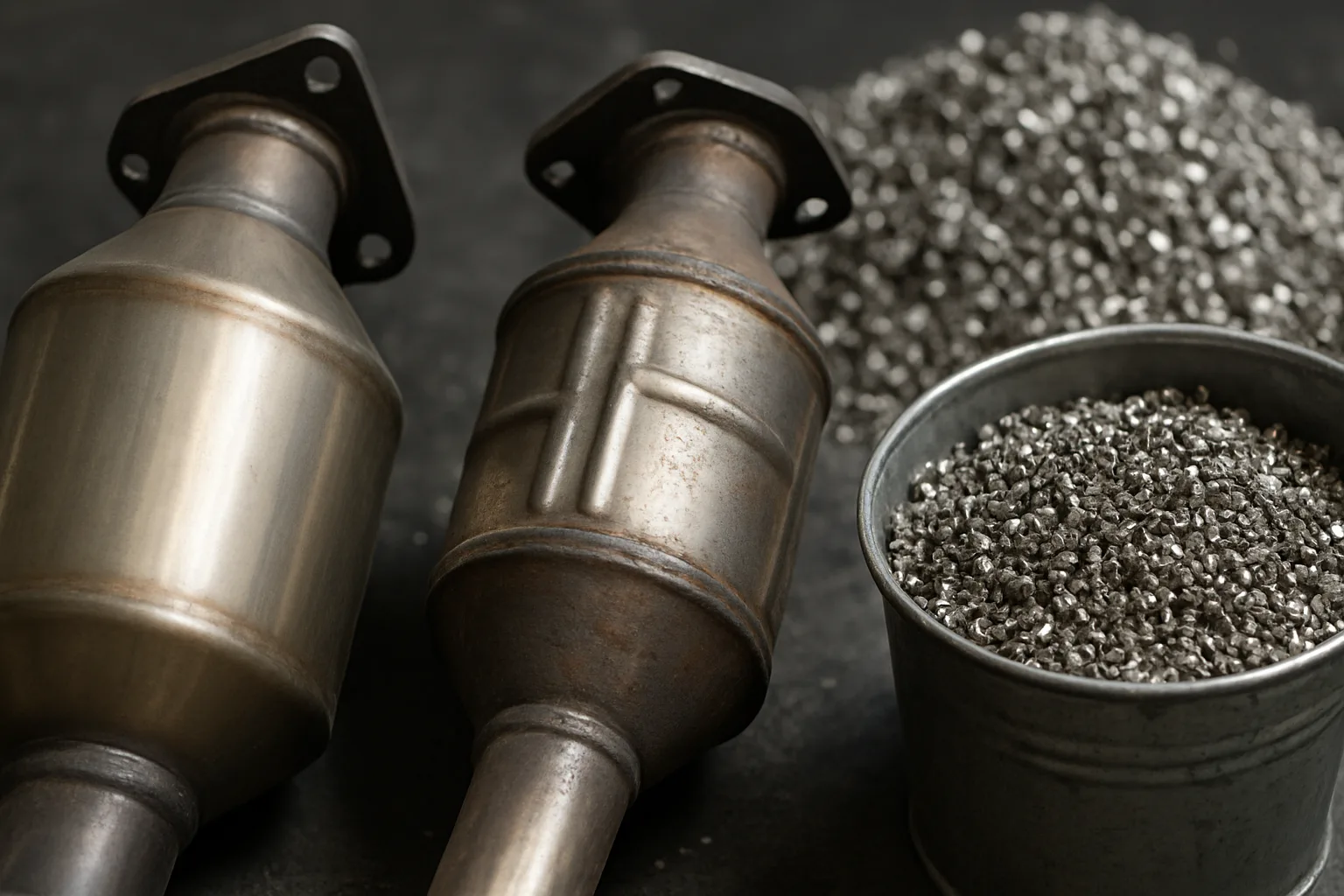
OEM vs Aftermarket Catalytic Converters: Why the Price Gap Is Bigger Than You Think
Hand a scrap buyer two catalytic converters pulled from the same make and model of vehicle, and you might get two wildly different quotes. Same car. Same year. Completely different scrap value. If that sounds like guesswork, it isn't — there's a real reason behind the gap, and understanding it puts money back in your pocket. Finding the best catalytic converter price Nanaimo has to offer starts with knowing what actually drives that number.
The answer comes down to one critical difference: OEM versus aftermarket. It's the single biggest variable that scrap buyers, recyclers, and precious metal refiners use to determine what your converter is worth. And if you're selling without knowing the difference, you're likely leaving money on the table.
What OEM and Aftermarket Actually Mean in the Scrap World
OEM stands for Original Equipment Manufacturer. These are the catalytic converters that came installed on your vehicle when it left the factory — built to exact manufacturer specifications, with precise precious metal loading calibrated for that engine's emissions output. Aftermarket converters are replacements installed later, typically during a repair, and they're manufactured to meet minimum regulatory standards — not to match the original's precious metal content.
That distinction matters enormously when your converter ends up at a recycler. The scrap value of a catalytic converter is almost entirely determined by its platinum group metals (PGMs) — platinum, palladium, and rhodium. OEM converters are loaded with these metals to meet the original performance specs of the vehicle. Aftermarket units use significantly less. Less PGM loading means a lower assay result, which means a lower payout.
Here's the part that surprises most sellers:
- An OEM converter from a late-model truck can contain substantially more rhodium and palladium than an aftermarket replacement of the "same" converter.
- Aftermarket units from some budget manufacturers may contain only a fraction of the PGM content of the OEM original.
- The ceramic substrate inside also differs — OEM substrates are often denser and finer, which affects how efficiently PGMs can be recovered during smelting.
This is why experienced buyers in Nanaimo and across British Columbia ask immediately: "Is this an original or a replacement?" It's not small talk. It's the most important question in the transaction.
How Rhodium Price Today Shapes the OEM Premium
Rhodium is the most volatile precious metal in the catalytic converter market — and it's the one that most dramatically separates OEM from aftermarket values. OEM converters, particularly from Japanese and European manufacturers, tend to carry higher rhodium concentrations because original emission control designs demanded it. Aftermarket replacements often substitute cheaper catalyst formulations to keep production costs down.
When rhodium prices spike — which they do, cyclically and dramatically — that difference in rhodium loading gets amplified. A converter with twice the rhodium content isn't worth twice as much at spot price; it can be worth significantly more once refining recovery rates and current rhodium price today are factored in. If you want to find the best scrap converter prices in Canada, you need a buyer who's actually calculating on live PGM data, not just eyeballing the serial number.
Palladium plays a similar role. Gasoline-engine OEM converters are often heavy in palladium, while cheaper aftermarket units use blended formulations that reduce the amount of palladium required. The refiners know this. The serious buyers know this. Now you do too.
Why Serial Numbers Matter More Than Visual Inspection
You can't tell an OEM converter from an aftermarket one by looking at the outside. The shell might look identical. The size might match. But the substrate inside — that honeycomb structure coated in precious metals — can be completely different. This is why the serial number, or lack of one, is so critical.
OEM converters typically carry manufacturer-stamped serial numbers that link directly to a specific vehicle platform. Legitimate scrap buyers use databases — and platforms like Canada's B2B scrap recycling marketplace use tools like VIN lookup and serial tracking — to identify the converter and verify its original PGM loading data. That verification is what separates a precise, data-backed offer from a low-ball guess.
Aftermarket converters often carry generic part numbers, third-party brand markings, or no meaningful identification at all. Without that serial reference, a buyer has to default to conservative estimates — which means a lower offer. If your converter has a clear OEM serial, make sure your buyer is actually using it to look up the spec sheet, not just using it to categorize the unit into a broad price tier.
Sellers in Nanaimo working with local recyclers should ask directly: "Are you pricing this on the serial database or on visual grade?" The answer tells you everything about the quality of the quote you're receiving.
The Case Study: Two Converters, One Vehicle, Two Completely Different Payouts
Here's a real-world scenario that plays out constantly at recycling yards across British Columbia. A seller brings in two catalytic converters removed from the same make and model — a mid-2010s Japanese sedan. One is the original OEM unit. The other was replaced eight years ago with an aftermarket unit when the original failed during a routine repair.
The OEM converter, identified by serial number and matched to the manufacturer's PGM loading spec, comes back with a strong offer — the precious metal content matches what the database predicts, and the buyer prices accordingly. The aftermarket unit, also from the same car, pulls a fraction of that offer. Same car, same position, same ceramic substrate volume. But the PGM content is dramatically different, and the payout reflects that reality.
This isn't the buyer being unfair. It's the market being accurate. The scrap value is the PGM value, and OEM units simply carry more of it. The seller who understands this walks in with realistic expectations and doesn't get blindsided. The seller who doesn't understand it feels cheated — even when the offer is completely justified.
To stay current on how this plays out with today's market, read Canadian scrap converter pricing guides that explain PGM pricing structures and how to benchmark what you're being offered.
How SMASH Brings Transparency to Converter Pricing
The problem with selling converters through a single buyer, a quick phone call, or a walk-in to a local yard is the same problem that plagues all single-buyer transactions: you have no idea if the offer is fair, low, or high. You're negotiating blind. That's especially damaging with OEM units that carry significant value — you might accept $80 for a converter worth $300 in a competitive market.
SMASH — the SMASH scrap metal auction platform — changes that dynamic. Instead of one buyer setting the price, multiple vetted buyers compete. That competition does what competition always does: it reveals the real market. When buyers know they're bidding against other buyers, lowball offers don't survive. Documented inventory, serial tracking, and photo documentation give buyers the confidence to bid aggressively on high-value OEM units, because the risk of uncertainty is removed.
For sellers with mixed loads — a combination of OEM and aftermarket units, or stainless-bodied foreign converters mixed with domestic units — that documentation becomes even more valuable. Each converter gets treated on its own merits, not averaged down into a bulk guess. Check current Canadian scrap converter prices and understand how auctions help you capture actual market value instead of whatever a single buyer decides to offer today.
No subscription fees. SMASH only benefits when the seller gets a better result. That alignment matters. It means the platform has every reason to ensure your OEM converters get seen by buyers who know what they're worth.
What This Means for Sellers in Nanaimo and British Columbia
If you're sitting on a collection of converters — pulled from vehicles, sourced from a repair shop, or accumulated through your own yard operations — knowing the OEM vs aftermarket distinction is step one. Step two is making sure your buyer is pricing on data, not assumptions.
The Vancouver Island and broader British Columbia market has no shortage of buyers, but competitive, transparent pricing isn't universal. Local Nanaimo scrap metal services have improved, but the gap between a well-documented, competitively bid converter load and a casual walk-in quote can still be substantial. That gap is the difference between leaving money behind and capturing your full market value.
Understanding scrap metal prices today and how they connect to live PGM markets is the foundation of making good selling decisions. OEM units from Japanese and European vehicles — common in British Columbia given import vehicle prevalence — often carry the strongest values. If you have them, treat them accordingly. Document them. Get them in front of multiple buyers. Don't let a single offer define their worth.
The best outcome isn't luck. It's information applied correctly. If you're ready to see what your converters are actually worth in a competitive market, find the best scrap converter prices in Canada and get a free quote at best-scrap-converter-prices.ca.
Frequently Asked Questions
Q: How do I know if my catalytic converter is OEM or aftermarket?
Check the serial number or part number stamped on the converter shell. OEM units typically carry manufacturer-specific codes that link to a vehicle platform and can be verified in industry databases. Aftermarket units often have generic brand markings or third-party part numbers. If the converter was replaced at a shop rather than being original to the vehicle, it's almost certainly aftermarket.
Q: Why does an OEM catalytic converter pay more at scrap than an aftermarket one?
OEM converters are engineered to meet original factory emissions standards, which requires precise and often higher loading of platinum group metals — platinum, palladium, and rhodium. Aftermarket replacements are built to meet minimum regulatory standards at lower production cost, which typically means less PGM content. Less precious metal content equals a lower scrap payout.
Q: Where can I get the best catalytic converter price in Nanaimo?
The best prices come from competitive, data-driven buying — not single-buyer walk-in quotes. Platforms like SMASH connect sellers with multiple vetted buyers who compete based on documented converter data, which tends to produce stronger offers than relying on one local buyer's assessment. Starting at best-scrap-converter-prices.ca gives you a baseline to benchmark any local offer you receive.
Q: Does the rhodium price today really affect what I get paid for my converter?
Yes, directly. Rhodium is one of the three primary PGMs recovered from catalytic converters, and its spot price feeds directly into refiner settlement values. When rhodium is high, OEM converters with significant rhodium loading become substantially more valuable. When it drops, payouts drop with it. Any serious buyer is pricing on live PGM market data — if yours isn't, that's a problem.
Q: Is there a difference in catalytic converter recycling prices between Nanaimo and Vancouver?
Buyer networks and local competition can create some regional variation, but the underlying PGM value of any converter is the same regardless of geography. The bigger factor is how many buyers are competing for your load and how well documented your inventory is. Sellers in Nanaimo who access broader buyer pools through auction platforms often close the gap with larger market centres like Vancouver.
Disclaimer: Catalytic converter scrap values fluctuate with live precious metal markets. Prices referenced in this article are for general context only. Always verify current rates before selling.
For ongoing updates on scrap metal markets and converter pricing trends, follow SMASH on LinkedIn — it's one of the fastest ways to stay current on PGM movements and what they mean for your next load.
```