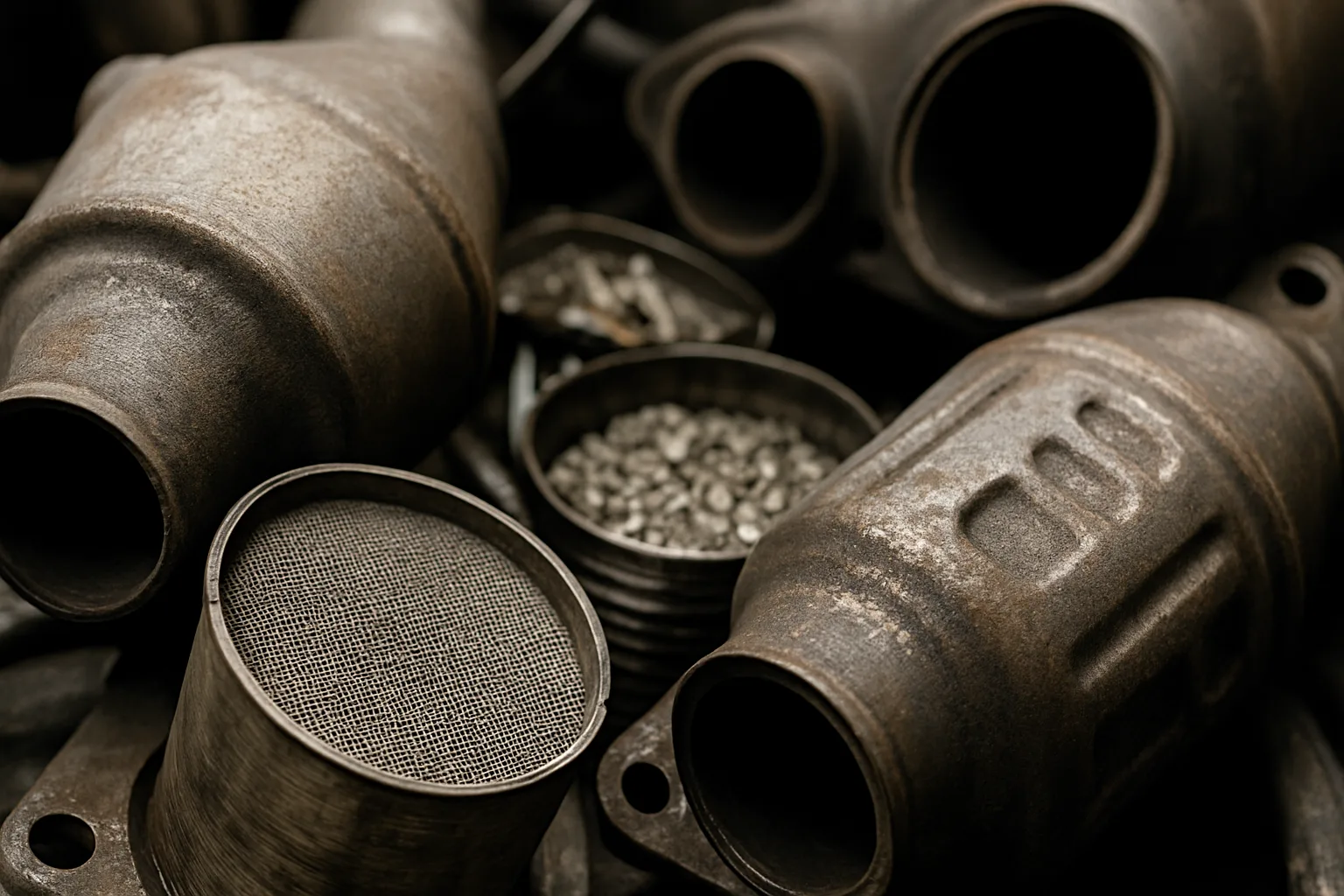
Why the Palladium Price Today Changes What Your Catalytic Converter Is Worth
Your catalytic converter's scrap value can shift by double digits in a single week — sometimes in a single day. That's not a glitch. That's the precious metals market doing what it does. If you're selling converters without checking the palladium price today, you're quoting blind. And quoting blind usually means leaving money on the table.
This guide breaks down how daily market fluctuations drive catalytic converter scrap prices, what that means for sellers in Ottawa and across Ontario, and how to stop guessing and start selling with real data behind you.
The Three Metals That Drive Catalytic Converter Scrap Prices in Canada
Every catalytic converter holds a mix of platinum group metals — platinum, palladium, and rhodium. These three determine your converter's actual market value. Not the age of the car. Not the brand. The assay.
Here's how each one plays a role:
- Palladium: Found heavily in gasoline engine converters. The palladium price today has the biggest day-to-day impact on most converter grades. It's volatile, and it moves fast with industrial demand and supply disruptions.
- Platinum: Dominates diesel converter catalysts. Tends to be more stable than palladium but still reacts to automotive sector news, mining output, and hydrogen fuel cell development.
- Rhodium: The wild card. Rhodium can spike dramatically on supply shortages — it's the rarest of the three and trades in thin markets. When rhodium moves, high-grade converters move with it.
You cannot separate catalytic converter scrap price in Canada from these spot markets. They're the same thing, just translated through assay percentages and processing margins. If you're using a flat price sheet from last quarter, you're working with stale data — full stop.
How Daily Fluctuations Actually Hit Your Payout
Here's where it gets practical. Precious metal spot prices are quoted in troy ounces on global exchanges. Your converter contains a small fraction of those ounces — usually measured in grams per unit. The processor applies a recovery rate (based on their smelting efficiency), subtracts their margin, and that's your number.
When the palladium price today climbs by $50/oz, a high-palladium converter grade can see its quoted value jump meaningfully per unit. When it drops, it falls the same way. That's why recyclers who check spot prices daily — or work with platforms that do it for them — consistently outperform those running on static price lists.
A few factors that drive day-to-day swings in scrap catalytic converter prices:
- Mining output news from South Africa and Russia (dominant palladium and platinum producers)
- Automotive production reports affecting demand forecasts
- Currency exchange — CAD/USD movements directly affect catalytic converter scrap price in Canada
- Speculative trading in futures markets
- Rhodium supply disruptions, which can create outsized price spikes
None of these are in your control. But understanding them means you're not confused when your buyer's price changes between Monday and Thursday. It also means you know when to hold a load and when to move it.
Catalytic Converter Price List by Serial Number — Why It Matters More Than You Think
Every converter has a serial number stamped on the body. That number maps to a specific vehicle application, which maps to a known precious metal content range. A catalytic converter price list by serial number is how serious buyers and processors quote accurately — not by eyeballing the size or brand.
For sellers in Ottawa and across Ontario, this matters because it shifts the conversation from "what do you think this is worth?" to "here's what the data says." That's a completely different negotiation. When you know the serial, you can cross-reference against published databases, verify the grade, and hold your buyer accountable to the actual value.
What serial number tracking helps you do:
- Identify high-value units before they get lumped into a low-grade mixed lot
- Dispute inaccurate assay reports with documentation
- Sort your inventory so premium units get premium pricing
- Build credibility with buyers — documented lots close faster
Platforms like SMASH build serial tracking directly into the inventory process. You photograph, log, and document before the load ships. Buyers see what they're bidding on. That transparency drives competition — and competition drives better converter scrap value for the seller. You can find the best scrap converter prices in Canada when your inventory is documented and competing for real bids, not just accepted by a single buyer with one number on a whiteboard.
Ottawa Sellers: What the Local Market Looks Like in 2026
Ottawa is a strong market for catalytic converter scrap. The region generates steady converter volume from automotive dismantlers, licensed vehicle recyclers, and fleet operators across the National Capital Region. But the local buyer network — like most mid-sized Canadian markets — can be thin. A few dominant buyers means limited competition, which means pricing often reflects what the buyer wants to pay, not what the market actually supports.
That's the problem Ottawa scrap metal services through platforms like SMASH are designed to solve. When your Ottawa load gets listed on a B2B scrap metal marketplace that reaches vetted buyers across Canada and the U.S., you're no longer locked into what one local buyer decides your converters are worth this week. More buyers means better price discovery. That's not a slogan — it's how competitive markets work.
Ontario sellers also benefit from the volume advantages of the province's automotive recycling sector. High-traffic markets mean more converter variety — from common domestic grades to specialty diesel units — and buyers who need consistent supply are willing to pay for well-documented, reliable loads. Building that reputation starts with how you sell, not just what you sell.
5 Converter Grades — and What Makes Each One Move Differently
Not all converters are created equal, and not all of them track the same spot metals. Here's a quick breakdown of how major converter grades respond to daily price movements:
- Domestic/Foreign Small Cars (High Palladium): These are your most palladium-sensitive units. When the palladium price today spikes, these move up fast. Think compact and mid-size gasoline vehicles. High volume, well-understood grades.
- Foreign Pre-Cats: Small, high-grade, and loaded with palladium. Often the highest per-unit value in a lot. Easy to identify by location on the vehicle (close to the manifold). Do not let these get lost in a mixed lot.
- Diesel/Large Truck Converters: Platinum-dominant. Track platinum more than palladium. Slower day-to-day swings but significant value — especially in fleet and heavy equipment markets common in Ontario's industrial corridors.
- OEM vs. Aftermarket: OEM converters (original equipment) carry higher PGM content than aftermarket replacements. An aftermarket unit on a Honda Civic is worth a fraction of the OEM equivalent. Always sort before you sell.
- Foil/Bead (High-Grade Specialty): Found in older vehicles and some industrial applications. These can carry significant rhodium content. When rhodium spikes, these spike hard. Document them separately.
Understanding which grade you're holding tells you which spot price to watch. If your load is heavy on domestic palladium grades, palladium price today is your number. Diesel-heavy load? Watch platinum. Mixed load? Check all three — and price accordingly, not as a blended average that undervalues your best units.
To stay current on what your converters are actually worth, read Canadian scrap converter pricing guides that break down grade-by-grade valuations tied to live market conditions — not static tables that go stale the moment a spot price shifts.
How a B2B Scrap Metal Marketplace Changes Your Price Discovery
The old model: call your one buyer, get a number, take it or leave it. No context, no competition, no documentation. That model worked when buyers and sellers had roughly equal information. Today, buyers have sophisticated pricing tools and assay data. If you're still calling one number and accepting it, you're on the wrong side of that information gap.
A B2B scrap metal marketplace flips that dynamic. Your load gets documented, listed, and competed for. Buyers who need what you have submit bids. The highest vetted bid wins. You see the spread — which itself tells you something about the market on that day.
SMASH runs exactly this model. No subscription fees. No guesswork. Vetted buyers, auction format, photo documentation, and auto-invoicing built in. When your converter lot is properly catalogued by serial number and grade, buyers can bid confidently — and competitive bidding is what drives prices toward actual market value, not away from it.
Want to see how competitive the market is for your specific load? Compare scrap metal bids from Canadian buyers and find out what real competition looks like for your converters.
If you're selling converters in Ottawa, Ontario, or anywhere across Canada, the question isn't whether to use a marketplace — it's how fast you can stop selling without one. Check current Canadian scrap converter prices and see what your inventory is actually worth before your next sale.
Stop guessing. Document your load, check the palladium price today, know your grades, and get your converters in front of more than one buyer. When you're ready to do that, best-scrap-converter-prices.ca is where to start for a free quote.
Frequently Asked Questions
Q: How often does the palladium price today change, and how does that affect my converter payout?
Palladium spot prices update continuously during global trading hours — prices can shift multiple times in a single day. For converter sellers, this means the value of your palladium-heavy units can move meaningfully between Monday morning and Friday afternoon. Checking the current spot price before you finalize a sale gives you context to evaluate whether a buyer's quote is fair or stale.
Q: Where can I find a reliable catalytic converter price list by serial number in Canada?
Several online databases publish converter grades tied to serial numbers, and reputable buyers use these to price lots accurately. Platforms like SMASH incorporate serial tracking into the listing process, so your units are identified and documented before they go to market. That documentation protects your value — buyers can't lump a high-grade pre-cat in with a low-grade mixed lot when you've already identified and photographed it.
Q: What are scrap catalytic converter prices in Ottawa right now?
Prices in Ottawa — like everywhere in Canada — are tied to live precious metal spot prices and change daily. The local buyer pool can be limited, which is why connecting to a broader Canadian marketplace often yields better price discovery than relying on a single local quote. For current rates, check best-scrap-converter-prices.ca for up-to-date Canadian converter pricing data.
Q: Does the CAD/USD exchange rate affect catalytic converter scrap prices in Canada?
Yes, significantly. Precious metals trade in USD globally, so when the Canadian dollar weakens against the U.S. dollar, converter prices quoted in CAD tend to rise — and vice versa. Ontario and Ottawa sellers should factor in currency movements alongside spot metal prices when timing their sales.
Q: What's the difference between OEM and aftermarket catalytic converters for scrap value?
OEM (original equipment manufacturer) converters contain significantly higher concentrations of platinum group metals than aftermarket replacements. An aftermarket unit can be worth a small fraction of its OEM equivalent from the same vehicle. Always sort OEM from aftermarket before selling — mixing them into a single lot means your premium units get averaged down to the lowest common denominator.
Disclaimer: Catalytic converter scrap prices fluctuate daily based on precious metal spot markets, exchange rates, and processing margins. All pricing information in this article is general in nature. Always verify current rates before finalizing a sale.
Follow SMASH on LinkedIn for ongoing scrap metal market insights, converter pricing updates, and industry news across Canada and North America.
```