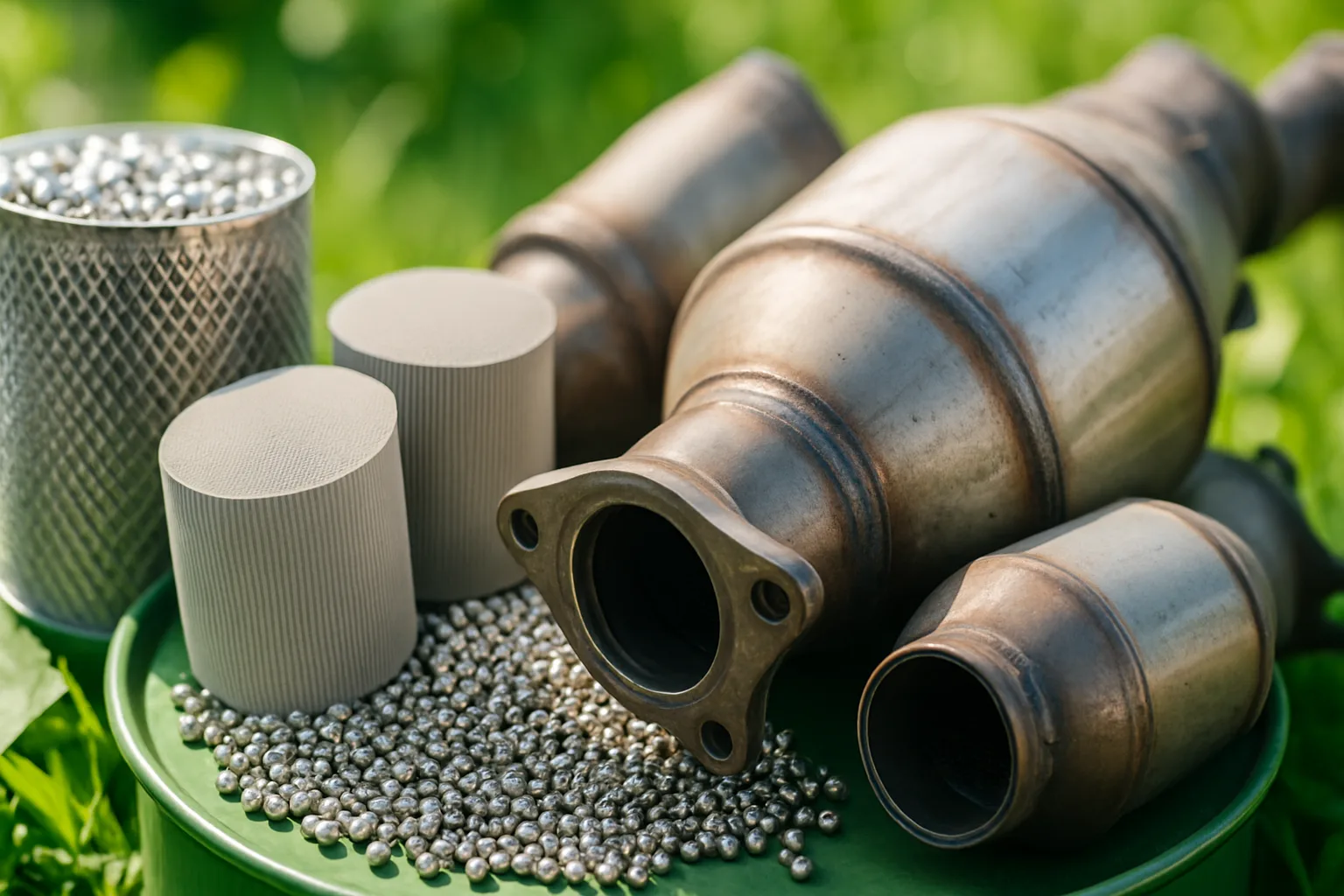
From Exhaust System to Precious Metal: What Actually Happens to a Catalytic Converter
Most people pulling a cat off a vehicle have one question: what's the palladium price today, and how does it affect what I get paid? That's the right instinct. But understanding the full lifecycle of a catalytic converter — from bolted-on emissions control device to refined precious metal — helps you make smarter selling decisions at every step.
The converter on your end of this transaction is the beginning of a long chain. Knowing how that chain works puts you in a stronger position, whether you're moving a single unit or running a yard in Richmond, British Columbia with bins full of cores waiting to ship.
Stage One: The Converter Does Its Job on the Vehicle
A catalytic converter sits in the exhaust system and does one thing: it converts harmful combustion byproducts into less toxic gases before they exit the tailpipe. Inside the metal shell is a ceramic or metallic substrate — often called a honeycomb — coated with a washcoat loaded with platinum group metals (PGMs). Those PGMs are platinum, palladium, and rhodium.
Palladium handles the oxidation of hydrocarbons and carbon monoxide. Platinum assists. Rhodium tackles nitrogen oxides. The loading of each metal varies by vehicle make, model, year, and emissions standard the converter was built to meet. A light-duty passenger car converter carries a different PGM profile than a heavy-duty diesel aftertreatment unit or a hybrid system converter.
Over the vehicle's lifespan — which can easily stretch a decade or longer — the converter degrades. Heat cycling, fuel contamination, physical damage, and age all reduce efficiency. Eventually, either the vehicle reaches end-of-life or the converter fails and gets replaced. That's when the scrap value conversation begins.
Stage Two: Removal, Sorting, and the Value Behind the Shell
Once a converter comes off a vehicle, it enters the recycling stream. But it's not all equal. A core that looks identical on the outside can carry dramatically different PGM content depending on what's inside. This is where yard operators and sellers often leave money on the table — treating every cat the same when the market clearly doesn't.
Proper identification matters. Experienced buyers and processors use serial numbers, manufacturer codes, and VIN lookups to identify the substrate and estimate PGM content before making an offer. If you're selling without that data, you're guessing. The buyer isn't.
For sellers in Richmond and across British Columbia, getting accurate identification on your cores before you sell is one of the highest-leverage moves you can make. Platforms like the SMASH Recycling auction platform support serial tracking and photo documentation so buyers can assess units confidently — which typically leads to stronger, more competitive bids.
A few key factors that influence a converter's scrap value at this stage:
- Substrate condition — intact honeycomb versus rattling or missing material
- PGM loading — varies significantly by OEM and application
- Converter type — OEM, aftermarket, diesel particulate filter, or three-way cat
- Current spot prices — the palladium price today, platinum, and rhodium all fluctuate daily
- Market demand — processor capacity and buyer competition in your region
Stage Three: Assay, Processing, and Precious Metal Recovery
After collection, converters move to a processor. The processing side of this industry is highly technical. Converters are decanned — the substrate is separated from the steel shell — then the material is processed into a homogenous sample. That sample goes through assay, which determines the actual PGM concentration in the batch.
The two main assay methods are fire assay and ICP (inductively coupled plasma) analysis. Fire assay is considered the gold standard for accuracy. ICP is faster. Large-volume shippers often negotiate tolling agreements with smelters, where they retain ownership of the PGMs through the refining process and receive payment based on actual recovered metal.
This is why the palladium price today matters so directly to what you're paid. If the spot price of palladium moves significantly between when you sell and when your load settles, that affects your return — depending on the terms of your deal. Some buyers quote based on today's price with a settlement date. Others lock in at time of purchase. Knowing which model your buyer uses is part of negotiating a fair deal.
The steel shells, once decanned, go into the ferrous stream. That's a separate value stream, typically modest, but it adds up at volume. Nothing goes to waste in a well-run converter processing operation.
How Current Palladium Prices Shape Scrap Catalytic Converter Prices in Richmond and Beyond
Precious metal markets trade around the clock. The palladium price today may be different from yesterday, and next week may look nothing like this week. For sellers trying to time the market, that volatility is both a risk and an opportunity.
Palladium has historically been the dominant PGM in gasoline-powered vehicle converters built for North American emissions standards. Rhodium, while present in smaller quantities, often carries a higher per-troy-ounce value and can swing dramatically on supply-demand imbalances. Platinum tends to be heavier in diesel applications.
For practical purposes, here's what affects what you actually receive per unit:
- Spot prices at time of settlement — palladium, platinum, and rhodium
- Refinery deductions — processing fees, assay costs, and treatment charges
- PGM recovery rate — percentage of contained metal the refiner recovers and credits back
- Buyer margin — what the buyer keeps for taking the position and handling logistics
- Competition among buyers — more bidders generally means better price discovery
That last point is where a B2B scrap metal marketplace changes the equation. When you sell to a single buyer through a phone call or a standing arrangement, you're accepting their margin without testing the market. When multiple vetted buyers compete for your load, the market sets the price — not the buyer's preference.
Sellers in Richmond using competitive auction formats have access to buyers they'd never reach through traditional channels. That reach matters when PGM prices are moving. To check current Canadian scrap converter prices before you sell, make sure you're working with a platform that reflects real buyer demand, not a posted rate that may lag the spot market.
What Sellers Often Get Wrong — And How to Fix It
The most common mistake in converter selling isn't a bad load — it's bad process. Sellers leave value behind not because their material is poor, but because they're not presenting it well, not identifying it accurately, or not reaching buyers who would pay more for it.
Here's what strong sellers do differently:
- Document everything — photos of the substrate, serial numbers, condition notes before shipping
- Sort by type — don't mix high-value OEM cats with low-value aftermarkets in the same lot unless you've negotiated accordingly
- Track the market — know roughly where palladium and rhodium are trading before you accept a quote
- Understand settlement terms — when does price lock in, and how are deductions calculated?
- Use competitive formats — one buyer means one price; multiple buyers means a market
SMASH was built specifically to address these gaps. The platform's inventory tools, VIN lookup, and serial tracking give buyers the information they need to bid confidently. Better documentation means more competitive bids. That's not a marketing pitch — it's how price discovery works. To find the best scrap converter prices in Canada, you need buyers competing, not just one voice on the phone.
If you operate a yard in the Lower Mainland or anywhere in British Columbia, connecting with Richmond scrap metal services through a verified marketplace is one of the fastest ways to test whether your current buyer relationship is actually competitive.
The End of the Chain — and Why It Connects Back to You
After processing and refining, recovered palladium, platinum, and rhodium re-enter the global supply chain. Some goes back into new catalytic converters. Some goes into electronics, dental, or industrial applications. The recycled PGM market is a meaningful portion of total PGM supply globally — urban mining through scrap recycling reduces pressure on primary mining operations.
That means your converter cores aren't scrap in the dismissive sense. They're a legitimate, trackable commodity with real market value tied to real global demand. Treating them that way — with proper documentation, competitive selling, and market-aware pricing — is how you capture that value instead of leaving it with the buyer.
SMASH operates as a no-subscription, auction-based platform where sellers only pay when a deal closes. No monthly fees. No locked-in pricing. Just competition among vetted buyers for your material. To read Canadian scrap converter pricing guides and stay current on how PGM markets affect your returns, it's worth building that education into your regular routine as a seller.
If you're moving converters and want to know what they're actually worth in today's market, the best move is straightforward: get a real quote based on real buyer competition. Find the best Canadian scrap converter prices and get a free quote at best-scrap-converter-prices.ca — and go into your next sale knowing the market, not guessing at it.
Frequently Asked Questions
Q: How does the palladium price today affect what I get for my scrap catalytic converters?
Palladium is one of the primary PGMs loaded into gasoline catalytic converters, so its spot price directly influences converter scrap value. When palladium trades higher, converters with strong palladium content are worth more — and vice versa. Always check where palladium is trading before accepting a quote, and make sure you understand whether your buyer locks in price at purchase or at settlement.
Q: What are scrap catalytic converter prices like for sellers in Richmond, BC right now?
Converter prices in Richmond — and across British Columbia — fluctuate with global PGM spot markets. There's no single posted price that applies to all units, since value depends on converter type, substrate condition, PGM loading, and buyer competition. Using a competitive marketplace like SMASH gives you a real-time read on what vetted buyers will actually pay for your specific material.
Q: Is there a catalytic converter price list or calculator I can use to estimate my converter's value?
Some platforms offer lookup tools that use serial numbers or VINs to estimate PGM content and approximate value — similar to a "how much is my catalytic converter worth calculator" function. These estimates are useful as a starting point but should be treated as directional, not final, since actual value depends on current spot prices, processor deductions, and buyer demand at time of sale.
Q: What's the difference between selling through a B2B scrap metal marketplace versus calling a single buyer?
A single buyer gives you one price — their price. A B2B scrap metal marketplace like SMASH puts your load in front of multiple vetted buyers who compete for it. That competition is how price discovery works. More buyers bidding on the same material typically means better outcomes for the seller, especially when PGM prices are elevated.
Q: Does converter substrate condition really affect what I'm paid?
Yes — significantly. A converter with an intact honeycomb substrate retains its full PGM content. A rattling or broken substrate has lost material, which means lower PGM yield for the processor. Buyers factor that in, which is why photo documentation and honest condition reporting at the time of listing leads to more accurate — and often stronger — bids from buyers who can actually evaluate what they're purchasing.
Follow SMASH on LinkedIn for industry updates, scrap metal market insights, and converter pricing trends: linkedin.com/company/scrap-metal-auction-sales-hub.
```