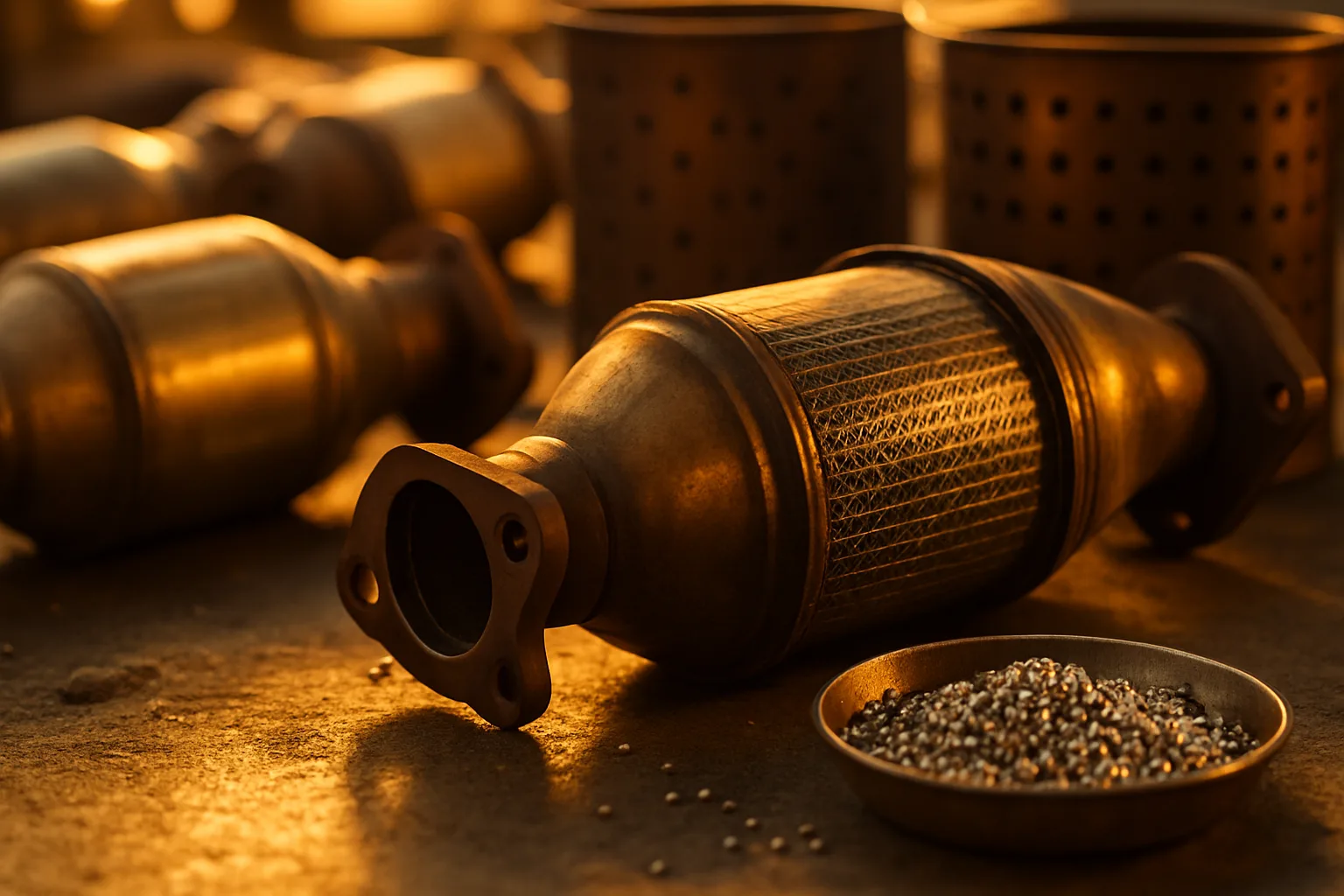
Most converter sellers obsess over platinum. That's understandable — platinum gets the headlines. But if you want to understand why two converters that look identical can have wildly different scrap values, you need to understand rhodium. It's the metal that most people outside the industry have never heard of, and it's often the single biggest driver of what your cats are actually worth.
Whether you're a yard operator in Dartmouth sitting on a drum of mixed cats, or a fleet shop clearing out cores after a vehicle refresh, understanding rhodium changes how you think about pricing — and how much money you leave on the table by accepting the first number someone throws at you.
If you want to find the best scrap converter prices in Canada, you need to know what's actually inside the unit you're selling. Rhodium is the place to start.
---What Is Rhodium and Why Does It Sit Above Platinum and Palladium?
Rhodium is a platinum group metal — PGM in industry shorthand. It shares a periodic table neighbourhood with platinum and palladium, but it behaves differently and it's far rarer. Global annual production of rhodium is measured in single-digit tonnes. To put that in context, gold production runs into thousands of tonnes per year. Rhodium is not just rare. It's exceptionally rare.
Inside a catalytic converter, rhodium handles a specific and critical job: converting nitrogen oxides (NOx) into nitrogen and oxygen. Platinum and palladium handle the oxidation side — burning off hydrocarbons and carbon monoxide. Rhodium handles the reduction side. You need all three working together to meet modern emissions standards. Remove rhodium from the equation, and the converter fails to perform its core function.
That functional necessity, combined with extreme scarcity, is why rhodium commands prices that make platinum look affordable. It has traded at multiples of gold during peak demand cycles. Even in more settled market conditions, it consistently prices significantly above both platinum and palladium per troy ounce. When you're trying to understand catalytic converter scrap price Canada values, rhodium loading is often the number that determines whether a unit is worth $40 or $400.
---How Rhodium Loading Affects Converter Scrap Value in Canada
Not all converters carry the same rhodium load. Manufacturer, vehicle type, engine configuration, model year, and the emissions standards the vehicle was built to meet — all of these influence how much rhodium ends up in the substrate. A diesel converter designed for European NOx compliance may carry a very different rhodium load than a gasoline unit from a North American compact car.
This is why "converter scrap value Canada" is not a simple lookup. It's a calculation. The assay process — whether that's a physical lab sample or a data-driven estimate using serial number databases — attempts to determine the actual PGM content per unit. Rhodium's contribution to total value can range from negligible to dominant depending on the specific unit.
Here's what that means practically for sellers:
- High-rhodium units (often from larger displacement engines, premium vehicles, or recent model years with tight NOx requirements) can return values that surprise sellers who didn't know what they had.
- Low-rhodium units (older vehicles, some diesel applications, aftermarket replacements) may return most of their value from palladium and platinum instead.
- Damaged or melted substrates lose value rapidly — the ceramic washcoat that holds the PGMs is the product, and physical damage destroys recoverable metal content.
- Aftermarket converters typically carry significantly lower PGM loads than OEM units. The scrap value reflects that.
If you're reading Canadian scrap converter pricing guides, the consistent message is the same: know your units before you price them. Rhodium is too expensive and too variable to guess.
---Platinum Price Today and Its Relationship to Rhodium Market Movements
Rhodium, platinum, and palladium don't move in lockstep, but they are related. All three are extracted primarily as co-products of nickel and copper mining in South Africa and Russia. Supply disruptions in either region send ripples through all three metals — but not always equally.
Platinum price today is driven heavily by jewelry demand, investment demand, and automotive sector use. Palladium moved aggressively in the early part of this decade as gasoline engine adoption outpaced supply. Rhodium is almost exclusively automotive — the vast majority of annual production goes directly into catalytic converter manufacturing. That concentration means rhodium prices can swing hard on automotive production news, emissions regulation changes, or mining supply shifts.
In 2026, the regulatory landscape continues to tighten globally on NOx emissions. That sustained pressure on emissions compliance keeps rhodium relevant even as EV adoption grows. Hybrid vehicles, in particular, require converters that often carry meaningful rhodium content — hybrids run their combustion engines under specific load conditions that can actually demand tighter emissions control than pure combustion vehicles in some applications.
The practical takeaway: watch all three metals, but don't anchor your expectations to platinum alone. On any given day, rhodium's movement may matter more to your payout than either platinum or palladium. For current pricing, always check current Canadian scrap converter prices — spot metal prices shift daily, and the difference between quoting on Monday versus Thursday can be real money.
Disclaimer: Precious metal prices fluctuate constantly based on spot markets, currency exchange rates, and global demand. All pricing information in this article is general and educational. Always verify current rates before making selling decisions.
---Why Selling Through a B2B Scrap Metal Marketplace Gets You Closer to Real Value
Here's the problem with the old way of selling cats. You call one buyer. They quote you a number. You have no idea if that number reflects current rhodium spot prices, current palladium movement, or their own margin goals for the quarter. You take it or you don't — but you're negotiating blind.
That's the friction that a B2B scrap metal marketplace like SMASH is built to eliminate. Competition is what reveals market value. When multiple vetted buyers are bidding on the same load — with documented inventory, photos, serial tracking, and full packing lists — you get price discovery instead of price-taking.
For a yard in Dartmouth or anywhere across Nova Scotia, the traditional option was to work with whatever local or regional buyer relationship you had. That relationship may be solid. But is it competitive? A single buyer relationship, no matter how long-standing, is not the same as a market. SMASH brings the market to your load.
Platforms like SMASH make it straightforward to document your converter inventory — serial numbers, VIN lookups where applicable, photo documentation of condition — and put it in front of multiple qualified buyers simultaneously. That process protects you legally, creates a clear record, and gives buyers the confidence to bid aggressively rather than hedging because they can't verify what they're buying.
To get competitive bids for your scrap in Canada, the documentation step is not optional — it's the foundation. A well-documented load of cats is worth more than an undocumented one, because uncertainty in buyer pricing always works against the seller.
---What Catalytic Converter Recycling Companies Actually Look For
When a catalytic converter recycling company evaluates your load, they're not just looking at unit count. They're building an expected PGM return from the assay or from database pricing on known units. Rhodium content is a major input in that calculation — but so are the factors that affect recoverable yield.
Recyclers look for:
- Intact substrates — cracked, rattling, or melted ceramic means lost PGM content and lower payouts.
- Accurate unit identification — serial numbers and manufacturer markings allow proper database pricing rather than generic low-end estimates.
- No pipe attached — most buyers want the converter body only, cleaned up for processing.
- Honest condition reporting — foiled, drilled, or hollowed-out units destroy trust and relationships fast in this industry.
- Volume consistency — a load of 20 identical units from a known vehicle platform is easier to price than a mixed drum of unknowns.
In Dartmouth and across Nova Scotia, yards that build a reputation for clean, documented, honestly-represented loads get better buyer engagement over time. That reputation compounds. Buyers bid higher on sellers they trust because the risk premium disappears from their calculation.
The same logic applies when you sell through SMASH. The platform's documentation tools aren't bureaucracy — they're the mechanism that generates better offers. Vetted buyers on the platform know what they're looking at. That confidence translates directly into bid behaviour.
---How to Position Your Cats for the Best Converter Price Canada Offers
Getting the best converter price Canada recyclers will pay isn't purely about timing the market — though timing matters. It's about how you present the load.
A few practical steps that consistently improve outcomes:
- Sort your units by type — don't mix high-value foreign units with low-value domestic aftermarkets in the same lot if you can separate them.
- Photograph everything — top, bottom, end view of the substrate, serial number visible. This removes ambiguity and buyer risk.
- Use serial number lookups where possible — SMASH's platform includes tools to help identify units, which directly supports more accurate buyer pricing.
- Track condition honestly — a cracked substrate noted upfront is better than a buyer discovering it after the bid.
- Time large lots strategically — if rhodium spot prices are rising, patience can pay. If they're falling, moving inventory quickly limits downside exposure.
None of this requires a chemistry degree. It requires discipline and the right tools. SMASH provides both the process structure and the buyer network to make that discipline worth your time.
If you're ready to stop guessing and start getting competitive, real-market offers on your converter inventory — whether you're running a yard in Dartmouth, a fleet operation in Nova Scotia, or a multi-location recycling business across the Maritimes — the place to start is best-scrap-converter-prices.ca, where you can get a free quote and understand what your cats are actually worth in today's market.
---Frequently Asked Questions
Q: Why is rhodium worth more than platinum or gold?
Rhodium is rarer than both platinum and gold by a significant margin — global annual production is tiny. It also has a very concentrated use case: the vast majority of rhodium produced goes directly into catalytic converter manufacturing. That combination of extreme scarcity and inelastic industrial demand drives its price above other precious metals in most market conditions.
Q: Can I sell catalytic converters online from Dartmouth, Nova Scotia?
Yes. Platforms like SMASH operate across North America, including Nova Scotia. You document your inventory using the platform's tools — photos, serial numbers, condition notes — and vetted buyers across the network bid on your load. You don't need to be in a major market to access competitive pricing.
Q: How does platinum price today affect what I get paid for my cats?
Platinum is one of three PGMs in most converters, so its spot price affects your payout — but so do palladium and rhodium. The relative weighting of each metal varies by unit type. On days when platinum is flat but rhodium is up, high-rhodium units pay better. Always check current spot prices before committing to a sale.
Q: What makes a catalytic converter recycling company bid higher on a load?
Documentation and trust. A load with clear photos, accurate serial numbers, honest condition reporting, and proper sorting gives buyers the confidence to bid aggressively rather than pricing in uncertainty. Undocumented or mixed loads invite conservative bids. The work you put into presenting a clean lot directly affects what buyers offer.
Q: How do I know if I'm getting the best converter price Canada buyers will pay?
The only way to know is competition. A single buyer quote tells you what one buyer is willing to pay — it doesn't tell you what the market will pay. Using a marketplace like SMASH, where multiple vetted buyers bid on the same documented load, is how you get actual price discovery rather than a number you have to take on faith.
---Follow SMASH on LinkedIn for scrap metal market insights, industry updates, and converter pricing news: linkedin.com/company/scrap-metal-auction-sales-hub.